
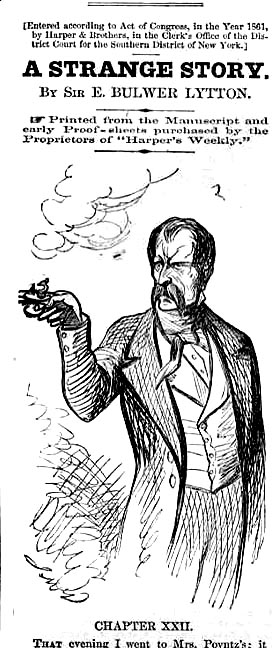
First page of eighth installment with uncaptioned headnote vignette (Chapters 22-23)
John McLenan
1861
10.4 cm. by 5.8 cm.
Bulwer-Lytton's A Strange Story
Harper's Weekly 5 (28 September 1861): 622.
Scanned image and commentary by Philip V. Allingham.
[You may use this image without prior permission for any scholarly or educational purpose as long as you (1) credit the person who scanned the image and (2) link your document to this URL in a web document or cite the Victorian Web in a print one.]

Passage Illustrated: The Impulsive Louis Grayle
Possibly, then, this poor Louis Grayle might have made a great figure, left his mark on his age and his name in history; but in contesting the borough, which he was sure to carry, he had to face an opponent in a real fine gentleman whom his father had ruined, cool and highbred, with a tongue like a rapier, a sneer like an adder. A quarrel of course; Louis Grayle sent a challenge. The fine gentleman, known to be no coward (fine gentlemen never are), was at first disposed to refuse with contempt. But Grayle had made himself the idol of the mob; and at a word from Grayle, the fine gentleman might have been ducked at a pump, or tossed in a blanket, — that would have made him ridiculous; to be shot at is a trifle, to be laughed at is serious. He therefore condescended to accept the challenge, and my father was his second.
“It was settled, of course, according to English custom, that both combatants should fire at the same time, and by signal. The antagonist fired at the right moment; his ball grazed Louis Grayle’s temple. Louis Grayle had not fired. He now seemed to the seconds to take slow and deliberate aim. They called out to him not to fire; they were rushing to prevent him, when the trigger was pulled, and his opponent fell dead on the field. The fight was, therefore, considered unfair; Louis Grayle was tried for his life: he did not stand the trial in person. He escaped to the Continent; hurried on to some distant uncivilized lands; could not be traced; reappeared in England no more. The lawyer who conducted his defence pleaded skilfully. He argued that the delay in firing was not intentional, therefore not criminal, — the effect of the stun which the wound in the temple had occasioned. The judge was a gentleman, and summed up the evidence so as to direct the jury to a verdict against the low wretch who had murdered a gentleman; but the aggravated nature of the homicide, — three years’ imprisonment. Grayle eluded the prison, but he was a man disgraced and an exile, — his ambition blasted, his career an outlaw’s, and his age not yet twenty-three. My father said that he was supposed to have changed his name; none knew what had become of him. And so this creature, brilliant and daring, whom if born under better auspices we might now be all fawning on, cringing to, — after living to old age, no one knows how, — dies murdered at Aleppo, no one, you say, knows by whom.” [Chapter XXII, p. 622]
Commentary: The Rash Louis Grayle Discharges His Duelling Pistol
McLenan makes the brilliant but impulsive "Man of the People" look every inch the sinister villain. Here, the moustachioed duellist discharges his long-barrelled weapon upon his adversary, "the fine gentleman" whom he detests. The aristocrat has already fired, grazing Grayle's temple (although the illustrator does not show the wound); now Grayle coolly takes deliberate aim at his helpless adversary, killing him with a single shot. He is guilty of murder because he has shot an unarmed man.
Bibliography
Bulwer-Lytton, Edward G. D. A Strange Story. Illustrated by John McLenan. Harper's Weekly V, 10 August — 21 December 1861.
Victorian
Web
E. Bulwer-
Lytton
Illustra-
tion
John
McLenan
Next
Created 21 November 2007 Last modified 16 June 2026