
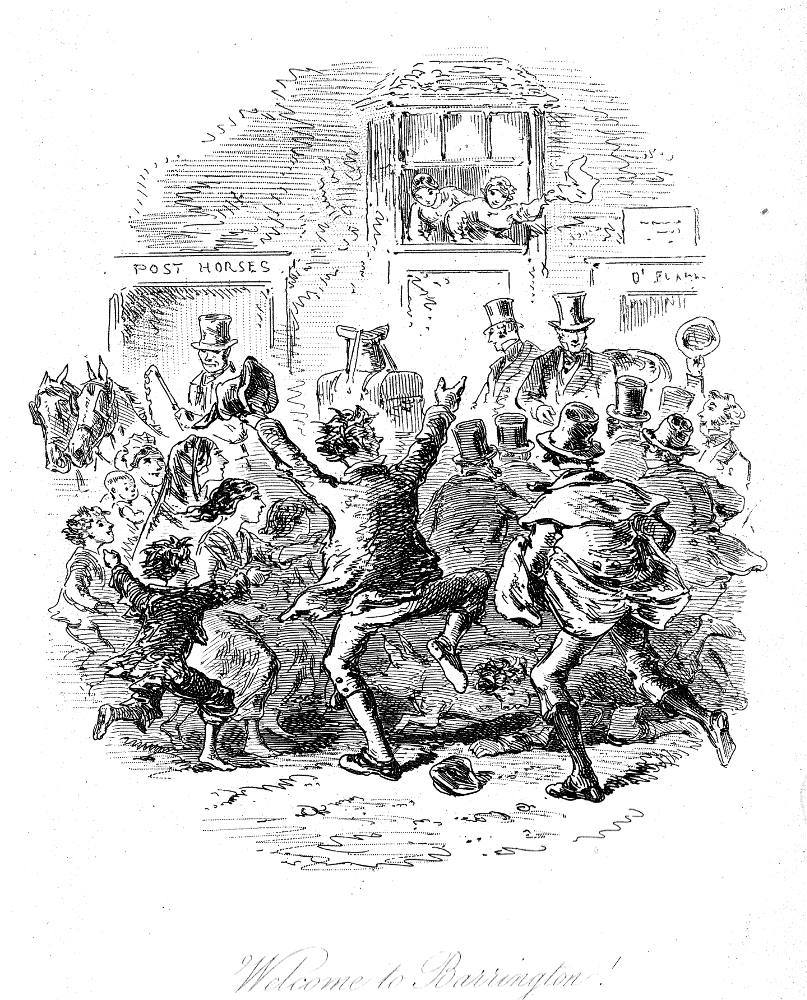
Welcome to Barrington!
Phiz (Hablot K. Browne)
steel engraving
12.4 cm high by 11.3 cm wide (4 ¾ by 4 ⅜ inches), vignetted.
January 1863
Final regular serial illustration for Charles Lever's Barrington, Chapter L, "The End," facing p. 404.
[Click on the image to enlarge it and mouse over text for links.]
Scanned image & text by Philip V. Allingham.
[You may use this image without prior permission for any scholarly or educational purpose as long as you (1) credit the person who scanned the image and (2) link your document to this URL in a web document or cite the Victorian Web in a print one.]
Passage Illustrated: The Village celebrates Peter Barrington's success
Not that he remarked how many had suddenly grown so cordial; what troops of passing acquaintances had become in a moment warm friends, well-wishing and affectionate. He never so much as suspected that “Luck” is a deity worshipped by thousands, who even in the remotest way are not to be benefited by it. He had always regarded the world as a far better thing than many moralists would allow it to be, — unsteady, wilful, capricious, if you like — but a well-intentioned, kindly minded world, that would at all times, where passion or prejudice stood aloof, infinitely rather do the generous thing than the cruel one.
Little wonder, then, if he journeyed in a sort of ovation! At every change of horses in each village they passed, there was sure to be some one who wanted to shake his hand. People hobbled out on crutches and quitted sick-beds to say how “glad they were;” mere acquaintances most of them, who felt a strange mysterious sort of self-consequence in fancying themselves for the moment the friends of Peter Barrington, the millionnaire! This is all very curious, but it is a fact, — a fact which I make no pretence to explain, however.
“And here comes the heartiest well-wisher of them all!” cried Barrington, as he saw his sister standing on the roadside, near the gate. With thoughtful delicacy, his companions lingered behind, while he went to meet and embraced her. “Was I not a true prophet, Dinah dear? Did I not often foretell this day to you?” said he, as he drew her arm, and led her along, forgetting all about his friends and companions. [Chapter L, "The End," 404]
Commentary: The Joyous Dénouement
In the intervening chapters, Horace Stapylton has been impeached by Lal Adeen, a Hindu whom the major has tried to murder in order to prevent his disclosing his true name and identity. General Conyers and Peter Barrington have reconciled, and Tom Dill has been accorded a hero's welcome back in England for his heroism in preventing an explosion on board the ship transporting his regiment to the Cape (mentioned in Chapter 42). In the finalé, Peter is cheered at every village as he travels home through Ireland, Major Hunter proposes to Polly, and Fred and Josephine are to be married in Kilkenny.
Related Material
- A Synopsis of Charles Lever's
- The Novels of Charles Lever, 1839-72
- Charles Lever (1806-1872): Anglo-Irish Novelist, Physician, and Diplomat
- Hablot Knight Browne, 1815-1882; A Brief Biography
Related material about Irish History
- Ireland (homepage)
- Dublin (homepage)
- The Act of Union making Ireland a Part of the United Kingdom
- Daniell O'Connell
- Irish Potato Famine
- Catholic emancipation
Bibliography
Lester, Valerie Browne. Phiz: The Man Who Drew Dickens. London: Chatto and Windus, 2004.
Lever, Charles. Barrington. With 25 engravings by Phiz [Hablột Knight Browne]. London: Chapman and Hall, 1863; rpt., 1872.
Steig, Michael. Dickens and Phiz. Bloomington: Indiana U. P., 1978.
Sutherland, John A. "Barrington." The Stanford Companion to Victorian Fiction. Stanford, Cal.: Stanford U. P., 1989, rpt. 1990, pp. 48-49.
Victorian
Web
Illus-
tration
Phiz
Barrington
Created 11 November 2007 Last updated 13 October 2026