
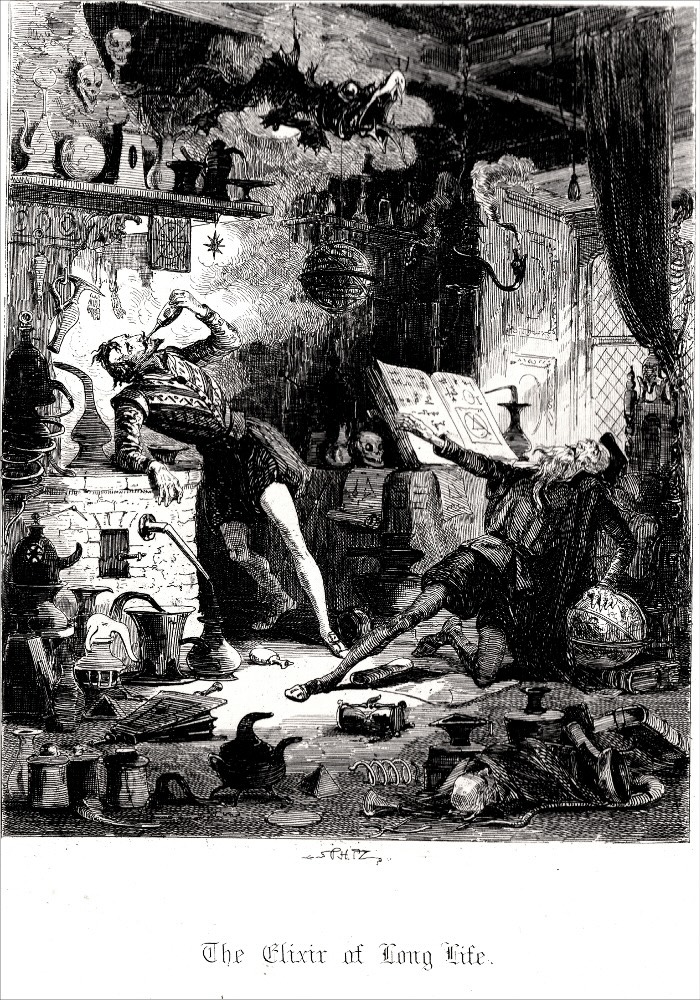
The Elixir of Long Life
Phiz
October 1844
12.7 cm high by 10.4 cm wide (5 by 4 inches), framed & signed "Phiz."
Facing page 288 in the 1844 serial, for William Harrison Ainsworth's Auriol; Or, The Elixir of Life (London: Chapman and Hall, 1850); rpt. George Routledge & Sons, 1865, facing p. 21
[Click on the image to enlarge it and mouse over text for links.]
Scanned image & text by Philip V. Allingham.
[You may use this image without prior permission for any scholarly or educational purpose as long as you (1) credit the person who scanned the image and (2) link your document to this URL in a web document or cite the Victorian Web in a print one.]

Passage Illustrated: Auriol Darcy takes Dr. Lamb's Elixir in the nick of time
"I know not what stays my hand," said the old man, raising the phial; "but now that immortality is in my reach, I dare not grasp it."
"Give me the potion, then," cried Auriol.
"Not for worlds," rejoined Darcy, hugging the phial to his breast. "No; I will be young again — rich — happy. I will go forth into the world — I will bask in the smiles of beauty — I will feast, revel, sing — life shall be one perpetual round of enjoyment. Now for the trial — ha!" and, as he raised the potion towards his lips, a sudden pang shot across his heart. "What is this?" he cried, staggering. "Can death assail me when I am just about to enter upon perpetual life? Help me, good grandson! Place the phial to my lips. Pour its contents down my throat — quick! quick!"
"I am too weak to stir," groaned Auriol. "You have delayed it too long."
"Oh, heavens! we shall both perish," shrieked Darcy, vainly endeavouring to raise his palsied arm, — "perish with the blissful shore in view."
And he sank backwards, and would have fallen to the ground if he had not caught at the terrestrial sphere for support.
"Help me — help me!" he screamed, fixing a glance of unutterable anguish on his relative.
"It is worth the struggle," cried Auriol. And, by a great effort, he raised himself, and staggered towards the old man.
"Saved — saved!" shrieked Darcy. "Pour it down my throat. An instant, and all will be well."
"Think you I have done this for you?" cried Auriol, snatching the potion; "no — no."
And, supporting himself against the furnace, he placed the phial to his lips, and eagerly drained its contents.
The old man seemed paralysed by the action, but kept his eye fixed upon the youth till he had drained the elixir to the last drop. He then uttered a piercing cry, threw up his arms, and fell heavily backwards.
Dead — dead! ["Prologue — 1599. Dr. Lamb," pp. 19-20; in the serial's "Prologue. 1599. The Elixir of Life," 293]
Commentary: What's two hundred years past is prologue
According to Steig, Phiz provided a total of fifteen etchings for the serial run of the novel when it first appeared as Revelations Of London in Ainsworth's Magazine, from October 1844 through May 1845, in eight monthly instalments. A further six instalments, also illustrated, appeared in The New Monthly Magazine as Auriol; Or, The Elixir of Life (August 1845 through January 1846). The 1850 Chapman and Hall single volume, accordingly, presents the serial's initial illustration as the second, the engraved frontispiece (referencing page 76 in "Book the First — Ebba," Chapter I, "The House in Vauxhall Road" which completed the first serial instalment).
The initial serial illustration, then, prepared magazine readers for the crucial scene in Ainsworth's "Prologue" when Auriol Darcy, having been wounded after taking down the heads of his father and brother at Traitor's Gate on the south end of London Bridge, is revived by the resident Southwark alchemist, Dr. Lamb. The Southwark Gate's guard, Baldred the gatekeeper, has grievously wounded the youth with his halberd; however, recognizing the youth's actions as perhaps justified, has taken Auriol to Dr. Lamb's laboratory nearby. In the near "dark" plate, the illustrator has visually satirized the aged alchemist (who is in fact Auriol's great-grandfather, whose real name is "Darcy"), but has treated the novel's protagonist with a high degree of realism, particularly in the details of his period clothing. Dr. Lamb expires as he reaches out for the bottle of magical elixir, wishing he could be forever young, although that is not precisely the effect that the potion may confer upon the one who drinks it. The principal feature of the illustration, however, is the chemist's shop itself:
Doctor Lamb, meanwhile, steadily pursued his task, though he ever and anon paused, to fling certain roots and drugs upon the charcoal. As he did this, various-coloured flames broke forth — now blue, now green, now blood-red.
Tinged by these fires, the different objects in the chamber seemed to take other forms, and to become instinct with animation. The gourd-shaped cucurbites were transformed into great bloated toads bursting with venom; the long-necked bolt-heads became monstrous serpents; the worm-like pipes turned into adders; the alembics looked like plumed helmets; the characters on the Isaical table, and those on the parchments, seemed traced in fire, and to be ever changing; the sea-monster bellowed and roared, and, flapping his fins, tried to burst from his hook; the skeletons wagged their jaws, and raised their fleshless fingers in mockery, while blue lights burnt in their eyeless sockets; the bellows became a prodigious bat fanning the fire with its wings; and the old alchemist assumed the appearance of the archfiend presiding over a witches' sabbath. [pp. 12-13 in volume]
Phiz, taking his cue from Ainsworth's own description of the laboratory, shows the floor "covered with instruments used by the adept . . . scattered about any attempt at arrangement." But in addition to bolt-heads, crucibles, cucurbites, and retorts, the illustrator delights in such arcane objects as the large terrestrial sphere (right), an astrolabe, mysterious-looking books, parchments, a motar and pestle, and the decapitated heads (lower right) removed from the Traitor's Gate. He has given prominence to the stuffed flying dragon, the skulls, and the alembic, all contributing to the most-admired disorder of the pseudo-scientist's worshop. The illustrator realizes the scene's climax, when, dying of wounds sustained in stealing his family's heads from Traitor's Gate nearby, Auriol Darcy seizes the magic potion and consumes the whole flagon, much to Dr. Lamb's consternation, "just as the new year 1600 breaks. The scene now flashes ahead to 1830, and the London 'Rookery' [of St. Giles Cripplegate] (Ainsworth here borrows from "Oliver Twist*)" (Sutherland, 33).
Eager to test the effect of the elixir, Auriol put his hand to his side. All traces of the wound were gone; nor did he experience the slightest pain in any other part of his body. On the contrary, he seemed endowed with preternatural strength. His breast dilated with rapture, and he longed to expand his joy in active motion.
Striding over the body of his aged relative, he threw open the window. As he did so, joyous peals burst from surrounding churches, announcing the arrival of the new year. [p. 293 in serial, at the curtain of the first chapter; page 22 in volume]
Related Material
- Hablot Knight Browne, 1815-1882; A Brief Biography
- William Harrison Ainsworth (1805-1882)
- William Harrison Ainsworth (1805-1882) — King of the Historical Potboiler: A Brief Biography
Bibliography
Ainsworth, William Harrison. Auriol; Or, The Elixir of Life. London: Chapman and Hall, 1850; George Routledge and Sons, 1865.
Ainsworth, William Harrison. Revelations of London.. Ainsworth's Magazine. Vol. VII (October — December 1844).
Lester, Valerie Browne. Phiz: The Man Who Drew Dickens. London: Chatto and Windus, 2004.
Steig, Michael. Dickens and Phiz. Bloomington & London: Indiana U. P., 1978.
Sutherland, John A. "Auriol." The Stanford Companion to Victorian Fiction. Stanford, Cal.: Stanford U. P., 1989, rpt. 1990, 33.
Vann, J. Don. "Auriol; Or, The Elixir of Life in Ainsworth's Magazine, October 1844 — May 1845." Victorian Novels in Serial. New York: Modern Language Association, 1985. Pp. 24-25.
Victorian
Web
Illus-
tration
Phiz
Auriol
Next
Created 5 August 2002 Last updated 5 October 2026