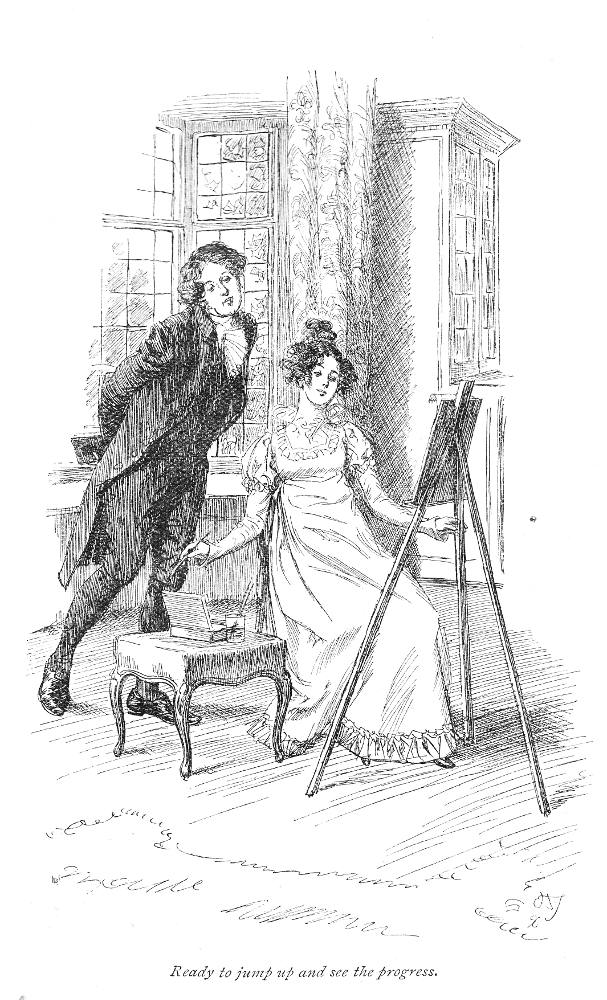
"Ready to jump up and see the progress."
Hugh Thomson
1905
Photomechanical reproduction of a pen-and-ink drawing
13 by 8.8 cm (5 ⅛ by 3 ¼ inches), vignetted
Jane Austen, Emma, facing page 39.
Scanned image and text by Philip V. Allingham.


[Victorian Web Home —> Jane Austen —> Visual Arts —> Illustration —> Hugh Thomson —> Next]
"Ready to jump up and see the progress."
Hugh Thomson
1905
Photomechanical reproduction of a pen-and-ink drawing
13 by 8.8 cm (5 ⅛ by 3 ¼ inches), vignetted
Jane Austen, Emma, facing page 39.
Scanned image and text by Philip V. Allingham.
[You may use this image without prior permission for any scholarly or educational purpose as long as you (1) credit the person who scanned the image and (2) link your document to this URL in a web document or cite the Victorian Web in a print one.]
She had soon fixed on the size and sort of portrait. It was to be a whole-length in water-colours, like Mr. John Knightley’s, and was destined, if she could please herself, to hold a very honourable station over the mantelpiece.
The sitting began; and Harriet, smiling and blushing, and afraid of not keeping her attitude and countenance, presented a very sweet mixture of youthful expression to the steady eyes of the artist. But there was no doing any thing, with Mr. Elton fidgeting behind her and watching every touch. She gave him credit for stationing himself where he might gaze and gaze again without offence; but was really obliged to put an end to it, and request him to place himself elsewhere. It then occurred to her to employ him in reading.
“If he would be so good as to read to them, it would be a kindness indeed! It would amuse away the difficulties of her part, and lessen the irksomeness of Miss Smith’s.”
Mr. Elton was only too happy. Harriet listened, and Emma drew in peace. She must allow him to be still frequently coming to look; any thing less would certainly have been too little in a lover; and he was ready at the smallest intermission of the pencil, to jump up and see the progress, and be charmed. — There was no being displeased with such an encourager, for his admiration made him discern a likeness almost before it was possible. She could not respect his eye, but his love and his complaisance were unexceptionable. [Chapter 3, pp. 37-38]
The scene occurs early in the novel as Emma attempts to pay tribute to the beauty of her young friend Harriet Smith. Although we cannot see the subject of the full-length portait that Emma intends should join that of Mr. Knightley above the mantlepiece, Thomson nevertheless focuses on Emma's manipulation of the image, her artistic pretensions, and her continuing efforts at match-making, this time between her friend Harriet and the social-climbing Mr. Elton. Emma attempts to improve on nature by making Harriet taller and more ladylike in her facial features, aspects of the sketch approved of by Mr. Elton. The prospective suitor (in fact, more interested in the artist that the sitter) hovers over her shoulder, and afterwards offers to take the small-scale portrait to London for framing. The portrait scene marks Emma's intention to improve Harriet in opinions, conversation, and social expectations. Ironically, Elton considers a match with Harriet beneath him socially, and is in fact paying court in this picture to the painter, not her subject.
Austen, Jane. Emma. Ed. Austin Dobson. With forty pen-and-ink illustrations by Hugh Thomson. The Novels of Jane Austen. London: Macmillan, 1896, rpt. 1905.
Austen, Jane. Emma. Ed. R. Brimley Johnson. With coloured illustrations by C. E. Brock. The Novels and Letters of Jane Austen. New York & Philadelphia: Frank S. Holby, 1906. 2 vols.
Austen, Jane. Emma. Ed. George Justice. 4th edition. New York: W. W. Norton, 2011.
Austen, Jane. Emma: An Annotated Edition. Ed. Bharat Tandon. Cambridge, Mass., and London: Belknap Press of Harvard U. P, 2012.
Created 25 April 2026