
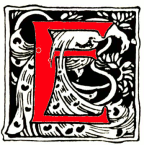
conomic agency is both an individual belief in one’s own efficacy in the world and, among others, a result of accumulated social connections and currency.
This is why women’s associational organisations (clubs, reading groups, unions) have always underpinned women’s advancements in securing personal and public rights, empowerment, and economic independence. Such groups range from the informal to the extremely formal, from neighbourhood cohorts to transnational endeavours funded by government grants. Equally, the opposite is true: When a woman’s social currency dwindles, so does her economic advancement.
This year Women, Money and Markets invite scholars at all stages of their career — postgraduate, postdoctoral, independent, employed, tenured — to present cutting-edge research on women’s global and local economies from the 1600s through the 1950s.
We are seeking historical, cultural, and literary scholarship that focuses on women’s networks of solidarity linked to progressing, securing, and supporting women’s professional, artistic, and economic opportunities. Work on large-scale transnational networks is as equally desired as research on small, local cohorts.
For this conference, emphasis is placed on alliances, unity, and solidarities. However, ruptures, breaks, and shifting alliances are heartily welcomed, as many women’s associational endeavours were both affected by disunity and accused of rupturing homes, marriages, and gender norms when seeking women’s basic human rights, as well as legal and economic independence from men.
The conference’s cohesion will lie in the confluence of disparate papers that all ultimately point to that give-and-take between personal efficacy and social capital. The interdisciplinary nature of the conference will likewise engender mutual learning and thinking in a cross-disciplinary way on the topic of women’s economic associations.
Finally, the historical span, from the 1600s to the twentieth century, ensures that the conference will reflect an unsettling reality, namely, what Gillian Beer reminded us of in the 1980s in her book, George Eliot: "Anyone who has studied women’s movements and the discussion of women’s rights and positions knows well that there has been no steady arc of progress. Instead, arguments and determinations have been advanced and then have apparently vanished again, as we see in the relationship between the end of the eighteenth century with the complex arguments of Mary Hays and Mary Wollstonecraft, and the beginning of the nineteenth."(p.2)
Continued historical, cultural, and literary study of and alliances of unity around women’s economic lives is the antidote to acquiescing gained ground for women’s public and private agency.
Paper topics can include, but are not limited to, the following:
- Formal associational groups or leagues centred on women’s work, unions, and trades
- Informal cohorts of local women supporting women’s economic lives
- Transnational women’s networks providing women’s employment
- Local or national women’s networks for the employment or professional training of women
- Colonial economies and women
- The economies and labour of women of all faiths, religions, or no religion
- Disunity amongst or within women’s organisations
- Ruptures external to women’s organisations: shaming, critiquing, denouncing women’s associational and professional organisations
- Disunity and rupture internally within a woman’s lived experience or narratives of labour and economic agency
- Artistic groups promoting the advancement of women’s public-facing work
- Literary representations of the New Woman’s individual agency and social capital for securing financial independence
- Historiographies of women’s associational and organisational lives around labour, work, employment, economic agency, trading, investing, saving, or philanthropy
- Medical associations dedicated to training women doctors; nurses’ unions; solidarities between women medical professionals and their patients
- (Representations of) care communities as informal and formal women’s economies
- (Representations of) female friendships as informal and formal women’s economies
The conference will take place at the Women’s University Club in the heart of London’s Mayfair. Since its foundation, the club has actively promoted causes closely associated with women and their education.
Please submit a 350- to 400-word proposal and a 50-word author bio to [email protected] by 15 September 2026. All notices of acceptance will go out by 15 October 2026. We are accepting proposals for individual papers as well as panels of three participants.
Created 18 August 2026 Last modified 18 August 2026