

oth Brownings were part of the inheritance that neo-pre-Raphaelites took on. (It can be noted that they were both on the list of Immortals drawn up by the founding Pre-Raphaelite Brothers.) This applied especially to Robert, perhaps, since his longer life enabled him to become a fixture in later Victorian society and an acquaintance or friend to many more pre-Raphaelite followers than had ever crossed the path of Elizabeth.
He was the source of several works by the so-called neo-pre-Raphaelite Eleanor Fortescue-Brickdale (1872-1945) or, it would be more precise to say, the source of titles for several works that she produced in the first years of the new century: these included Thy Body at its best (1903), Natural Magic (1904), My Last Duchess (1904), The Cap that fits (1905), and When earth was nigher heav’n than now, which was seen at the RA in 1907. Some of these appeared in her 1905 exhibition at Dowdeswell’s Galleries bearing the Browning tag. This can indicate that the artist was a long-term Browning reader, although it is equally valid to say that it suggests that she surmised a continuing interest in the poet on the part of her public – and, as all readers of the Victorian Web’s Fine Arts sections know, the typical Victorian painter routinely used literary tags to draw the public’s attention to new works.
It was a different matter, however, when, in March and April 1908, mention appeared in the press of Chatto and Windus’s intended series of limited edition, colour-illustrated volumes of poetry: “a new series of English poets in large type, and with illustrations after well-known modern artists” (Athenaeum, 481) John Byam Shaw was the artist for the first two, to appear in the spring, and Eleanor Fortescue-Brickdale the artist for the second brace, which could be expected in the autumn; the poetry in question was, firstly, two selections from Percy’s Reliques and other old ballads and, secondly, Robert Browning’s "Pippa Passes" and Men and Women, and Dramatis Personae and Dramatic Romances.
Accordingly, ten watercolours by Fortescue-Brickdale illustrated the Chatto and Windus volume "Pippa Passes" and Men and Women that appeared at the very end of 1908. The number of poems therein amounted (if "Pippa" is taken as one) to fifty but, despite this richness of opportunity, the book contained only ten pictures: two related to "Pippa" and the rest to Men and Women. Amongst them, the plates for Evelyn Hope and The Last Ride Together are two of the artist’s most appealing compositions in all media while others, such as Another Way of Love, are eccentric both as pictorial compositions and illustrations of the poem. Indeed, a fair number of reviewers complained both that the compositions did not match the verses and that many different poems would have provided better opportunities for illustration. In this light, it is tantalizing that no documentation of the enterprise seems to have survived that would illuminate who made which decisions in the commission and execution of the project, meaning that it is next to impossible to determine whose choice of topics won the day.
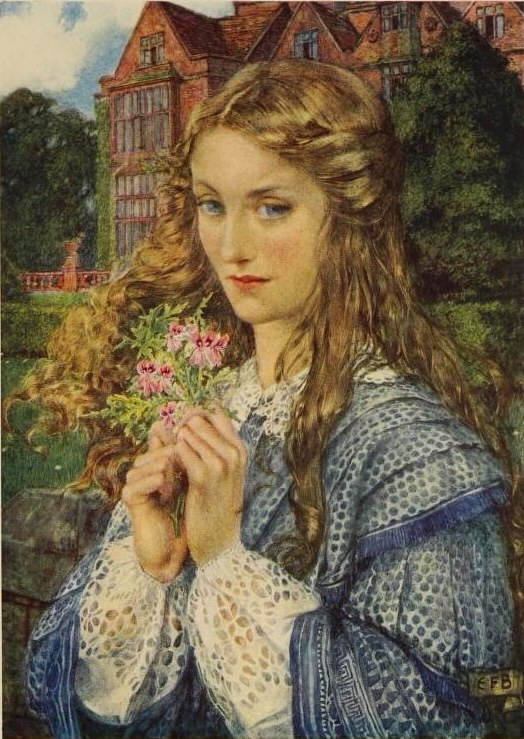
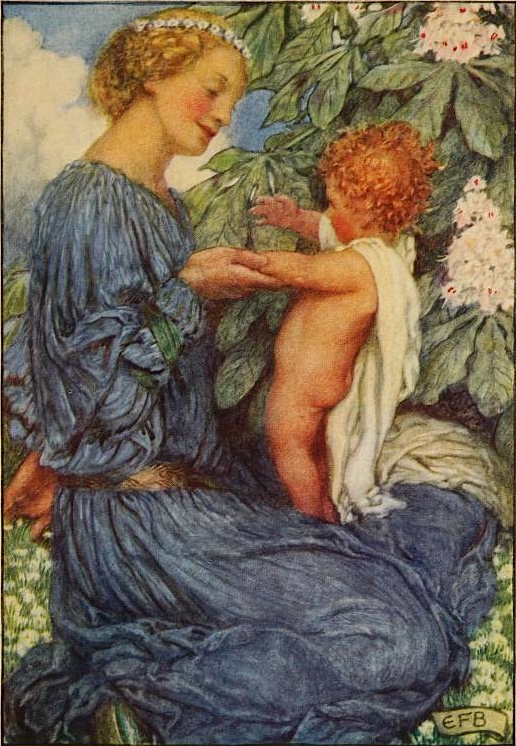
Two illustrations from "Pippa Passes" and Men and Women. Left: Evelyn Hope, facing p. 64. Right: The Last Ride Together, facing p. 138. [Click on all the images on this page to enlarge them, and usually for more information about them.]
Fortescue-Brickdale will have been well aware, in tackling this commission, that her close friend Byam Shaw’s 1897 illustration of Browning’s Poems, published by George Bell, for whom she had also worked, was still in publication in 1908. It presented a substantial challenge to equal or surpass, given that she was all too often cast by critics as a follower or, worse, imitator of Shaw. While his version comprised only black-and-white designs, it ran to sixty-seven of them, meaning that it had covered quite a lot of territory. Sufficient to say that at least some reviewers found that Fortescue-Brickdale “has helped to make a volume which every lover of Browning and of art should value” – thus the Glasgow Herald, cited in the publisher’s advertisements.
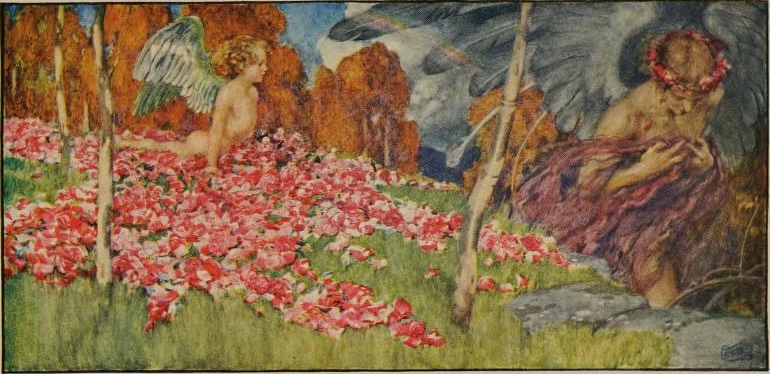
Another illustration from "Pippa Passes" and Men and Women: Another Way of Love, facing p. 246.
Before the Dramatis Personae and Dramatic Romances and Lyrics volume could appear, in June 1909 the Dowdeswell Galleries showed 40 watercolours by Fortescue-Brickdale under the title “The Poems of Robert Browning”, an exhibition that included the first ten works, the ten that eventually appeared in the second volume, and an additional ten, the complement consisting of designs the artist had made for another publication altogether, Mabel (Mrs Percy) Dearmer’s Child’s Life of Christ , published by Methuen in 1906. This roll-call indicates that Fortescue-Brickdale produced a greater number of designs than would be eventually used in the books, which she was permitted by the contract she had with Chatto and Windus to use to her advantage by this exhibition of work for sale. On the other hand, it also indicates that by mid-1909 she had insufficient works on hand to supply Dowdeswell’s with an entire exhibition solely based on Browning. This circumstance speaks to the artist’s life-long modus operandi of taking on more tasks than she was temperamentally up to organizing. Characteristically, in an unpublished letter to a friend dated 12 July 1908, she wrote: “There is very little to tell you about us – I have still so much to finish of Dowdeswell’s Browning pictures that I shall have to stay in stuffy London all through August…” (Peele papers, Shropshire Archives, Shrewsbury).
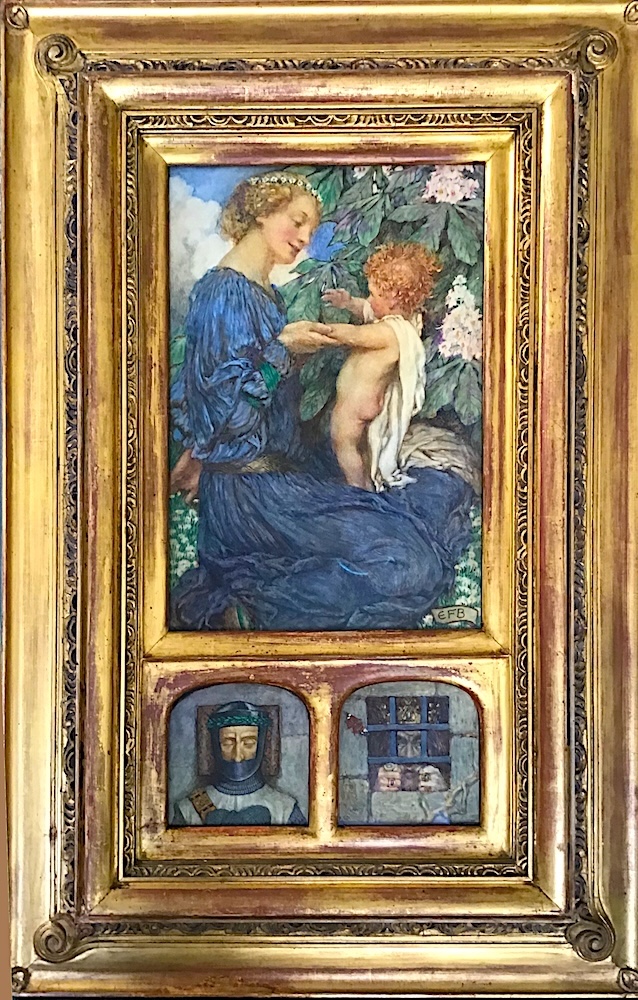
With regard to the burden of work to which she had committed herself, it is also worth noting that in some cases the exhibited watercolour was much more complex a work than the illustration appearing in either of the books. A case in point is The Last Ride Together (see top right), illustrating the poem of the same name in the first volume amongst the "Men and Women" verses, facing p. 138: in its physical form, this design, of a merry woman in blue dandling a naked baby on her knees, is merely the primary element of the three-part composition shown alongside in its frame, from a private collection. Here, a predella below the main image shows, at left, the head and shoulders of what seems to be a knight on his death-bed and, at right, the sinister face of a king glowering behind a barred window. The whole was framed, as seen, in the usual gilded frame of an oil painting, in the artist’s favourite (recurring) design, demonstrating her habit of presenting her exhibition watercolours as having an equal status to oil paintings.
Reviews of both the books and the exhibition were divided. Naturally, opinion derived from the speaker’s feelings about the poet as much as from their views of the artist. It was typical for the more highbrow observer to suggest that the artist had somehow failed the poet, as in the Burlington Magazine’s verdict on the first volume: “Miss Brickdale’s drawings from first to last are admirable in themselves and admirably reproduced, but we feel that they are much less illustrations of Browning’s poems than an embroidery of personal artistic fancy, with Browning’s poems for centre” (248). Something of the same was expressed when the exhibition came on some six months later, as in the Manchester Guardian’s columnist’s comment: “Some of the pictures are so good that the contrasts suggest a rule for future attempts – illustrate Browning, but keep your illustrations out of Browning”. (Manchester Guardian, 6).
The design which attracted the most attention – in the exhibition, perhaps by its great charm, and in the second volume by its prominence as the frontispiece – was that which illustrated the poem "Home Thoughts from Abroad," frequently referred to as "Oh to be in England!" or "In England- now!" It was instanced in the course of the line of criticism identified above in the Times review of the exhibition: “Miss Brickdale, for example, makes an attractive little picture of three children playing in the grass, and labels it 'In England - now!'; and this, like most of the other drawings, has no exclusive relation to the poet’s words. They are, indeed, much more characteristic of the artist than the poet…” (Times, 10) And it is debateable whether the subsequent issue of this composition as a Medici calendar was proof of the appeal that the artist’s work or the poet’s work had for the Edwardian public.
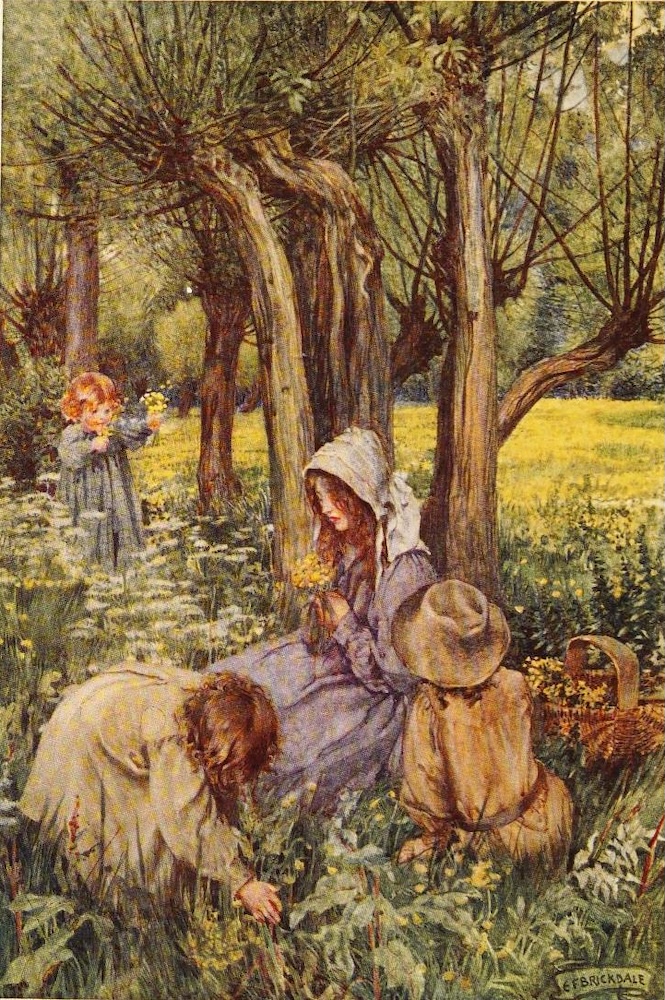
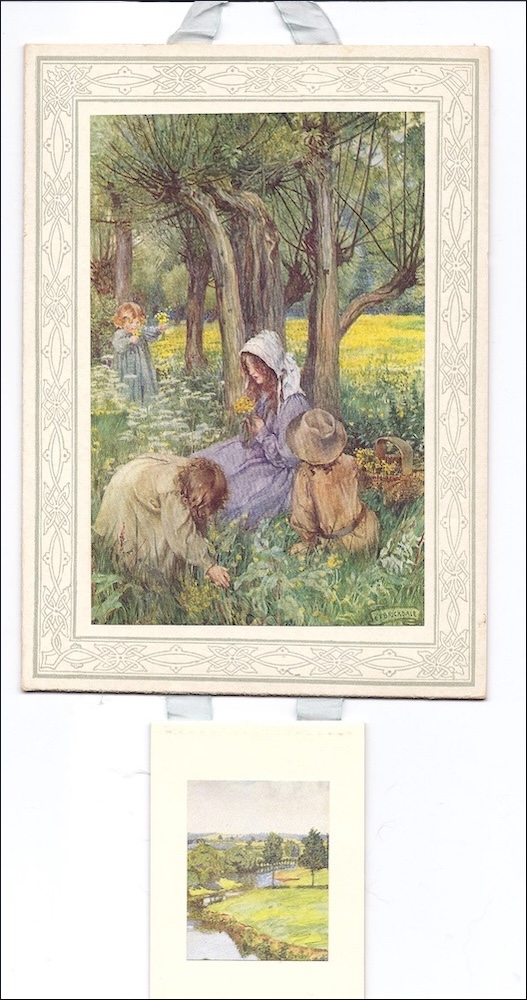
Left: Oh to be in England / Now that April's there, frontispiece to Dramatis Personae & Dramatic Romances and Lyrics. Right: The popular frontispiece used to illustrate a Medici calendar.
The image which has had the most exposure in our own time, however, was that which illustrated the poem "A Face," in the Dramatis Personae collection, under the title "If I could have that little head of hers" . This seems to have been the model for the seated figure in the artist’s later canvas The Forerunner (1920, Lady Lever Art Gallery; see below), and has been a treasured possession of the Russell-Cotes Art Gallery and Museum for many years – possibly purchased from its first public appearance in 1909.
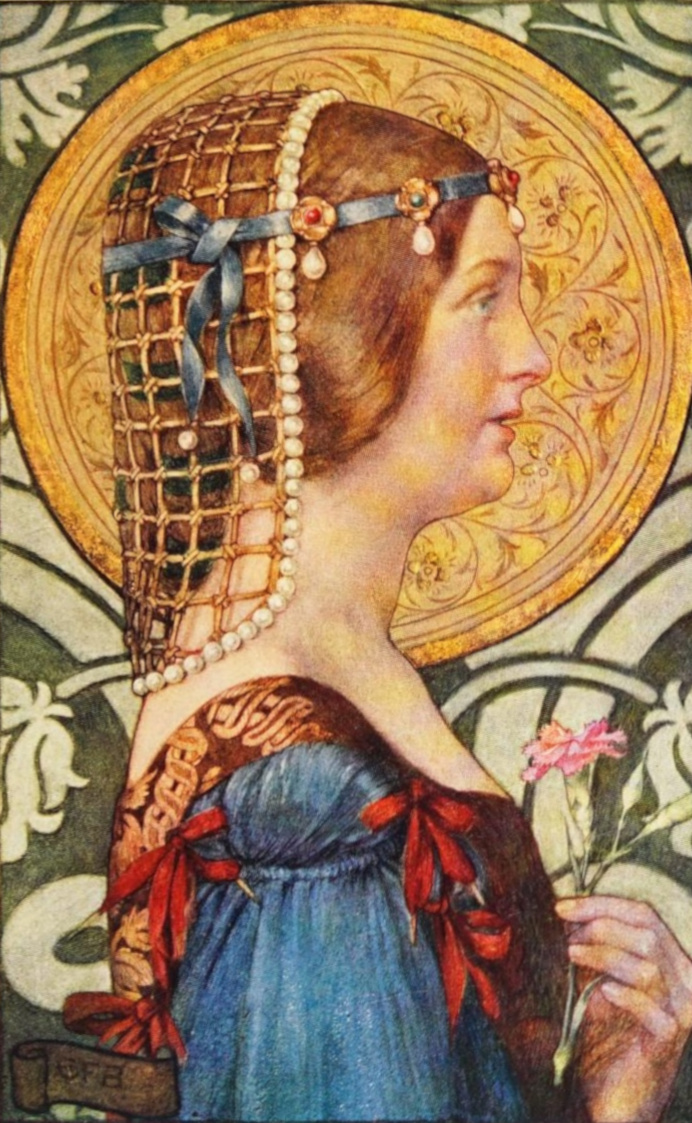
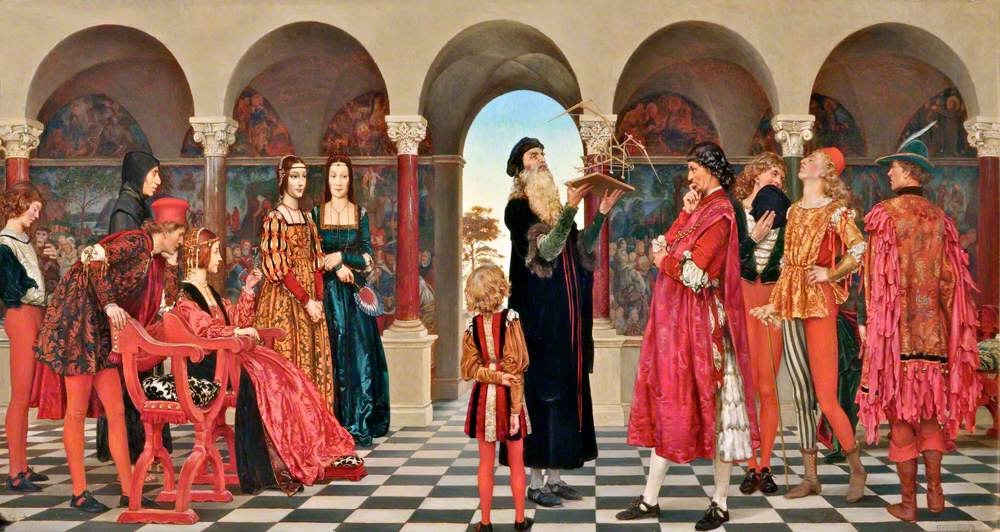
Left: "If I could have that little head of hers / Painted upon a background of pale gold", facing p. 74 in Dramatis Personae & Dramatic Romances and Lyrics. Right: The Forerunner (1920), a scene of the Italian Renaissance in which Da Vinci shows off his model flying machine to his patrons, the Duke and Duchess of Milan. The seated noblewoman is the powerful Beatrice d'Este, Duchess of Milan. Image credit: Lady Lever Art Gallery, reproduced on the Creative Commons Attribution-NonCommercial licence (CC BY-NC).
Evidently not all these pictures sold, however, as Fra Lippo Lippi and the Prior’s Niece was shown at the RWS as late as 1932, not credited to an owner so thus understood to be still in the artist’s hands (and even now held by Fortescue-Brickdale’s descendants).
Bibliography
Anonymous. "Literary Gossip." The Athenaeum. 18 April 1908: 481.
Anonymous. "In Bond Street." The Times. 10 June 1909: 10.
Anonymous. "Pictures to Browning." Manchester Guardian. 17 June 1909: 6.
Baldwin Brown, G. "Art Books of the Month: Gift Books." Burlington Magazine. Vol 14, no. 70 (January 1909): 248.
Browning, Robert. "Pippa Passes" & Men and Women. 1908. Philadelphia, PA: Lippincott/London: Chatto and Windus, 1909. Internet Archive, from a copy in the library of the University of St Francis University. Web. 8 June 2026.
_____. Dramatis Personae & Dramatic Romances and Lyrics. London: Chatto and Windus, 1909. Internet Archive. Web. 8 June 2026.
Dreamer, Mabel (Mrs Percy). Child’s Life of Christ. London: Methuen, 1906.
Fortescue-Brickdale, Eleanor. The Forerunner. Art UK. Web. 9 June 2026.
Gerrish Nunn, Pamela. A Pre-Raphaelite Journey: the Art of Eleanor Fortescue-Brickdale. Liverpool: Liverpool University Press, 2012.
Howe, John and Ann Carling. "The Stuff of Dreams: the Illustrations of Eleanor Fortescue Brickdale." The IBIS Journal no.5 (2014): 7-57.
Created 8 June 2026
Last modified 12 June 2026