
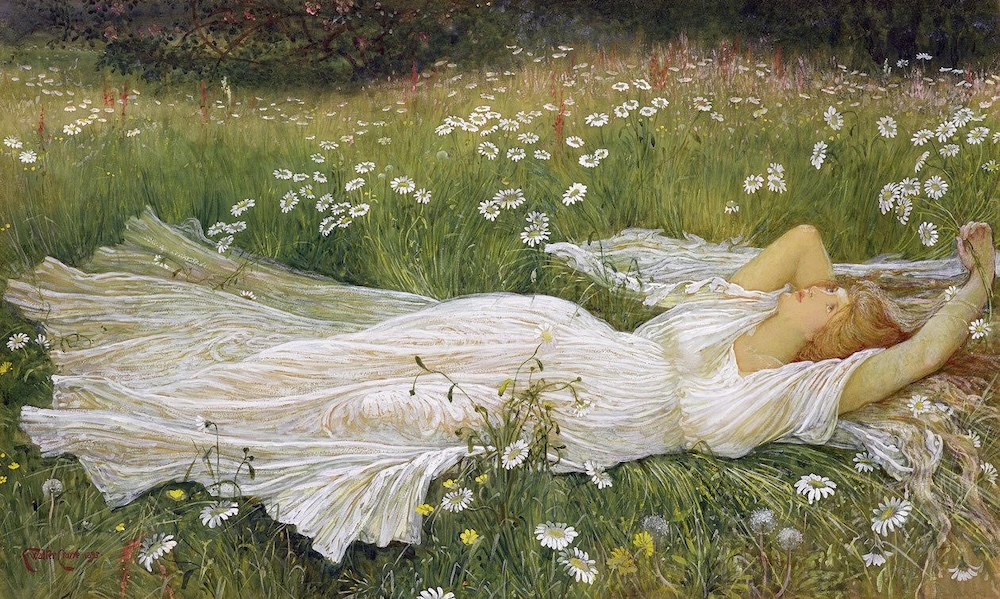
Summer by Walter Crane (1845-1915). 1895. Watercolour and gouache. 21 ½ x 36 inches (54.6 x 91.4 cm). Private collection. Image courtesy of Sotheby's, London.
Crane exhibited this work at the Winter Exhibition of the Royal Society of Painters in Water Colours in 1895-96, no. 200. It features a beautiful young maiden clad in a diaphanous white gown lying in a meadow, her right hand tucked under her head. She holds white daisies in her left hand and the meadow is filled with further white daisies and other wild flowers. The white daisies may have been included purely for their decorative effect, but in the Victorian language of flowers white daisies symbolized purity and innocence. A row of bushes fills the background with no glimpse of the sky. When this work sold at Christie's in 2007, one of their specialists, likely John Christian, remarked: "This sensuous and evocative scene conflates two of Crane's most distinctive qualities, the desire to paint figurative subjects on a grand scale and the drive to explore allegorical meaning as a means to convey profound moral truths. Time and again throughout his career Crane returns to the theme of the seasons. They date from all periods of his career, and most are concerned with the joy that a new season, most often Spring, brings" (107). In this watercolour, however, Crane has chosen to feature summer in one of his most beautiful Pre-Raphaelite-inspired works where the continued influence of Edward Burne-Jones is clearly seen. The picture is also reminiscent of the reclining woman in white in J.W. Waterhouse's first version of Ophelia of 1889, or John Byam Shaw's painting Silent Noon of 1894.
Contemporary Reviews of the Painting
The most exhaustive review of the painting was by the critic of the Art Journal who found it pleasingly decorative:
Mr. Walter Crane's Summer, a graceful piece of decoration entirely characteristic of his curiously learned art. The figure of the maiden, lightly draped in diaphanous white robes, who lies outstretched among the marguerites with which the foreground of the picture is filled, is less robust and fully developed than is usual in representations of the season in full bloom; and her attitude is not so much one of rejoicing in the strength of youth, as one of languor and exhaustion; but these deficiencies are compensated for by technical beauties, by charm of design and delicacy of colour, and by the individuality of manner which gives to Mr. Crane's work a place by itself. [62]
Bibliography
The British Sale. London: Sotheby's (15 June 2000): lot 57.
British Works on Paper. London: Christie's (21 November 2007): lot 115, 106-07. https://www.christies.com/en/lot/lot-4998487
Konody, Paul G. The Art of Walter Crane. London: George Bell & Sons, 1902. 137.
"The Royal Society of Painters in Water Colours." The Art Journal LVIII (1896): 60-63.
Created 29 November 2025