
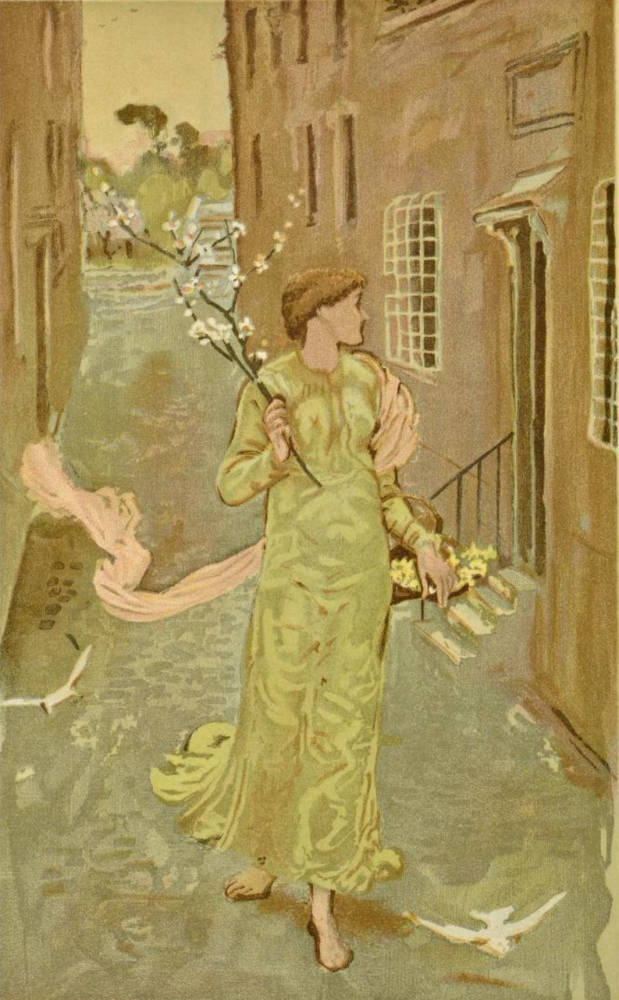
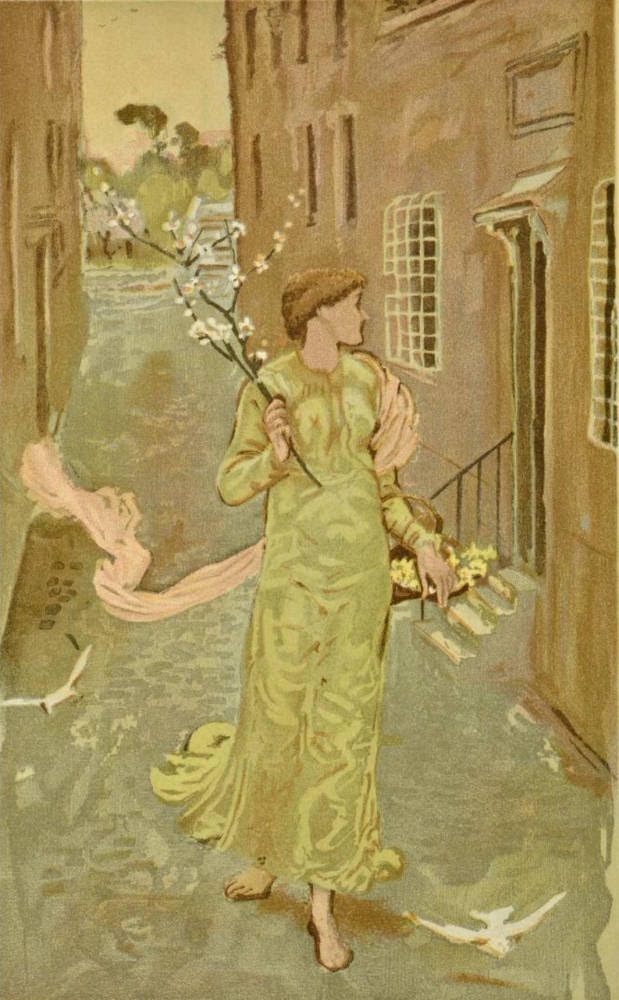
A Herald of Spring. 1872. Left: Watercolour-based mixed media on paper. 24 1/4 x 13 5/8 inches (61.4 x 34.7 cm). Collection of Birmingham Museums and Art Gallery, inventory no. 1929P528. Image courtesy of Birmingham Museums Trust, made available under a Creative Commons Zero licence (CCO). Right: Watercolour sketch, dimensions and whereabouts unknown. Image source: The Work of Walter Crane (1898). [Click on the images to enlarge them.]
Crane exhibited the finished watercolour of A Herald of Spring at the Dudley Gallery in 1873, no. 97, a prime example of a work from his "Poetry Without Grammar School" period. In his reminiscences Crane describes it in this way: "A figure in a pale green robe and pink scarf coming down a Roman street in the early morning with a basket of daffodils on her arm" (139). The painting had been executed in 1872 during Crane's honeymoon in Italy where he was entranced by the beauty of the Italian spring. About twenty years after its exhibition at the Dudley Gallery, the Cranes bought the picture back from its original owner because his wife had a particular affection for it. Paul Konody feels this was the "most important" of the watercolours that Crane exhibited at the Dudley Gallery between 1870-76, showing "a graceful maiden in a clinging robe of primrose hue, carrying a spray of almond blossoms, and stepping airily along a typical Roman street. The colouring is extremely delicate and suggestive of early spring, the drawing as exact and conscientious as that of all true pre-Raphaelites" (94).
Greg Smith and Sarah Hyde give a more detailed and nuanced critique:
According to Crane the twin inspirations for this work were the beauty of the Roman spring, which resulted in a number of landscape studies, and his wife, who was the model for the figure. The drawing of the background shows the Via Sistina with the church of S Trinità dei Monti. The viewpoint in the drawing appears to have been from a window and this causes some confusion when it is converted to a ground-level view in the finished work. Crane's limitations as a draughtsman are also apparent in the figure study where the relation between the drapery and the underlying figure are unsatisfactory. The problem is not resolved in the finished work, nor is the figure happily related to the background. [108-09]
Contemporary Reviews of the Painting
Crane's contributions to the Dudley Gallery in 1873 were not widely reviewed at the time. A critic for The Architect found the watercolour charming but not Crane's best work, noting "the charm of a quaint fancy, and a play of delicate colour" in his work, and describing it briefly ("a girl draped in saffron robes, basket of yellow lilies on arm, and almond branch in hand, pacing down a quiet street lined with pink and gray houses"), but then adding: "There is really more of affectation than poetry in the picture, and Mr. Crane has done more admirable work and shown more true art feeling in green pastoral landscapes, or in his delightful illustrations to nursery rhymes" (71).
You may use these images without prior permission for any scholarly or educational purpose as long as you (1) credit the appropriate source and (2) link your document to this URL in a web document or cite the Victorian Web in a print one.

Bibliography
Crane, Walter. An Artist's Reminiscences. London: Methuen & Co., 1907. 138-39.
"Dudley Gallery Water-Colour Exhibition." The Architect IX (8 February 1873): 71.
Konody, Paul G. The Art of Walter Crane. London: George Bell & Sons, 1902. 93.
Smith, Greg and Sarah Hyde. Walter Crane 1845-1915. Artist, Designer and Socialist. London: Lund Humphries, 1989, cat. D2, 108-09.
The Work of Walter Crane with Notes by the Artist. The Easter Art Annual for 1898: Extra Number of the "Art Journal". London: J. S. Virtue, 1898. HathiTrust version of a copy in the Getty Art Institute. Web. 20 November 2025. [Originally sourced by George P. Landow]
Created 3 January 2018
Last modified 20 November 2025