
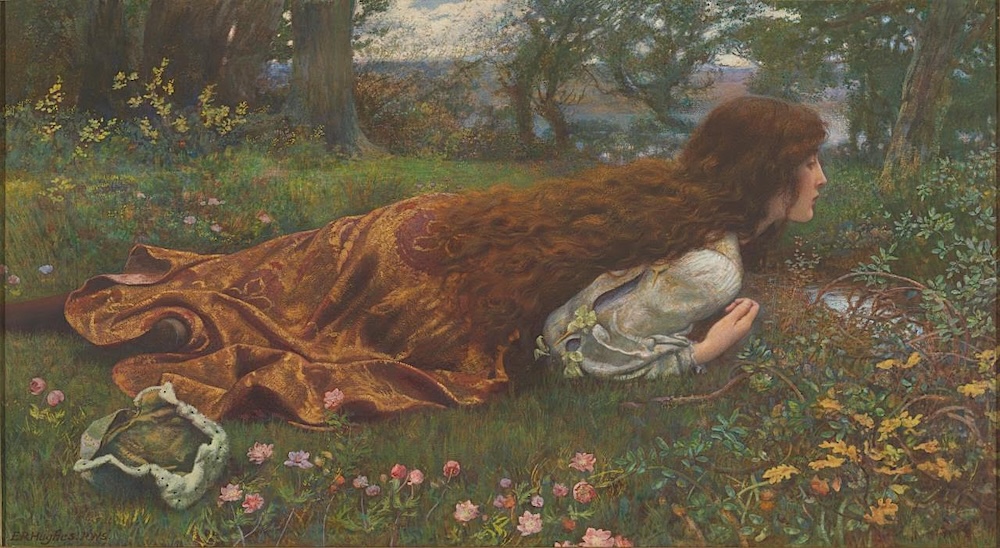
The Princess out of School. 1901. Gouache and watercolour, with some scratching out, on paper. 20 1/2 x 37 1/2 inches (52.0 x 95.3 cm). Collection of the National Gallery of Victoria, Melbourne. Image courtesy of the National Gallery of Victoria, Melbourne. [Click on the image to enlarge it.]
Hughes exhibited this watercolour, surely one of his most beautiful works, at the Summer Exhibition of the Royal Watercolour Society in 1901 where it was accompanied in the catalogue by lines from John Keats's poem "Endymion."
"Under her favourite bower's quiet shade.
On her own couch, new made of flower leaves."
It shows the beautiful auburn-haired princess, clad in a magnificent white silk dress and a golden brocade cloak. Such a form of dress was frequently portrayed in Italian Renaissance paintings, which likely influenced Hughes's choice of it here. The princess is shown lying in an idyllic meadow and looking over a small stream that flows into the river in the background. She is studying nature first hand rather than being in school. Her scholar's cap sits on the ground in the left foreground, surrounded by wild flowers. All this is treated in a meticulously detailed Pre-Raphaelite style. A clump of trees fills the midground leading down to the riverbank, with a row of low hills in the background. When this picture was shown at the Royal Society of Water Colours exhibition, it was well regarded. A reviewer for the journal Literature reported that The Princess out of School "occupies what may be regarded as the place of honour in the gallery, and it is a tribute to the intelligence of the hanging committee that it is so well placed" (qtd. in Osborne, 29). The picture is reminiscent of works by Edward's uncle Arthur Hughes, such as The Rift Within the Lute of 1861-62 and Endymion of 1868-70.
Alison Inglis feels that The Princess out of School fits well within the tradition of Pre-Raphaelite painting: "Although mainly recognized as a Pre-Raphaelite, Hughes is well known for his ethereal and dreamlike paintings which are more in keeping with the Symbolist and Aesthetic movements. The princess out of school, c.1901, however, is painted with an incredible level of detail, rendered in dazzling and strong colours, in a manner that firmly places it in the Pre-Raphaelite tradition" (38).
Vivien Gaston, in her abstract to the extensive article she published on this watercolour in the Australian Journal of Victorian Studies, felt this work not only related to Keats's "Endymion" but to Alfred Tennyson's poem "The Princess" where Princess Ida prioritized education over marriage:
This essay is the first to explore the meaning and cultural context of Edward Robert Hughes's large-scale watercolour The Princess out of School, 1901, in the collection of the National Gallery of Victoria. While the work has familiar artistic sources in depictions of reclining meditative figures, this lineage is combined with an unusually rich literary emphasis, referring to both Tennyson's poem "The Princess," 1847, in its title and Keats' "Endymion," 1818, in a quotation that accompanied the work when it was first exhibited. Identified as a student by her abandoned scholar's cap, Hughes's figure takes up Tennyson's narrative about a princess who founds a university exclusively for women, reflecting current debates about female education, untamed nature and Darwinian evolution. These ideas were also reflected in Gilbert and Sullivan's Princess Ida; or Castle Adamant, first performed in 1884, with production designs that compare closely with Hughes's composition. Hughes's connections with leading aesthetic and literary circles are also reflected in the quotation from Keats' poem referring to an idyllic bower that provides respite for his troubled protagonist Endymion. Likewise Hughes's heroine rejects the academy in favour of a direct experience of nature, her robe and hair seemingly entwined with the flowers and leaves. Immersing her figure in a tapestry-like field of colours, Hughes extends his innovative use of watercolour towards the abstract metaphysical dimensions sought by Symbolist artists as well as writers such as Christina Rossetti, whose poetry he also illustrated. Audaciously emulating two of the most influential nineteenth-century poets, Hughes's depiction is a therapeutic vision of nature: the fertile untamed bank which the princess studies "out of school" reinterprets Keats's visual aesthetic of organic plenitude while enacting Tennyson's vision for female emancipation as part of a wider Darwinian evolution. [58]
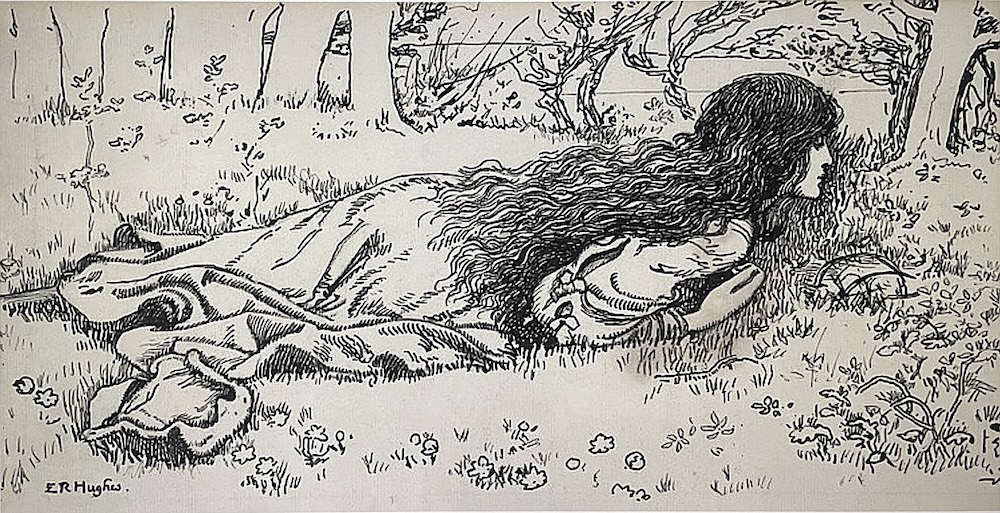
Study for The Princess out of School. 1900. Pencil, pen and black ink on paper. 10 ¼ x 16 ¾ inches (26 x 42.6 cm). Private collection. Image reproduced courtesy of Christie's, © 2019 Christie's Images Limited right click disabled; not to be downloaded.
A pen-and-ink drawing relating to the watercolour was offered for sale at Christie's, London, on 11 July 2019. Since it follows the composition of the painting so closely it may actually be after the watercolour rather than a study for it.
Bibliography
British and European Art: Victorian, Pre-Raphaelite & British Impressionist Art.. London: Christie's (11 July 2019): lot 5.
Gaston, Vivien. "'New Made of Flower Leaves': Nature, Evolution and Female Education in Edward Robert Hughes's The Princess out of School." In Pre-Raphaelitism in Australasia (Part 2), Australian Journal of Victorian Studies XXVI (21 October 2022): 58-72.https://openjournals.library.sydney.edu.au/AJVS/article/view/13368
Inglis, Alison. "The Medieval World." Medieval Moderns. The Pre-Raphaelite Brotherhood. Laurie Benson Ed. Melbourne: National Gallery of Victoria, 2015, 38.
"Old Water Colours." Literature CLXXXV (4 May 1901): 371.
Osborne, Victoria Jean. "A British Symbolist in Pre-Raphaelite Circles: Edward Robert Hughes RWS (1851-1914)." M. Phil. thesis, University of Birmingham, 2009, 29.
Created 6 May 2026