
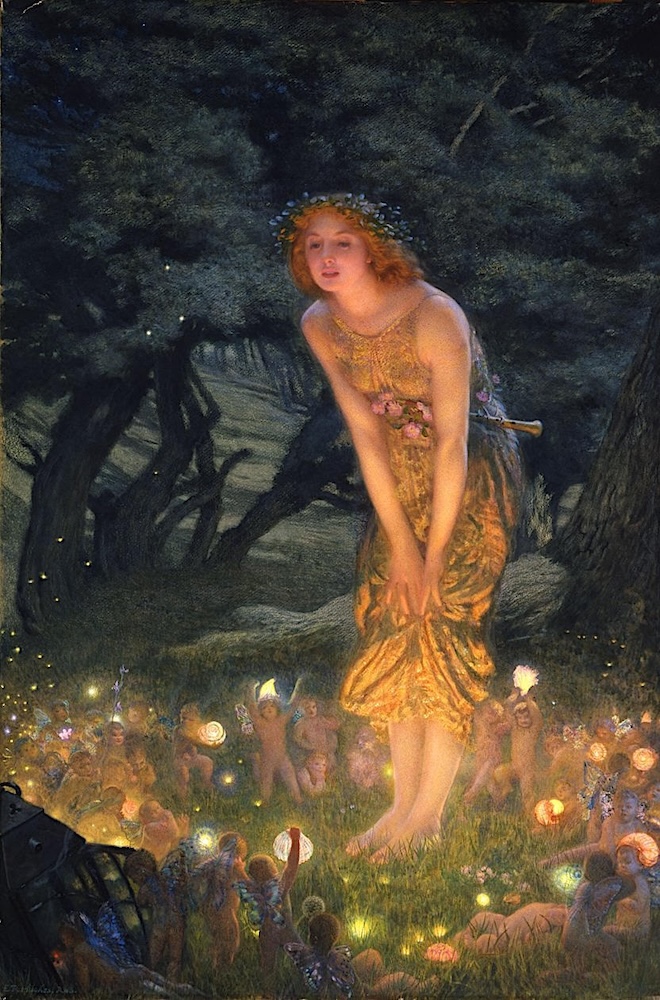
Midsummer Eve. 1908. Watercolour and gouache on paper. 45 x 30 inches (114.3 x 76.2 cm). Private collection, image courtesy of Sotheby's, New York. [Click on the image to enlarge it.]
Hughes exhibited this watercolour at the Royal Society of Painters in Water Colours in 1908, no. 88, and possibly later at the Royal Birmingham Society of Artists in Birmingham in 1909. It is one of the most impressive of his fairy paintings, a nocturnal composition located in the clearing of a forest. A young woman in a golden dress stands at dusk with a flute tucked under her left arm, her hands clasped on her knees, and bends over to gaze at a group of small fairies with butterfly wings holding glowing objects, who encircle her: one of the fairies, as Victoria Osborne notes, "has crept into her lantern and extinguished it, so the scene is lit only by the twilight and the firefly-like glow of the fairies themselves…. Midsummer eve itself already carried associations with the supernatural, being traditionally the night of the year when fairy power was thought to be at its strongest" (83). The subject may possibly have been inspired by Shakespeare's A Midsummer Night's Dream.
When the work sold at Christie's in New York in 1995 their specialists compared it to another of Hughes's works: "The present picture, first exhibited at the Royal Watercolour Society in 1908, shows him in his most romantic vein and may be compared to Night with her Train of Stars of 1912…. The nocturnal light effect is similar, and both pictures introduce a host of supernatural figures, putti in Night with her Train of Stars, fairies in Midsummer Eve. The mood and setting, however, are very different, Night being a sombre symbolist theme set in the sky, while Midsummer Eve is earth-bound, light-hearted and playful."
The specialists at Sotheby's in New York later gave a more detailed interpretation of this watercolour when it sold in 2005:
This painting belongs to a traditional Victorian genre of fairies shown frolicking in their "natural" woodland environment. A ring of winged, plump, child-like creatures form around a young woman, perhaps a wood nymph. Holding a flute under her arm, her golden dress lifted, the woman poses as if she has been invited to perform a song — her stage the loamy grass, her curtain the lush leaves of the trees, and her flood-lights the illuminated shells, flowers, and seed pods held aloft by her miniature audience. In this mix of the natural and the supernatural, the theatrical and the real, Hughes fulfills the contemporary demand for fairy subjects while infusing the work with the artistic ideals of the late Pre-Raphaelite Brotherhood and British Romantic painters. First exhibited and adored at the Royal Watercolor Society in 1908, the painting transports the viewer into a world of sensual pleasures, yet does not deny a meticulous observation of nature and intricate painterly technique, providing an excuse for an onlooker's lengthy examination. A talented watercolorist, Hughes uses the medium to fill the surface with hazy, dreamlike swabs of saturated color, and employs more heavily bodied gouache to create shape and form, mixing the earth-bound with the light-hearted and playful. As such, he succeeds in creating a mood rather than a narrative providing a peek into a world outside the troubles of mundane reality.
When this work was shown in the exhibition Victorian Fairy Painting in 1997, Charlotte Gere and Lionel Lambourne felt that it upheld and expanded the finest traditions of Victorian fairy painting. suggesting that it belonged "to the genre of fairies in a woodland setting, their traditional habitat. Anticipating the next development in fairy painting, the enormously popular 'flower fairy' subjects, Hughes has managed to keep enough of the Victorian sense of mystery and the supernatural to avoid the insipidity that finally destroyed the genre" (145).
Related Material
Bibliography
19th Century European Art. New York: Sotheby's (20 April 2005): lot 86.
19th Century European Paintings, Drawings, Watercolors & Sculpture. New York: Christie's (15 February 1995), lot 288.
Brown, Nicola. Fairies in Nineteenth Century Art and Literature. Cambridge: Cambridge University Press, 2001. 69-70.
Martineau, Jane Ed. Victorian Fairy Painting. London: Merrell Holberton 1997, cat. 68, 144-45.
Osborne, Victoria Jean. "A British Symbolist in Pre-Raphaelite Circles: Edward Robert Hughes RWS (1851-1914). M. Phil. thesis, University of Birmingham, 2009. 83.
Wood, Christopher. Fairies in Victorian Art. Woodbridge: Antique Collectors' Club, 2000. 132-35 and 150-51.
Wood, Christopher. Victorian Painting. Boston: Bullfinch Press, 1999. 243.
Created 11 May 2026