
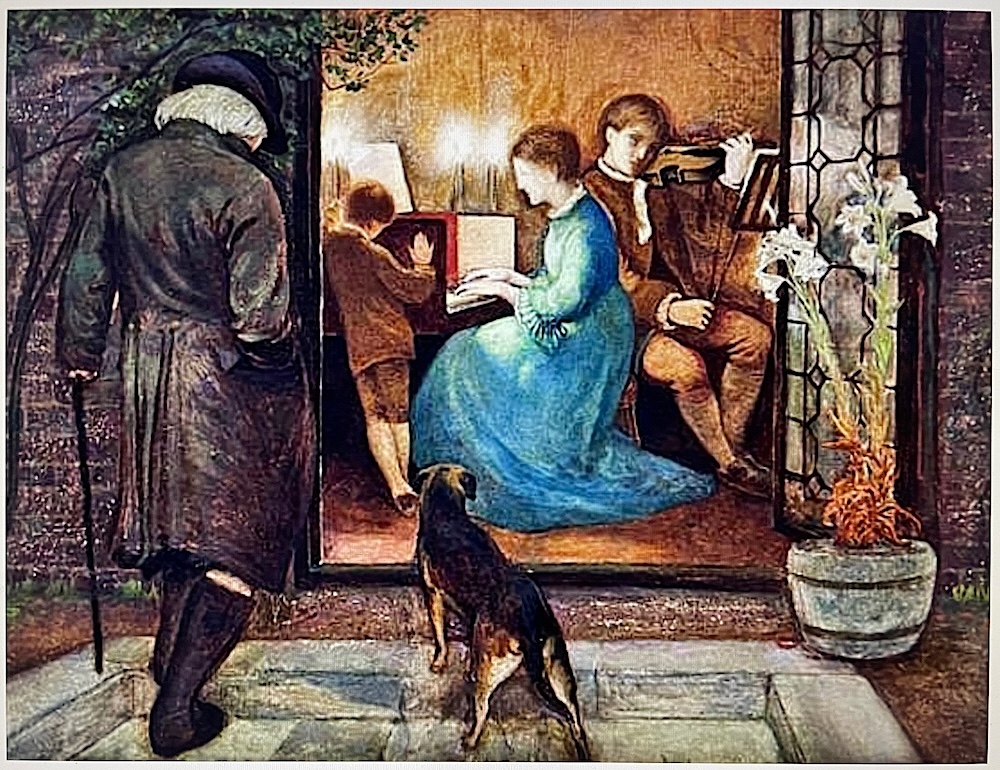
Evensong, by Edward R. Hughes (1851-1914). 1871. Watercolour and gouache on paper laid onto canvas. 9 ½ x 12 ¾ inches (24 x 32.5 cm). Private collection, image courtesy of Martel Maides, St. Peter Point, Guernsey. [Click on the image to enlarge it.]
Evensong in the Anglican church is the choral or sung version of evening prayers, which prior to the Reformation was the English name for the service of Vespers. Hughes exhibited this work entitled Evensong at the General Exhibition of Water Colour Drawings at the Dudley Gallery in 1871, no. 530. It shows an elderly gentleman, head bowed and with a cane in his left hand, approaching the entrance to a house accompanied by his dog. Three young people, including a young woman in a blue dress at a harpsichord and a young man playing the violin, are performing music by candlelight. A tapestry hanging on a wall appears to form the background. A pot containing white lilies, one of the major symbols associated with the Aesthetic Movement, lies in front of a leaded glass door at the entrance to the house.
Evensong is typical of works by members of the Poetry Without Grammar School that were exhibited at the Dudley Gallery and reflects the influence on Hughes, not only of Pre-Raphaelitism but the nascent Aesthetic Movement. Although Hughes was not mentioned by Walter Crane in his Reminiscences as being a "formal" member of this clique, Crane did mention him as being "another of our early friends (88). This watercolour was certainly influenced by one of the Dudley's principal contributors, Hughes's friend Simeon Solomon. Solomon had exhibited his Prelude to Bach [A Song] at the Dudley Gallery in 1869, no. 315, which features figures in eighteenth-century costume gathered round to listen to a young woman at the piano. This type of subject obviously appealed to Hughes because in 1870 he had exhibited The Spinet at the Royal Academy, no. 551, a small watercolour depicting a little girl playing music in an interior, watched over by a young woman (Osborne 12). Interestingly the same year Hughes exhibited Evensong at the Dudley Gallery, Thomas Armstrong showed a similar composition A Drawing Room at the Royal Academy, no. 544, showing a young priest playing a piano and watched over by two young women. This work is another good example of the early Aesthetic Movement. When Evensong was shown at the Dudley in 1871 it was ignored by the critics, likely because Hughes was a largely unknown artist aged only nineteen.
Bibliography
Crane, Walter. An Artist's Reminiscences. London: Methuen & Co., 1907. 86-88.
Family Tett Catalogue Sale. St. Peter Point, Guernsey: Martel Maides (May 19, 2012): lot 330.
Lanigan, Dennis T. "The Dudley Gallery Water Colour Drawings Exhibitions 1865-1882." The Journal of Pre-Raphaelite Studies XII (Spring 2003): 74-96.
Osborne, Victoria Jean. A British Symbolist in Pre-Raphaelite Circles: Edward Robert Hughes RWS (1851-1914). M. Phil. thesis, University of Birmingham, 2009, 15.
Created 2 May 2026