
With special thanks to Professor François Grosjean for introducing me to the story of the Gunhilda. Professor Grosjean is the great-grandson of Gustavus Pratt, one of the two original owners of Cox & King in the Victorian period; see the bibliography for his presentation on the company, and the other luxury yachts in its listing.
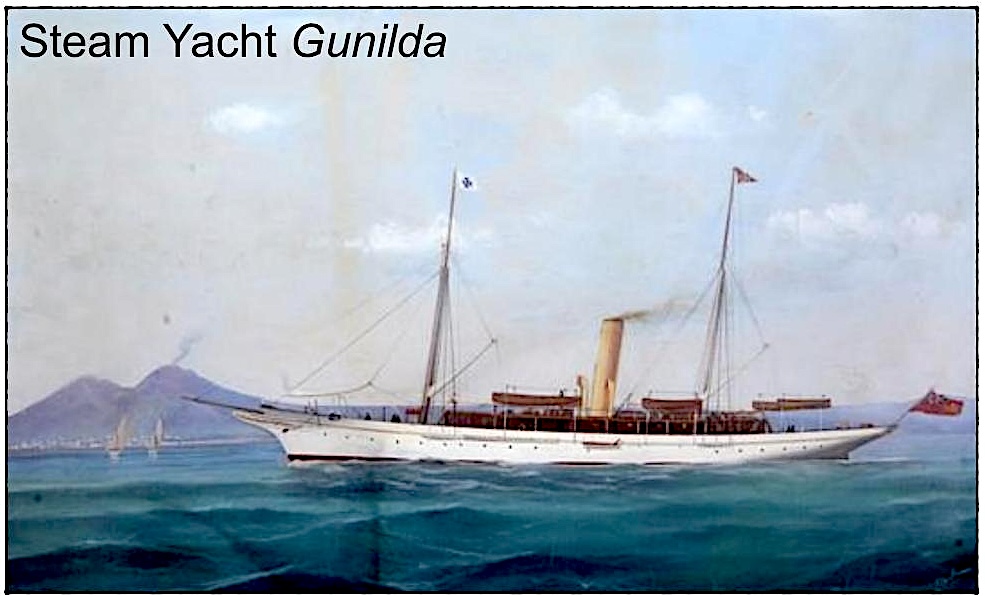
The sailing yacht Gunilda was built by Ramage & Ferguson in Leith, Scotland, "to the order of Messrs A.R. and J.M. Sladen, Windermere" and, as noted in the Marine Engineer and Motorship Builder of 1 May 1897, was launched from the shipyard at Leith on 1 April that year. [Image source, Log Book, p. 9.]
This was a state of the art vessel in every respect. It was designed for the firm of Cox & King, which had its London headquarters in Pall Mall. Under the ownership of Gustavus Pratt and Sidney Depree, the firm had first appeared in the Lloyd's Register of Yachts in 1878. Besides its London offices, Cox & King had offices in Wivenhoe, Essex, where the yachts were fitted out — later, yachts would be built there as well, but, as noted above, the Gunilda was built in Scotland. Its precise specifications are given in its catalogue: at 499 (492) tons, it was 59 meters (195') long. However, the former figure is queried by Scott McWilliam, who believes that the calculation may have been based on Thames River tonnage, a way of measuring that means it differs markedly from figures given later on the other side of the Atlantic (see McWilliam 7).
Cox & King's naval architect, Joseph Edwin Wilkins, was at the top of his profession: he can be found participating at some length in a highly technical discussion following two other members' papers in the Transactions of Institution of Naval Architects in 1907 ("Discussion," p. 138). Moreover, the firm was supplying customers at the highest end of the market: Alfred Rayner Sladen (1866-1944) and John Mortimer Sladen (1868-1943) were wealthy brothers, the former himself a "talented and noted yacht designer," and the latter a highly successful yachtsman, who would become Commodore of the Royal Windermere Yacht Club in 1900. So the Gunilda was an outstanding example of its kind:
The yacht is built of steel to the highest class at Lloyd's, and has triple-expansion engines of the builders’ make, supplied with steam from two boilers, and all designed to propel her at a high rate of speed. The accommodation is very large for a yacht of this size, comprising dining, drawing, and smoke rooms on main deck, with promenade deck above, while on lower deck a large number of state rooms are placed for owners ond their friends. [Marine Engineer, 73]
Steam Yachts
Yachting was popular in Victorian England. There was some resistance to the steam yacht, but its progress could not be stalled. Sir Edward Sullivan, authority on yachting, wrote in the introduction to his book,
One of the objects of the Royal Yacht Squadron, when it was originally founded, was to encourage seamanship, and, as steam was supposed to destroy seamanship, steamers were not admitted into the Club; and the Royal Yacht Squadron was right. Steam does destroy seamanship; a steamship hand is certainly not half a sailor. Now more than half the tonnage of the Club is in steamers.
Sullivan himself could not be won over to this new development:
I think it is a pity, and they are such steamers too! 800 tons, 1,000 tons, 1,500 tons. I do not see where they are to stop; but, I believe that in this, as in most things, we have run into excess. I cannot believe that the largest steam yacht afloat, with all the luxury and cost that upholsterers and cabinet-makers can devise, will ever give a man who is fond of the sea and seafaring matters a tithe of the gratification that a 100-ton sailing vessel will afford; one is a floating hotel, the other is a floating cottage. I prefer the cottage.
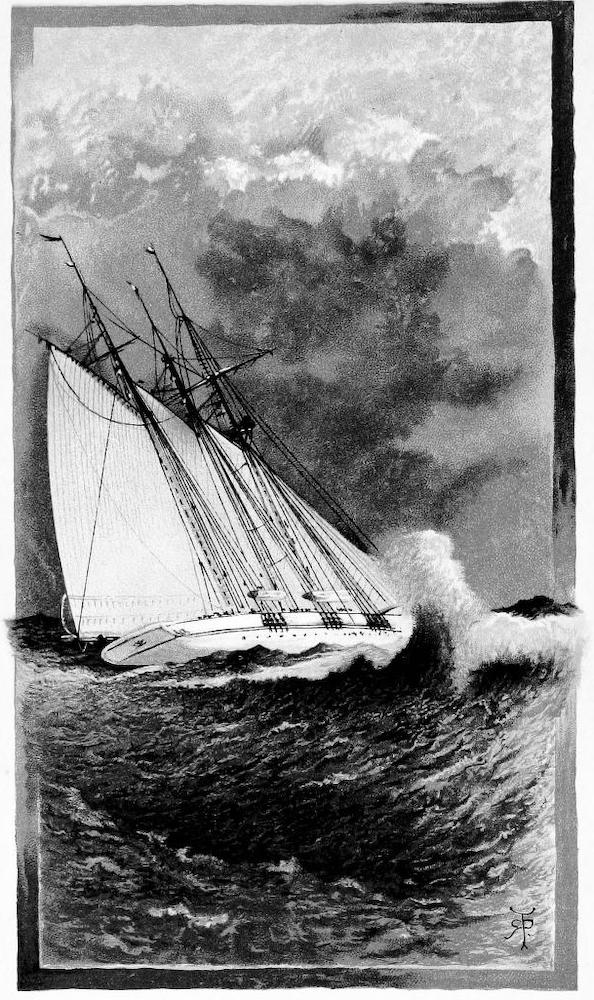
He was right to describe such yachts as the Gunilda as floating hotels. There are some wonderful records of life aboard them. A notable example is Annie Brassey's account of her eleven-month circumnavigation of 1876-77 on the Sunbeam (shown on the right here, in R.T. Pritchett's illustration from a later voyage, on which he accompanied the Brasseys): "We were forty-three on board, all told.... We had with us, besides, two dogs, three birds, and a charming Persian kitten belonging to the baby" — although the kitten was soon lost (2). It was a home away from home for an extended period. But for all the Sunbeam's enhanced capabilities and residential comforts, Brassey certainly felt the romance of sails: "On the morning of the 6th a light breeze sprang up, and enabled us to go through the Needles [off the Isle of Wight] with sails up and funnel down, a performance of which all on board felt very proud, as many yachtsmen had pronounced it to be an impossibility for our vessel to beat out in so light a breeze" (2).
The Fate of the Gunilda
Yet, after all, these high-performace yacht "hotels" were operating on the sea, and the sea could be inhospitable. After fourteen years afloat, the Gunilda sank in Lake Superior in 1911 — to appear, in the same Cox & King listing as its specifications, as a "[s]plendid wreck often visited by divers." The events leading up to its fate started in 1901, as the Victorian period gave way to the Edwardian.
In the Cox & King list of vessels, later owners of the yacht are named as F. Sykes (England) & W. Harkness (New York). Little is known about Sykes, but the change to American ownership followed the chartering of the yacht by a member of the New York Yacht Club. Having made the long voyage over the Atlantic, the vessel was acquired by William L. Harkness (1858-1919), who had inherited his fortune from Standard Oil. The yacht now became the flagship of the New York Yacht Club. Harkness was in command of the vessel when it was grounded on a reef whilst sailing on the vast freshwater lake that stretches between America and Canada, a catastrophe blamed by others, like Vicki Banning, on Harkness's own "ill-advised decisions." No one was hurt but the yacht sank during attempts to salvage it. The accident was widely reported, as in the following account in the Marine Review of October 1911:
The loss of Wm. L. Harkness’ yacht, the Gunilda, was one of the most singular that has happened on the lakes. This yacht stranded on a reef in Nipigon Bay, north of Copper Island, and the tug James Whalen with a wrecking crew outfit was sent to her relief from Port Arthur. The Gunilda was found to be resting on the reef about 80 ft. from the stem, at which point there was about 5 ft. of water. The fore end of the keel was out about 5 ft. and about 80 ft. of the forward part of the yacht was unsupported. The yacht was drawing water aft well up to her deck, but was resting easy. The wreckers began operations about six o’clock on the morning of Aug. 3rd, carrying a 12-in. hawser around the yacht, passing through the hawse pipe and being fastened to the fore bitts. The wreckers’ steel towing cable was made fast to the after end of the hawser and two other lines were made fast to the wrecking tug’s bitts and the after bitts of the Gunilda on each side. An attempt was made to pull the vessel astern without success, but the Gunilda’s stern swung somewhat to port. When the lines were readjusted and further effort made to pull her astern, instead of leaving the reef she listed heavily to starboard, submerging her bulwarks and filling the house and after end with water. In about 15 minutes it was observed that the extra weight aft was gradually lifting the bow into the air and in a little while she slipped over the reef, stern first, and disappeared in 300 ft. of water. All that was saved was the portable equipment on deck which floated off as she went down, including naphtha launches, cutter, sail boat and dinghey and steamer chairs. [375]
Gunilda Today
Wretched as all this was, the shipwreck had one positive result. Located in 1967, it turned out to have been very well preserved. This is a boon for those interested in naval architecture, because, as MacWilliam explains, only a limited number of such luxury steam yachts were built, and the others "were scrapped, modified or lost during the various wars," while the Gunilda itself, albeit resistant to salvaging and still submerged in the waters of Lake Superior, "remains structurally and contextually intact" — making it "the last known example of the great age of steam yachts" (1).
Related Material
Bibliography
Banning, Vicki. "Gunilda's Life on the Water." Northern Ontario Travel: The Official Magazine. 23 May 2025. Web. 1 June 2026. https://northernontario.travel/superior-country/steam-yacht-gunilda-history
The 1913 Cox & King Catalogue of Yachts and Motor Boats. Web. 1 June 2026. https://www.francoisgrosjean.ch/cox_and_king/index.html
Grosjean, François (with the help of Paul W. Gockel and Wendy Schnur). "A Brief Presentation of Cox & King Yacht Brokers, Surveyors and Designers." Web. 1 June 2026. https://www.francoisgrosjean.ch/cox_and_king/presentation.html
"Launches — Scotch." The Marine Engineer Vol. XIX (April 18977-March 1898). 1 May 1897: 72-74. Google Books. Web. 1 June 2026.
Log Book of the USS Essex, November 21, 1902-July 18, 1903 (#50). Maritime Heritage Minnesota, Ann Merriman, Christopher Olson. Published in 2019. Reproduced under the terms of the Attribution-NonCommercial-NoDerivatives 4.0 International CC BY-NC-ND 4.0 Deed. Internet Archive. Web. 1 June 2026.
"Loss of the Gunilda." Marine Review. Vol.41 (October 1911): 375. Internet Archive. Web. 1 June 2026.
McWilliam, Scott. "Gunilda Revised." Academia. Web. 1 June 2026.
Sullivan, Sir Edward. Yachting, Vol. 1. Project Gutenberg. Web. 1 June 2026.
Transactions of the Institution of Naval Architects Vol. XLIX (1907): xiv and 138. Web. 1 June 2026.
Warburton, Jean. "John Mortimer Sladen (1868-1943)." Cumbrian Lives. Web. 1 June 2026.
Created 1 June 2026