

The following biography is an extract from Dr Hyland's "One Time Partners/Collaborators of E.W.Pugin," an article in a special issue of True Principles: The Journal of the Pugin Society (Vol. 5, no. 5 (Spring 2020): 237-244) devoted to "The Life and Works of E.W. Pugin." It has been slightly adapted for our own website, principally by the addition of sub-headings, links, and the incorporation of its footnotes.
A.W.N. Pugin's influence spread not only from his own oeuvre, but from the works of his successors, working together or with their like-minded contemporaries. One of the most able of these was G.C. Ashlin, later to become President of the Royal Institute of Irish Architects. As Professor Hyland explains, the last surviving partner of Pugin & Pugin, Charles Henry Cuthbert Purcell (1874-1958, a grandson of A.W.N. Pugin himself) was trained in Ashlin's office. — JB
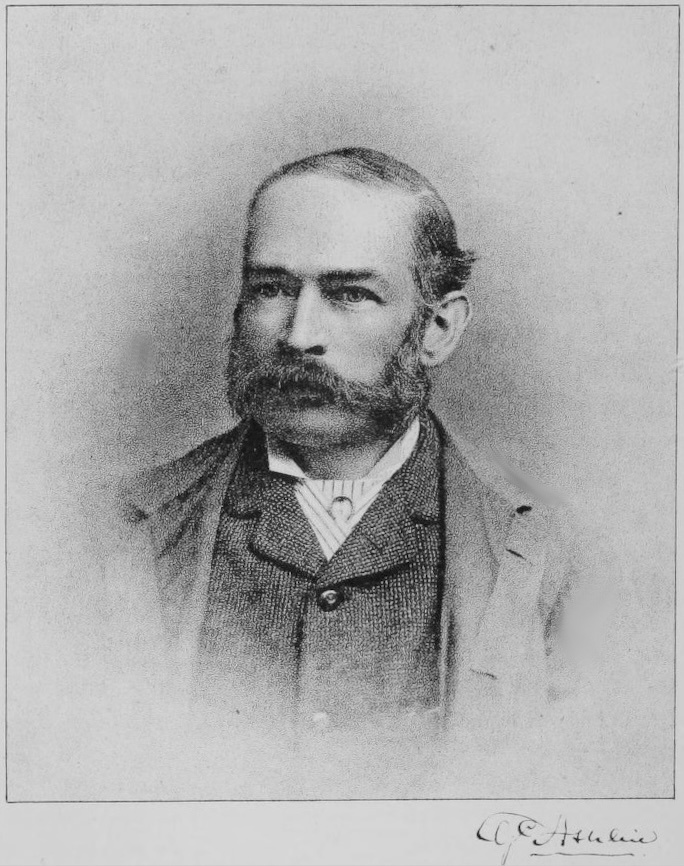
eorge Coppinger Ashlin (1837-1921) was born on 28 May 1837 at Carrigrenane, Co. Cork, the third and youngest son of John & Dorinda (née Coppinger) Ashlin. He was educated first in Liège, Belgium (1850-51), and thereafter at St Mary's College, Oscott, near Birmingham. He left Oscott in 1855, and became articled to E.W. Pugin (1834-1875) the following year.
The Pugin Connection
E.W. Pugin probably knew of Ashlin through A.W.N. Pugin's influential connections in Counties Cork, Waterford & Wexford, such as the uncle of Lord Shrewsbury's wife, John Hyacinth Talbot of Co. Wexford who was a son-in-law of Sir John Power Bt., two of whose other daughters were married to Ashlin's maternal (Coppinger) uncles. It is possible that Power commissioned A.W.N. Pugin to design his domestic chapel at Edermine, Co. Wexford, the realisation of which after the deaths of both A.W.N. Pugin and Power fell to E.W. Pugin during 1858-59, after the baronetcy had passed to Sir John's son James in 1855. Another connection was via Lord Midleton who commissioned work from A.W.N. Pugin both on his English estate in Surrey at Peper Harow, and in Midleton, Co. Cork, where the Coppingers had business interests, and where the future Bishop of Cloyne, Dr William Keane had been Parish Priest during the 1840s; later as Bishop of Cloyne (1857-74), Keane was responsible for aggrandising the elevations of Cobh cathedral.
In 1856, Ashlin moved with E.W. Pugin from Birmingham to London (where Ashlin's family were then resident), entering the Royal Academy Schools in March 1858.
Around this time, E.W. Pugin obtained the prestigious commission for the church of Ss. Peter & Paul in Cork, Co. Cork, a parish with which the Coppinger family was much involved, but being aware of the difficulties his father had experienced in controlling his Irish commissions decided, in 1860, to send Ashlin to Dublin (upon completion of his articles) to set up an office at 90, St Stephen's Green South, Dublin (in use from 1861-79) from where the commission could be managed. Later the same year, having secured a commission to design another large church - this time in Dublin for the Augustinians - he decided to take Ashlin into partnership with him, under the style Pugin & Ashlin, although the partnership applied only to work Ireland.
Pugin and Ashlin
The Builder of 26 May 1860, reporting on the Royal Academy Exhibition of that year, states: "The view of St. Augustine's Church, Dublin," exhibited by Mr E.W. Pugin, represents a design by Messrs Pugin & Ashlin." E.W. Pugin's earlier partnership with James Murray (1831-1863) had ceased in December 1858. In its eight years of existence, the Pugin & Ashlin partnership was involved in at least 40 projects exclusively in Ireland, including some 26 places of worship (cathedrals/churches/chapels), all but seven of which were built (but not always to the original design - e.g. the church at Monkstown, Co. Cork).
However, within one year of Pugin & Ashlin's obtaining their most prestigious commission in 1867, St Colman's Cathedral in Cobh, and within one year of his marriage to E.W. Pugin's youngest sister, Mary, on 27 November 1867 at St Augustine's, Ramsgate, Ashlin decided, in August 1868, to terminate the partnership and to practise on his own account. The first mention of a work by Ashlin alone would appear to be in the Irish Builder [Vol. X] of 1 December 1868, in connection with his modified design of an earlier projected one by Pugin & Ashlin for a church in Brosna, Co. Kerry, dating from 1866. On 1 September 1869, it was announced in the Irish Builder that a church in Crosshaven, Co. Cork, for which Pugin & Ashlin had submitted plans in July 1868, was now to be built, to a different design of E.W. Pugin's alone under the superintendence of his new Irish representative W. Collingridge Barnett (1845-1923).
Despite the dissolution of their partnership, some kind of informal working arrangement was maintained in order to progress the Augustinian church in Dublin and Cobh Cathedral. Around 1876, after the death of E.W. Pugin, Ashlin went into partnership (until c.1880) with C.W. and P.P. Pugin under the style Pugin, Ashlin & Pugin, who oversaw, in the UK, the execution (to their own design) of a number of projects that had originated with E.W. Pugin, such as the OMI church in Kilburn [Sacred Heart, Quex Road, for the Oblates of Mary Immaculate], and the Franciscan Church in Glasgow [St Francis, Cumberland Street, in the Gorbals]. Just as the original Pugin & Ashlin partnership applied only to works in Ireland, so that of Pugin, Ashlin & Pugin was confined to work in the UK. The latter partnership lasted only until about 1880, when Ashlin left to concentrate on his extensive practice in Ireland, after which the firm became Pugin & Pugin, the architecturally active partner being Peter Paul Pugin, with his half-brother Cuthbert effectively a "sleeping" partner.
Ashlin and Coleman
In 1903, Ashlin went into partnership with his former pupil and manager Thomas Aloysius Coleman under the style Ashlin & Coleman: this was the partnership that replaced Pugin & Ashlin's originally projected spire of Cobh Cathedral with a design of their own, which was the one actually built, 1911-14. Ashlin's nephew and former pupil, Stephen Martin Ashlin, joined them as a partner in 1911. Note, however, that by 1880, Ashlin had exhausted his Gothic repertoire, and thereafter confined himself to Romanesque. He was elected President of the Royal Institute of Irish Architects in 1902, and died on 10 December 1921 in the house he had designed for himself at Killiney, Co Dublin.
The Last Partner: C.H.C. Purcell
Charles Henry Cuthbert Purcell (1874-1958) - a grandson of A.W.N. Pugin - was trained in Ashlin's office. The last surviving partner of Pugin & Pugin, he was the son of Henry Francis Purcell (d.1877), a barrister-at-law who represented E.W. Pugin on at least one occasion, and his wife, Margaret, A.W.N. Pugin's daughter by his third wife, Jane (née) Knill. Pursuing his grandfather's career rather than his father's, Charles Henry joined Pugin & Pugin around 1899, and became a partner (with Sebastian Pugin Powell) in 1919. After the latter's death in 1949, Purcell continued Pugin & Pugin until his death in 1958, after which Pugin & Pugin ceased to exist. He was the architect of numerous Catholic churches in England and Scotland, including the post-World War II replacement (1952-54) of E.W. Pugin's church of Holy Cross in Liverpool, which had been destroyed by bombing; he had earlier designed altar-rails for three other Merseyside churches by E.W. Pugin.
Related Material
- Gerard Hyland's The Life and Works of E.W. Pugin, Architect, 1834-75 [Review]
- Catriona Blaker's Edward Pugin and Kent: His Life and Work within the County [Review]
Bibliography
"Ashlin, George Coppinger." Dictionary of Irish Architects. Web. 14 June 2026.
"Death of Mr George C. Ashlin, RHA." Irish Builder. Vol. 63 (1921): 841. Google Books (unfortunately, only snippet view). Web. 14 June 2026.
Dunne, M. The Early Career of George Coppinger Ashlin (1859-1869): Gothic Revival Architect. Thesis submitted to the University of Dublin for the Degree of Master of Letters, 2001.
"G.C. Ashlin, RHA. Architect of Queenstown Cathedral." The Building News Vol. 58 (January-June 1890): following p. 332 (portrait source). Web. 14 June 2026.
"New Crosshaven Church." Irish Builder. Vol. XI (1869): 205. HathiTrust, from a copy in the library of the University of Illinois — Urbana-Champaign. Web. 14 June 2026.
O'Dwyer, F. "A Victorian Partnership - The Architecture of Pugin & Ashlin." 150 Years of Architecture in Ireland. Edited by J. Graby. Dublin: RIAI & Eblana Editions, 1989.
The Tablet. Vol 33 (30 November 1868): 763.
Created 16 June 2026