
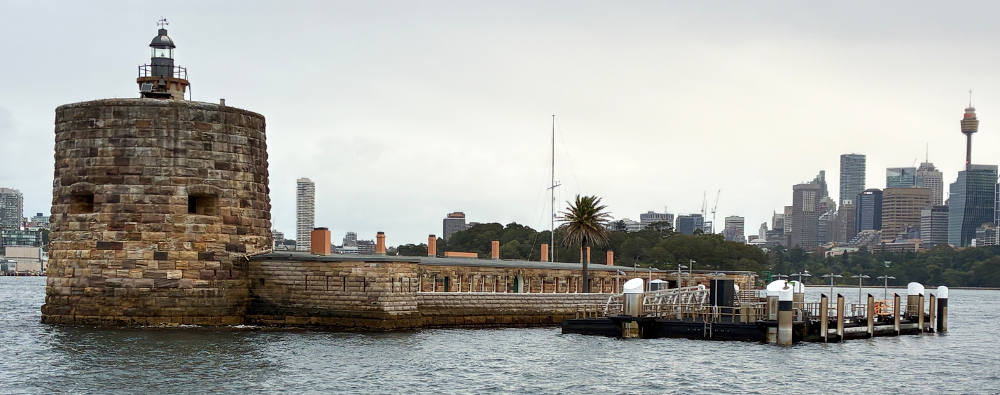
Fort Denison, located on a small island at the mouth of Sydney Harbour, features the only Martello tower built in Australia, and the last such coastal defensive tower constructed in the British Empire from 1794 during the Napoleonic Wars.
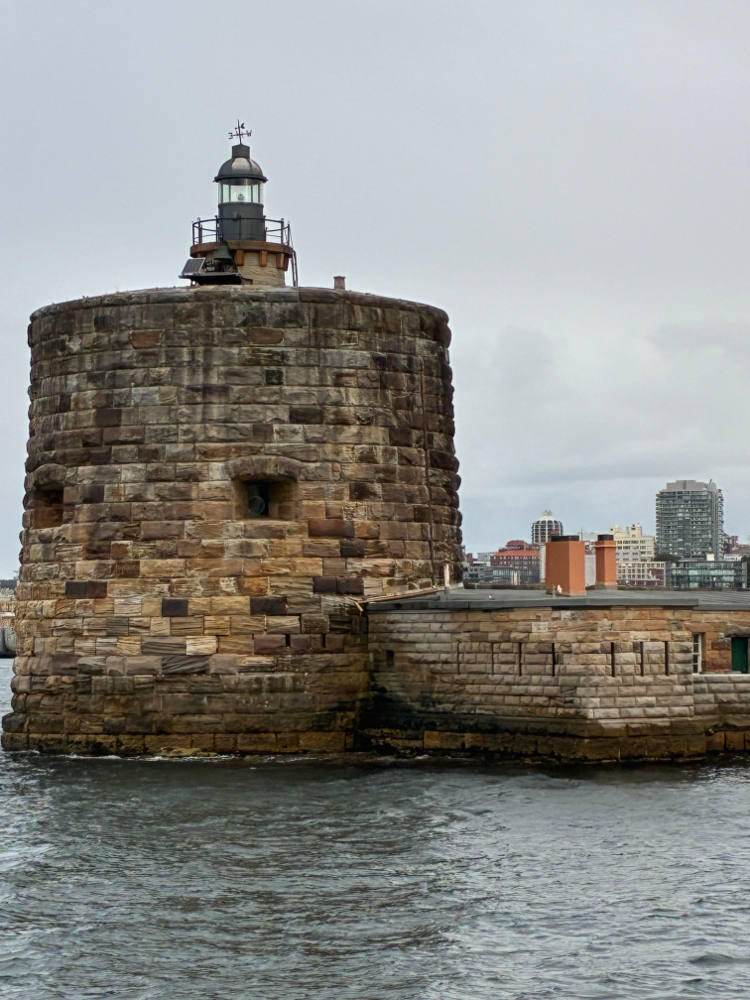
Closer view of the tower.
In the indigenous Eora language, the site was probably named "Mat-te-wan-ye" or "Muddawahnyuh." But after the arrival of the first fleet from Britain in 1788, Governor Phillips named the 15-metre outcropping "Rock Island." It was levelled, and its first use was to maroon prisoners, partly as punishment and partly to protect the wider settlement. At that point it earned the name "Pinchgut Island," partly, it seems, from its narrowness, and partly from the prisoners' privations. However, the arrival of two American men of war by night in 1839 led to concern about foreign attack, and triggered an immediate review of the harbour's defences. Named after William Denison (Governor of New South Wales 1854-61), Fort Denison was then developed for defensive purposes by Wolverhampton-born military engineer George Barney (1792-1862), who had arrived in New South Wales in late 1835, eventually to become Surveyor General there.
The fortress was constructed of native sandstone, at first mined from the levelling of the land there, mostly by the prisoners themselves. Work proceeded under the supervision of another of the early arrivals who made important contributions to New South Wales: William Randle (1826-1884). Randle was "responsible for crucial infrastructure in the 1850s including water storage, the first railway and the defences on Fort Denison" ("Randle, William"). Fear of a Russian attack during the Crimean War hastened the completion of the project, and the fort opened on 14 November 1857.
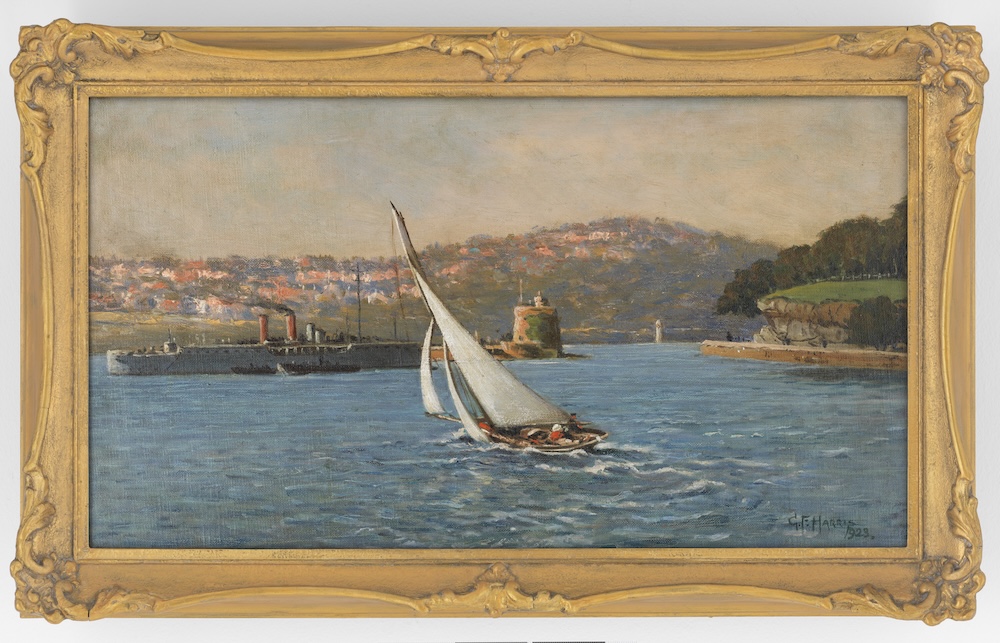
[Fort Denison], 1923, an oil painting by George F. Harris (1856-1924, who emigrated to Australia only in 1920). Out of copyright, credit: Dixson Galleries, State Library of New South Wales, IE8954386 F.
Thanks to developments in naval artillery, the fort soon became obsolete, and was never put to use in any hostilities. During World War II the tower was damaged by friendly fire from the USS Chicago while it was firing at attacking Japanese submarines in 1942. But it still serves a useful purpose today, by monitoring the tides. It is also a popular tourist attraction, housing a museum and restored cannons (two ten-inch guns and twelve eight-inch pounders). It also provides a spectacular 360-degree view of Sydney harbour from the tower.
Related Material
- A Martello Tower is seen on the left of Felix Darley's The Rehearsal, as part of the stage scenery for the Crummles' colonial-themed ballet in Nicholas Nickleby
- Trial Bay Gaol in New South Wales, where prisoners were also sequestered
Photographs and text by Philip V. Allingham, with additions by Jacqueline Banerjee. [You may use the images without prior permission for any scholarly or educational purpose as long as you (1) credit the photographer and (2) link your document to this URL in a web document or cite the Victorian Web in a print one.]
Bibliography
"Barney, George." The Dictionary of Sydney. Web. 25 February 2025. https://dictionaryofsydney.org/person/barney_george
"Centenary of Fort Denison." Monument Australia. Web. 25 February 2025. https://www.monumentaustralia.org/themes/landscape/settlement/display/23182-centenary-of-fort-denison
Ellmos, Laila. "Fort Dennison." The Dictionary of Sydney. Web. 25 February 2025. https://dictionaryofsydney.org/entry/fort_denison
"Fort Dennison." Muddawahnyuh. NSW National Parks. Web. 25 February 2026. https://www.nationalparks.nsw/gov.au/things-to-do/historic-buildings-places/fort-denison-muddawahnyuh
"George F. Harris." Coogee Media. Web. 25 February 2026.http://coogeemedia.com.au/harris.htm
"Randle, William." The Dictionary of Sydney. Web. 25 February 2025. https://dictionaryofsydney.org/person/randle_william
Created 27 February 2026
Last modified 17 March 2026