
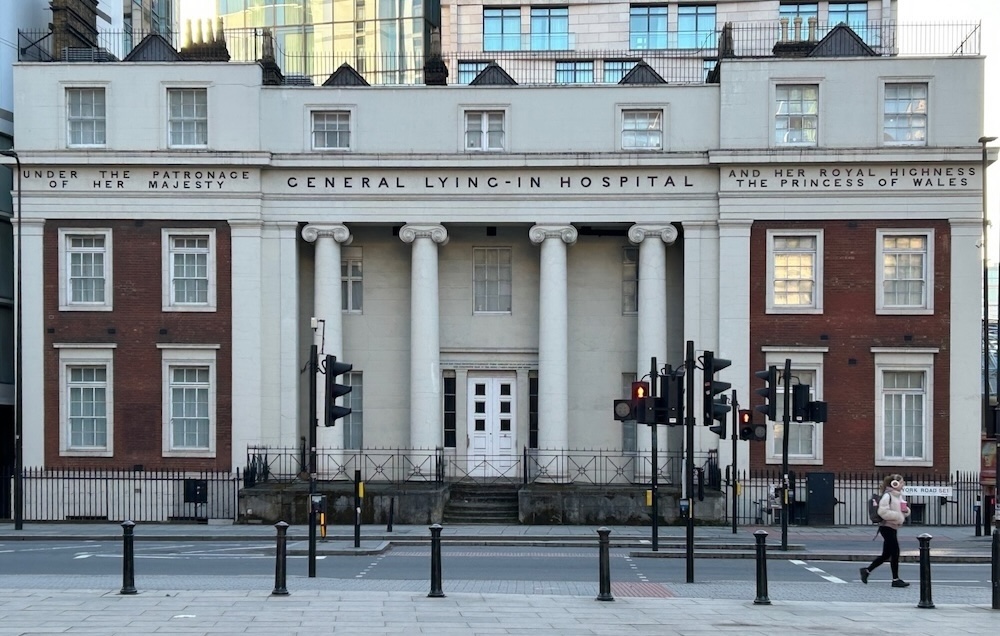
The General Lying-in Hospital, designed by Henry Harrison (c.1785-c.1865), opened in 1828 as the Westminster Lying-in Hospital, on the east side of York Road, not far from either Waterloo Station or St Thomas's Hospital. Photograph by Tim Willasey-Wilsey. [Click on the image to enlarge it.]
This is a neoclassical two-storey red-brick building with a basement below and attic above. The listing text describes it as having "7 windows on west front... with stuccoed attic storey above entablature, and having a stuccoed recessed 3-bar centre, treated as full height tetrastyle Ionic portico in antis" with "[s]tuccoed pilasters at angles of side sections." Prominently inscribed on the frieze are the words,"GENERAL LYING-IN HOSPITAL, UNDER THE PATRONAGE OF HER MAJESTY AND HRH THE PRINCESS OF WALES." A striking feature is the porticoed feature at the top of a wide flight of steps. It has to be added, though, that architectural historian Howard Colvin dismissed the building as one of those "typical of the somewhat tame Greek Revival style" that Harrison "favoured in the 1820s" (392).
The project to provide maternity care for indigent and perhaps "fallen" women, in what was termed "the Surrey side of Westminster bridge" was a charitable one, initiated by Dr John Leake (1729-1792), a physician specialising in midwifery, who had acquired a plot of land there for that purpose. The eighteenth-century fund-raising pamphlet explained:
The Institution of this Charity is principally designed for the Relief of those Child-bearing Women who are the Wives of poor industrious Tradesmen or distress'd House-keepers who, either from unavoidable Misfortunes or the Expense of maintaining large Families, are reduced to real Want: Also for the Reception and immediate Relief of indigent Soldiers and Sailorswives, the former, in particular, being
very numerous in and about the City of Westminster but it being represented to the
Governors of this Hospital, that great Hardships do arise to poor Women with Child,
who, from their Inability to produce Certificates of their Marriage are excluded elsewhere; in order to remove such Inconveniences, and to render this Charity more extensively useful they have unanimously resolv'd, at a General Meeting not to require
any Certificates of Marriage towards the Admission of such Women, as are otherwise properly recommended as Objects of real Want; — but lest the Perversion of this
Circumstance should tend to encourage Licentiousness
It is much to be lamented, that many >extreme Poverty, and the high Price of Provisions, are often bereft of such Comforts as tend to the immediate Preservation of their own Lives, as well as those of their Infants, who might, in due time, become serviceable to their Country.
The appeal was successful and the hospital opened on its first site in Westminster Bridge Road in 1767, operating there until the lease was due to run out and another plot of land was acquired, at which point the new hospital was built. The biggest name associated with it in Victorian times was that of Joseph Lister, who became its consulting surgeon in 1879, and introduced antiseptic conditions for deliveries, a big step forward in midwifery practice. Looking back in the British Gynaecological Journal of 1897, the outgoing President, Clement Godson, noted approvingly that in 1883, "342 women were confined, of whom 3 died (1 in 114), 2 from septicemia, quite independent of one another," and reported the committee's wish to "tender their congratulations to the eminent surgeon to the hospital, Sir Joseph Lister, Bart., to whom this and other institutions are so much indebted for the satisfactory medical results obtained through the system with which his name is associated” (524).
In the next century, after the Second World War, the now greatly extended facilities of the hospital were incorporated into nearby St Thomas's. It continued to be employed sd the larger hospital's maternity wing up until 1971. After its role was completely taken over by St Thomas's, the (to the present writer's mind) rather fine building was rescued from dereliction and is now in use not as a hospital, but as a hotel.
Bibliography
An account of the Westminster New Lying-in Hospital, begun and finished under the patronage of the Right Honorable Earl Percy, president.... London: 1768. Internet Archive, from a copy in the US National Library of Medicine. Web. 23 May 2026.
Colvin, H.M. A Biographical Dictionary of British Architects, 1600-1840. New York: Facts on File, 1980.
General Lying-in Hospital, York Road, London SE1. Historic England. Web. 23 May 2026.
Godson, Clement. "Valedictory Address." British Gynaecological Journal Vol. 12, no. 48: 513-52. , from a copy in Gerstein, University of Toronto. Web. 23 May 2026.
Last modified 22 May 2026