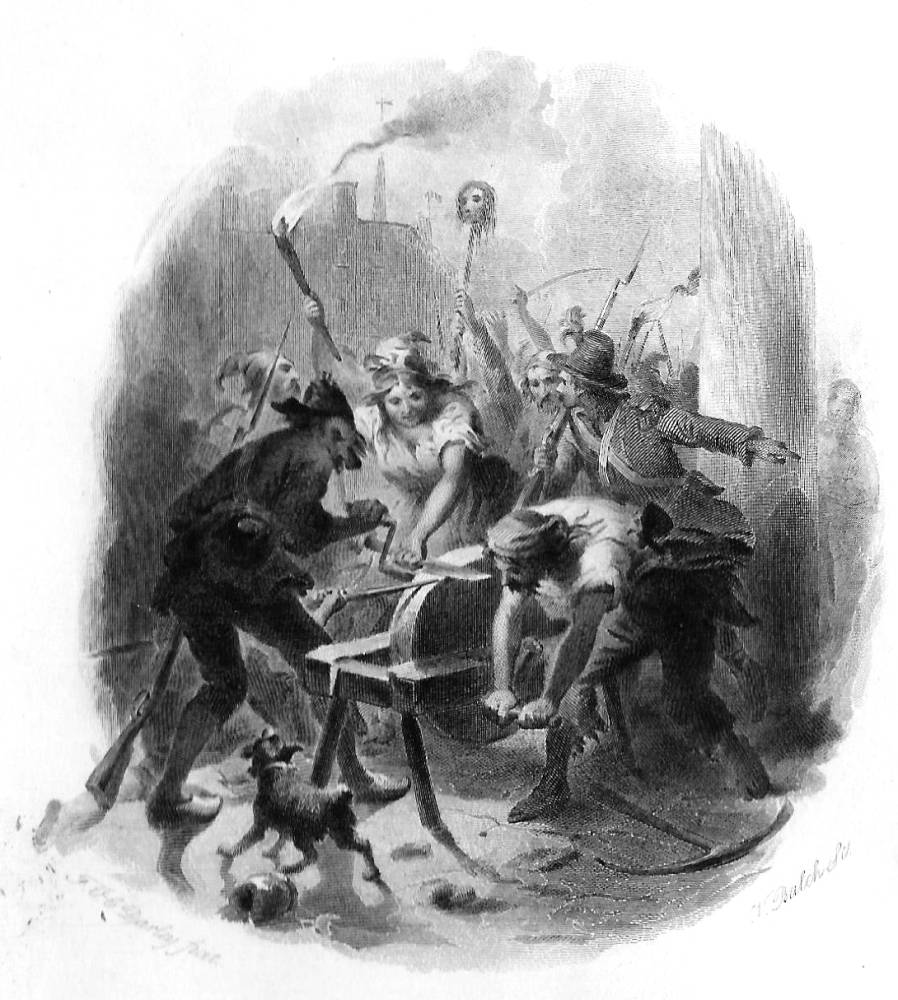
The Grindstone
Felix O. C. Darley
1863
Photogravure
9.5 by 9 cm (3 ¾ by 3 ½ inches) vignetted
Dickens's A Tale of Two Cities, Household Edition, vol. 2: frontispiece.
[Click on the image to enlarge it.]
Scanned image and text by Philip V. Allingham.


[Victorian Web Home —> Visual Arts —> Illustration —> F. O. C. Darley —> Next]
The Grindstone
Felix O. C. Darley
1863
Photogravure
9.5 by 9 cm (3 ¾ by 3 ½ inches) vignetted
Dickens's A Tale of Two Cities, Household Edition, vol. 2: frontispiece.
[Click on the image to enlarge it.]
Scanned image and text by Philip V. Allingham.
Looked out upon a throng of men and women: not enough in number, or near enough, to fill the courtyard: not more than forty or fifty in all. The people in possession of the house had let them in at the gate, and they had rushed in to work at the grindstone; it had evidently been set up there for their purpose, as in a convenient and retired spot.
But, such awful workers, and such awful work!
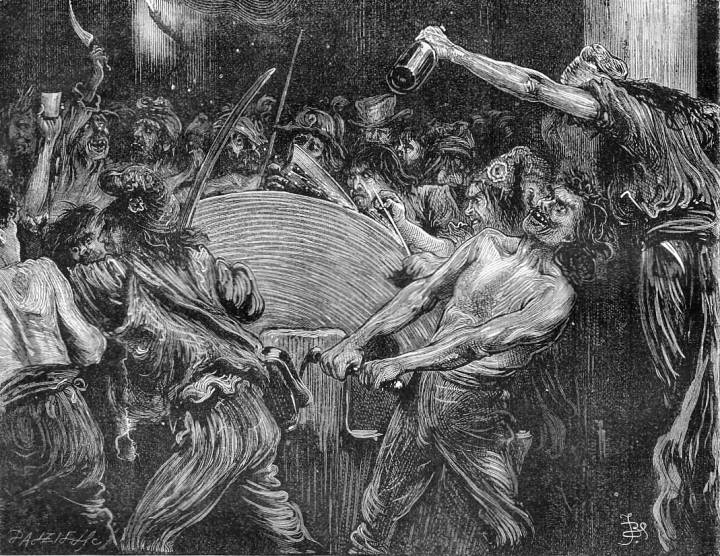
The grindstone had a double handle, and, turning at it madly were two men, whose faces, as their long hair flapped back when the whirlings of the grindstone brought their faces up, were more horrible and cruel than the visages of the wildest savages in their most barbarous disguise. False eyebrows and false moustaches were stuck upon them, and their hideous countenances were all bloody and sweaty, and all awry with howling, and all staring and glaring with beastly excitement and want of sleep. As these ruffians turned and turned, their matted locks now flung forward over their eyes, now flung backward over their necks, some women held wine to their mouths that they might drink; and what with dropping blood, and what with dropping wine, and what with the stream of sparks struck out of the stone, all their wicked atmosphere seemed gore and fire. The eye could not detect one creature in the group free from the smear of blood. Shouldering one another to get next at the sharpening-stone, were men stripped to the waist, with the stain all over their limbs and bodies; men in all sorts of rags, with the stain upon those rags; men devilishly set off with spoils of women's lace and silk and ribbon, with the stain dyeing those trifles through and through. Hatchets, knives, bayonets, swords, all brought to be sharpened, were all red with it. Some of the hacked swords were tied to the wrists of those who carried them, with strips of linen and fragments of dress: ligatures various in kind, but all deep of the one colour. And as the frantic wielders of these weapons snatched them from the stream of sparks and tore away into the streets, the same red hue was red in their frenzied eyes; — eyes which any unbrutalised beholder would have given twenty years of life, to petrify with a well-directed gun. [Book Three, "The Track of the Storm"; Chapter Two, "The Grindstone," vol. 2, 101-102]
This frontispiece refers to the scene in which the mob, in the midst of the September Massacres, sharpens its weapons in the courtyard of Tellson's Bank, Paris. To add to the horror of the snapshot of revolutionary violence Darley has introduced a severed head on a sabre (upper centre), and has a woman jointly commanding control of the grindstone (centre). Unlike Fred Barnard, however, in the 1874 realisation of the scene, Darley does not exaggerate the size of the grindstone or embellish the figures with grotesque touches to intensify the savagery of the mob. However, in overlooking the more gruesome aspects of Dickens's description of the riotous crowd — "Shouldering one another to get next at the sharpening-stone, were men stripped to the waist, with the stain all over their limbs and bodies" — Darley seems to be indulging in a species of censorship, ennobling rather than conveying accurately Dickens's image of these revolutionaries in the bloody September Massacres (1792).
Although all nineteenth-century illustrators of the 1859 novel have at least one scene depicting the atavism of the Saint Antoine mob under the leadership of the Defarges, the original illustrator, Hablot Knight Browne does not depict the grisly scene of the mobile vulgus preparing to slaughter imprisoned aristocrats, the description indicating that the demonic celebrants have already bathed in the blood of their enemies. Savage enough is the behaviour the revolutionaries as they seize the royal financial administrator Foulon at the city hall in Phiz's second illustration for the fifth monthly instalment, The Sea Rises. As in the Household Edition illustration entitled The Grindstone, the breakdown of civil authority has liberated the most savage impulses of wretched St. Antoine's working-class men and women alike.
Two of the book's initial American illustrators, John McLenan and Sol Eytinge, Jr., have included realisations of scenes of mob violence in their narrative-pictorial sequences. Whereas the weekly instalments in All the Year Round have no illustrations whatsoever, the weekly instalments in Harper's Weekly: A Journal of Civilization have at least two illustrations each, usually a regular wood-engraving (which becomes in the T. B. Peterson volume a full-page illustration) and a headnote vignette, a situation which gave McLenan the flexibility to alert the reader to an important event in the week's instalment as well as to realise a significant moment in the action. Thus, for Book Three, Chapter Two (1 October 1859), McLenan depicts the weapon-sharpening scene outside Tellson's with vigour, as fully-clothed but burly and uncouth sans-culottes utilize the grindstone, in contrast to the tranquil scene of Lucie and her daughter, possible objects of anti-aristocratic and xenophobic mob violence, in the uncaptioned headnote vignette; on the facing page we have the all-male crowd sharpening sabres (presumably part of the arms cache seized at the Bastille). In particular, one masculine arm holds aloft a blood-drenched blade (centre). Using this same organizational strategy, Darley places a severed head atop a sabre or sword blade in much the same position. However, Darley's insurgents, shown against a smoky urban backdrop, are less heavy in limbs and more refined in their features — indeed, the uniformed man in the hat implies the participation of bourgeoisie in the affair. In short, Darley gives us ordinary people, transformed by circumstance and license into sadistic killers, whereas McLenan makes his homicidal horde into more primitive types. Darley's characters are more dynamic, caught in the midst of action, as heads and weapons, emerging in the background, add to the impression of chaos and confusion.
The most emotionally charged version of this horrific scene occurs in Fred Barnard's illustrations for the 1874 Household Edition of the novel. Vividly realising the scene as Dickens describes it, Fred Barnard surrounds an oversized grindstone with savage, sharp-toothed revellers, half-naked and crazed by drink; such visual distortion amounting to editorial hyperbole also occurs in Sol Eytinge, Junior's image of mob violence, The Vengeance as he has transformed the grocer's drum-beating wife into an ogress, goggle-eyed, fearsome, and blood-thirsty. The reasonable and realistic Darley fails to capture this "night side" of the scene of impending violence and retribution, despite his Rembrandtesque shadows and smoking torch.
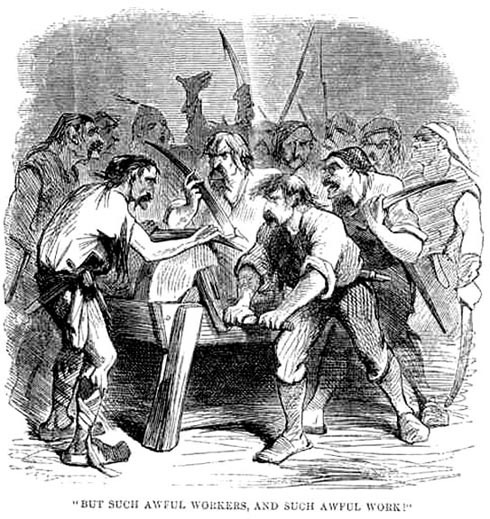
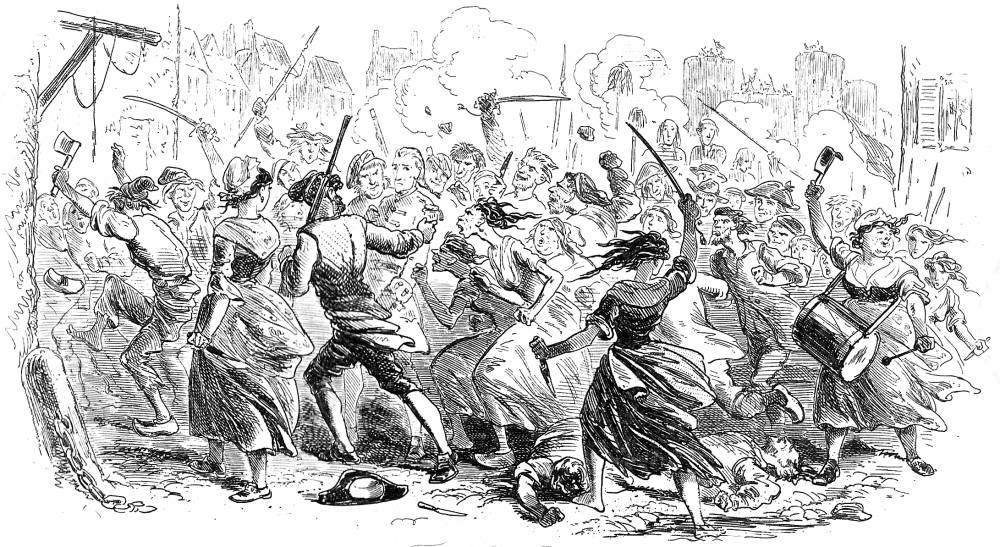
Left: John McLenan's ""But such awful workers, and such awful work!" (1 October 1859). Centre: Hablot Knight Browne's "The Sea Rises" (October 1859). [Click on images to enlarge them.]
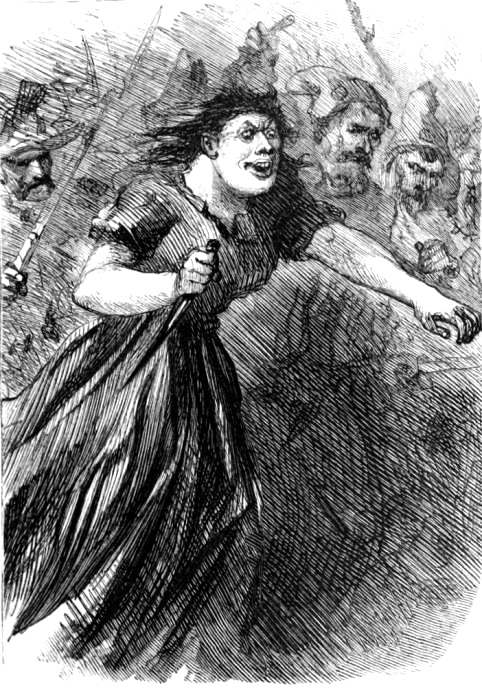
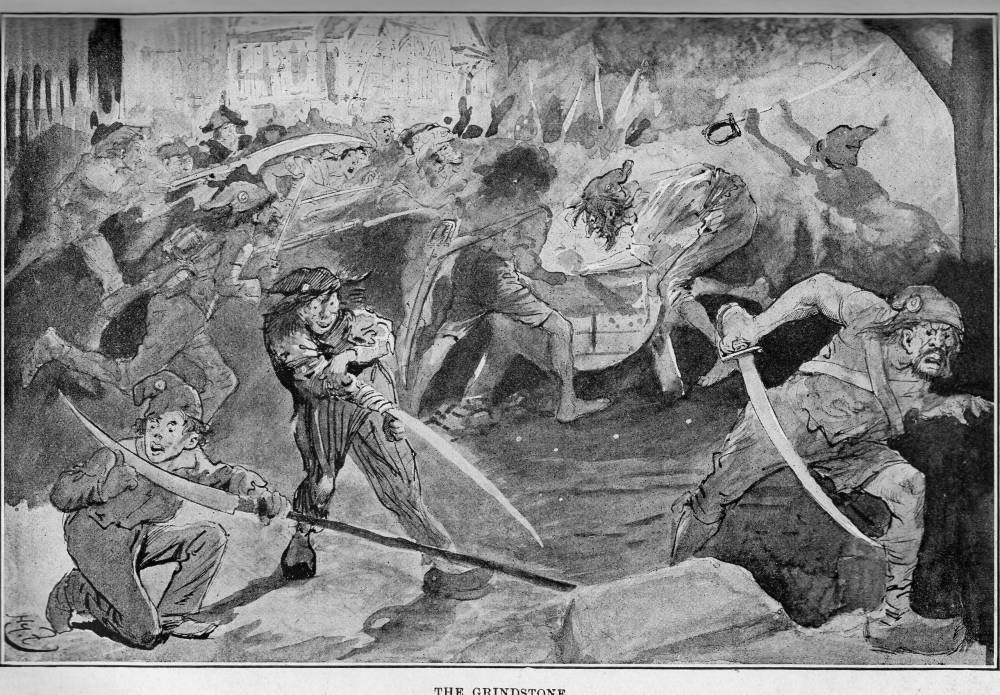
Later Editions. Left: Sol Eytinge, Junior's "The Vengeance" (1867). Centre: Fred Barnard's "The Grindstone" (1874). Right: Harry Furniss's "The Grindstone" (1910). [Click on images to enlarge them.]
Bentley, Nicolas, Michael Slater, and Nina Burgis. The Dickens Index. New York and Oxford: Oxford U. P., 1990.
Dickens, Charles. A Tale of Two Cities. Illustrated by Hablot Knight Browne ('Phiz'). London: Chapman and Hall, 1859.
Dickens, Charles. A Tale of Two Cities. Illustrated by John McLenan. Philadephia: T. B. Peterson, 1859. Based on the Harper's Weekly serialisation, 7 May through 3 December 1859.
Dickens, Charles. A Tale of Two Cities. Works of Charles Dickens. Household Edition. 55 vols. Illustrated by F. O. C. Darley and John Gilbert. New York: Sheldon and Co., 1863. Vol. 2.
Dickens, Charles. A Tale of Two Cities and Great Expectations. The Diamond Edition. 14 vols. Illustrated by Sol Eytinge, Junior. Boston: Ticknor and Fields, 1867. Vol. XIII.
Dickens, Charles. A Tale of Two Cities. Illustrated by Fred Barnard. The Household Edition. 22 vols. London: Chapman & Hall, 1874. Vol. VIII.
Created 23 March 2016