
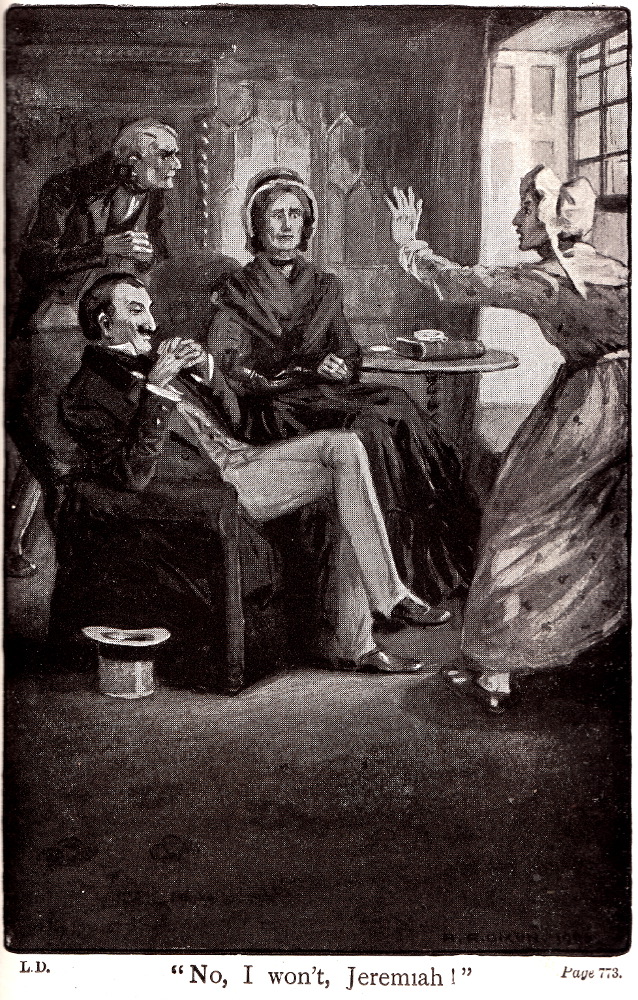
“No, I won't, Jeremiah!”
Arthur A. Dixon
1906
Lithographic reproduction of a watercolour
12.1 cm high by 8 cm wide (4 ⅞ by 3 ⅛ inches), framed.
Eighth and final illustration for Little Dorrit, in the Collins' Pocket Edition (1906), facing p. 772, referencing p. 773.
[Click on the image to enlarge it and mouse over text for links.]
Scanned image and text by Philip V. Allingham.

Passage Illustrated: Rigaud confronts Mrs. Clennam, Jeremiah and Affery Flintwinch
In a moment Affery had thrown the stocking down, started up, caught hold of the windowsill with her right hand, lodged herself upon the window-seat with her right knee, and was flourishing her left hand, beating expected assailants off.
‘No, I won’t, Jeremiah — no, I won’t — no, I won’t! I won’t go! I’ll stay here. I’ll hear all I don’t know, and say all I know. I will, at last, if I die for it. I will, I will, I will, I will!’
Mr. Flintwinch, stiffening with indignation and amazement, moistened the fingers of one hand at his lips, softly described a circle with them in the palm of the other hand, and continued with a menacing grin to screw himself in the direction of his wife; gasping some remark as he advanced, of which, in his choking anger, only the words, ‘Such a dose!’ were audible.
‘Not a bit nearer, Jeremiah!’ cried Affery, never ceasing to beat the air. ‘Don’t come a bit nearer to me, or I’ll rouse the neighbourhood! I’ll throw myself out of window. I’ll scream Fire and Murder! I’ll wake the dead! Stop where you are, or I’ll make shrieks enough to wake the dead!’
The determined voice of Mrs. Clennam echoed ‘Stop!’ Jeremiah had stopped already. [Book Two, “Riches,” Chapter XXX, “Closing In,” p. 773]
Commentary: The Diabolical Frenchman Extorts £2,000 from Cunning Mrs. Clennam
Dickens had introduced the cunning career criminal Rigaud in the opening chapter, and now makes use of him in the matter of the purloined codicil that would make Amy Dorrit an heiress. Thus, Dickens fleshes out the complex inheritance plot by having Rigaud bargain with the puritanical Mrs. Clennam over the papers which Jeremiah's twin brother has stolen, and with which Rigaud in turn has absconded. Moreover, Rigaud has penetrated Mrs. Clennam's greatest secret, that she is not Arthur's natural mother. This scene was originally the climactic confrontation that opened serial parts 19-20 in the double number for June 1857.
The scene transpires in the matriarch's room above stairs in the Clennam mansion at the culmination of the plot concerning her having suppressed the truth of Arthur's birth and the bequest to the Dorrits. In the original serial, the illustration for this chapter only obliquely alludes to Rigaud's blackmail plot, and does not show the dramatic confrontation between Flintwich, Rigaud (just right of centre here and in the F. O. C. Darley frontispiece,) and Mrs. Clennam. Phiz's June 1857 symbolic portrait of the house Damocles (a dark plate, Book Two, Chapter 30) realises the aftermath of the blackmail scene, when the overconfident Rigaud, clinking his coins, believes he has Mrs. Clennam in his power, even though she is about to flee the house, abandoning the wheelchair in which she has been trapped for fifteen years.
The group scene, as in the earlier Phiz illustration set in that room, Mr. Flintwich mediates as a friend of the family, is Mrs. Clennam's upstairs parlour and bedroom. The characters depicted in the Mahoney wood-engraving and the Dixon lithograph are Monsieur Rigaud, the devious Frenchman to whom Dickens introduced us in the opening chapter; behind him, Mrs. Clennam; Flintwich, Mrs. Clennam's confidential servant (centre); and, making as if to climb out the window in the Household Edition composite woodblock engraving, Jeremiah Flintwich's wife, the habitually terrified maid Affery. The illustration makes it clear that Affery, like the reader, is about to receive a revellation.
Both James Mahoney in the 1873 edition and Arthur Dixon in the 1906 edition have chosen to focus on the distraught Affery rather than just on her auditors, Mrs. Clennam and Rigaud. Both illustrators show Rigaud as entirely at his ease, but Mrs. Clennam as uncomfortable, when Flintwich orders an overwrought Affery out of the room as Rigaud begins his blackmail narrative — and Affery, asserting herself at last, refuses to leave: "I'll hear all I don't know, and say all I know. I will, at last, if I die for it. I will, I will, I will, I will!" In consequence of the dialogue realised, both Mahoney and Dixon have made the figure of Mrs. Clennam less important in this group illustration, so that momentarily the deadly serious subject matter is supplanted by the comedic situation, as the reader's attention shifts away from the cunning Frenchman and his blackmail victim and towards the antics of the unstrung maid at this crucial point in the narrative.
The picture makes conscious allusion to the backstory of the Flintwinch marriage, as the brutal husband assures Affery's obedience by terrorizing her with the constant threat of physical punishment. Ironically, the befuddled maid does not understand the specific contents of Mrs. Clennam's papers. However, she does know exactly who stole them and how. Although Jeremiah constantly dismisses her observations as mere "dreams," in her sleepwalking episodes she actually acquires accurate information. Consequently, her account of the papers' being taken from the house by night (by a thief who resembles her own husband, namely his twin brother, Ephraim) is accurate; and by her insisting upon being heard here Affery helps others to resolve the mystery.
Pertinent illustrations in four other editions: 1856-7, 1867, 1873, and 1910
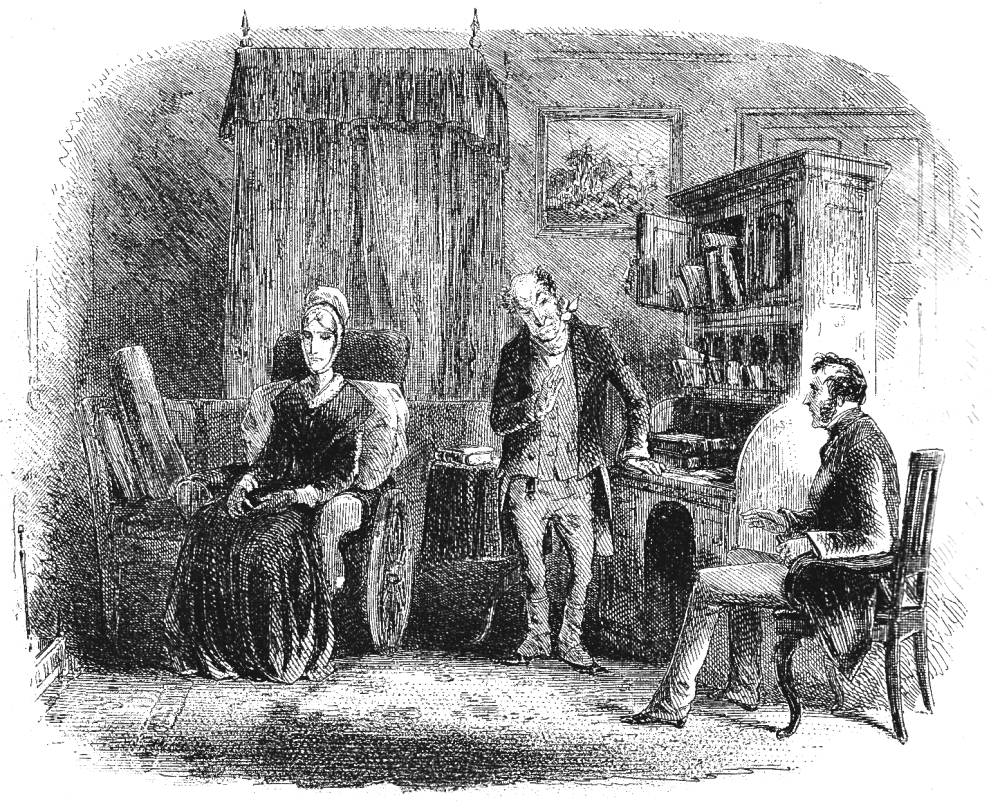
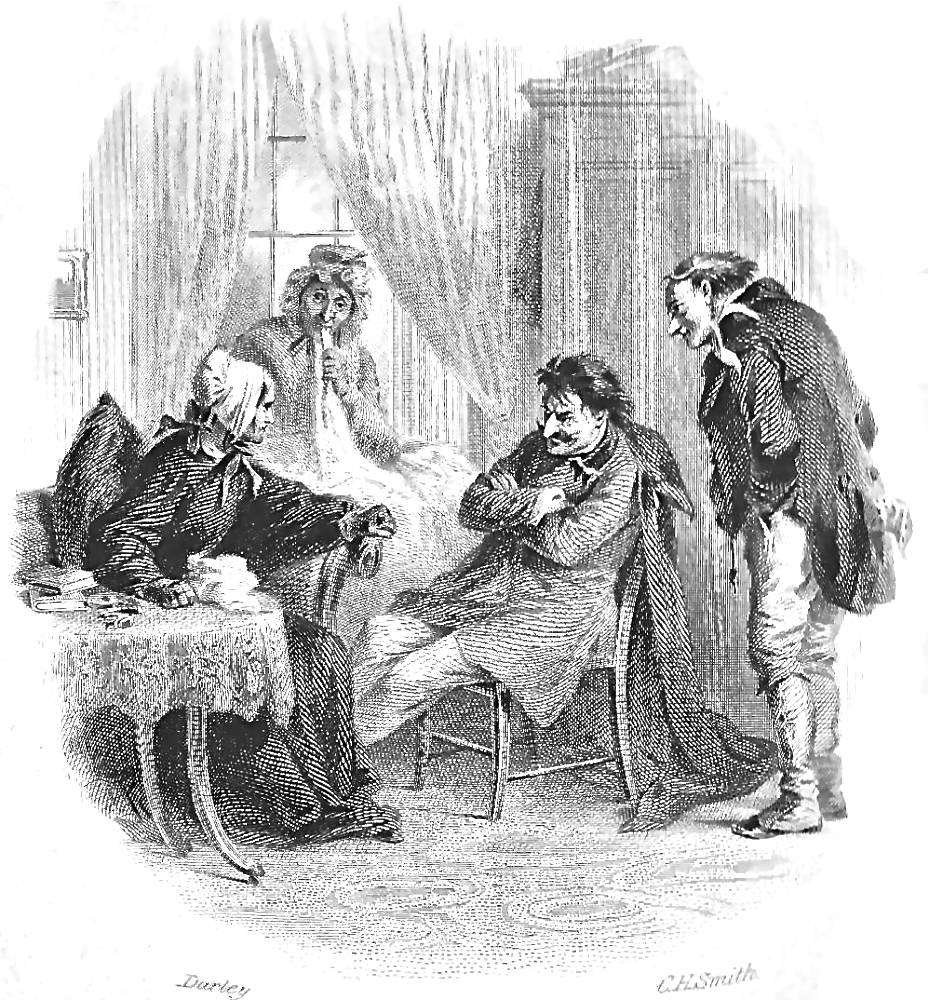
Left: Phiz's original serial illustration of Mrs. Clennam in her wheelchair, Mr. Flintwich mediates as a friend of the family (January 1856). Right: Sol Eytinge, Junior's interpretation of the devious Mrs. Clennam and her adopted son, Arthur, Mrs. Clennam and Arthur Clennam (1867). [Click on images to enlarge them.]
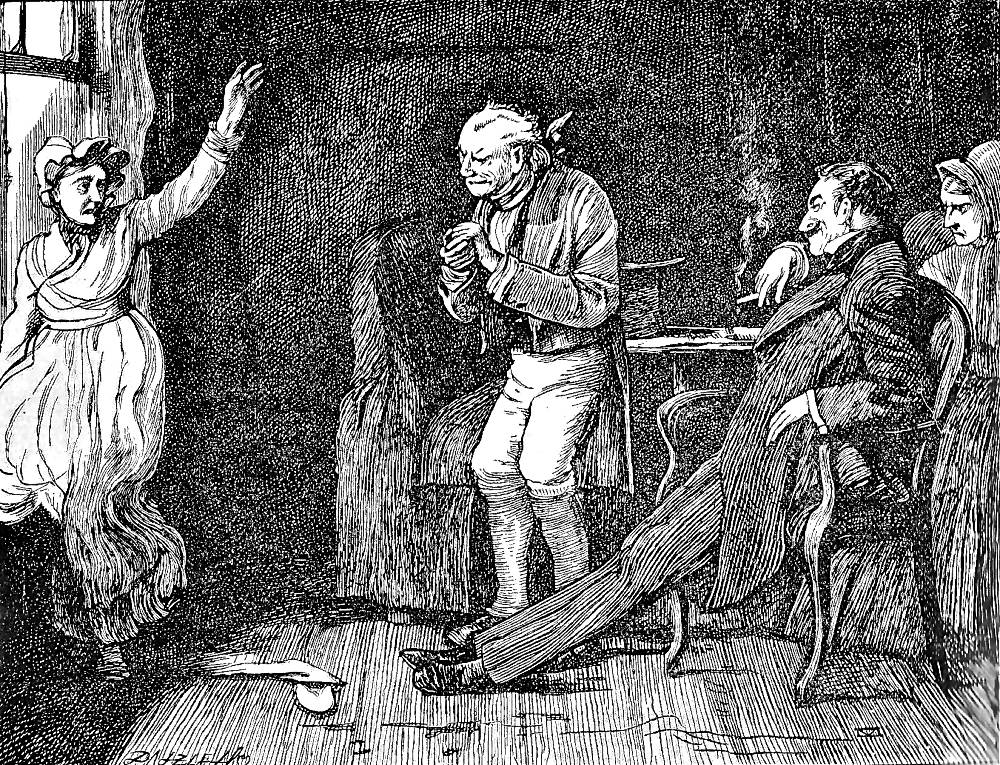
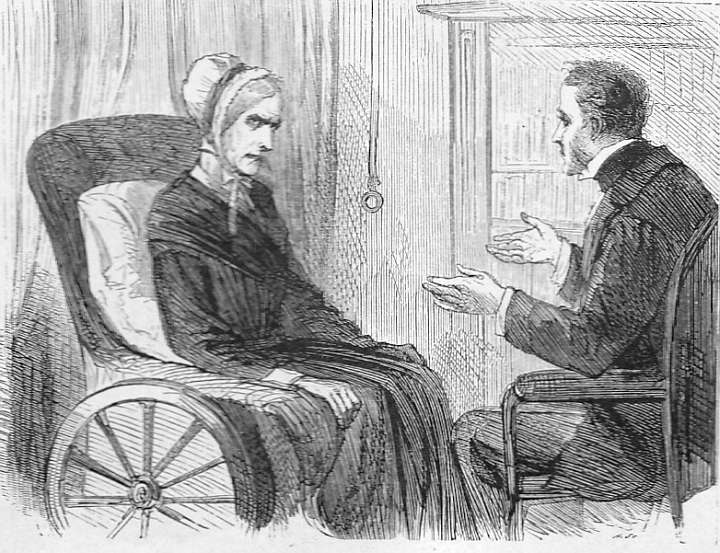
Left: James Mahoney's realistic interpretation of a subsequent event in the same meeting, In a moment Affery had thrown the stocking down, started up, caught hold of the windowsill with her right hand, lodged herself upon the window-seat with her right knee, and was flourishing her left hand, beating expected assailants off (Household Edition, 1873). Right: Sol Eytinge, Junior's interpretation of the devious Mrs. Clennam and her adopted son, Arthur, Mrs. Clennam and Arthur Clennam (1867). [Click on the images to enlarge them.]
Related Material: The Other Illustrated Editions (1863 — 1910)
- Illustrations by "Phiz" (Hablot Knight Browne) for Little Dorrit (December 1855 — June 1857)
- James Mahoney's 58 illustrations for Dickens's Little Dorrit (1873)
- Harry Furniss's 29 illustrations for Dickens's Little Dorrit (1910)
- Charles Dickens's Little Dorrit (1857): Site Map
- Felix Octavius Carr Darley — three engraved frontispieces, volumes 1, 2, and 4: 1863)
- Illustrations by Sol Eytinge, Jr. — 16 plates from the Ticknor and Fields' Diamond Edition (1867)
Bibliography
Dickens, Charles. Little Dorrit. Illustrated by Hablot Knight Browne ("Phiz"). The Authentic Edition. London: Chapman and Hall, 1901 [rpt. 30 May 1857 volume].
Dickens, Charles. Little Dorrit. Frontispieces by Felix Octavius Carr Darley and Sir John Gilbert. The Household Edition. 55 vols. New York: Sheldon & Co., 1863. 4 vols.
Dickens, Charles. Little Dorrit. Illustrated by Sol Eytinge, Jr. The Diamond Edition. 14 vols. Boston: Ticknor & Fields, 1867.
Dickens, Charles. Little Dorrit. Illustrated by James Mahoney. The Household Edition. 22 vols. London: Chapman and Hall, 1873. Vol. V.
Dickens, Charles. Little Dorrit. Illustrated by A. A. Dixon. With an engraved title by Harry Furniss. London and Glasgow: Collins Clear-Type Press, 1906.
Dickens, Charles. Little Dorrit. Illustrated by Harry Furniss. The Charles Dickens Library Edition. 18 vols. London: Educational Book, 1910. Vol. XII.
Steig, Michael. "Chapter 6: Bleak House and Little Dorrit: Iconography of Darkness." Dickens and Phiz. Bloomington: Indiana University Press, 1978.
Created 14 September 2026