
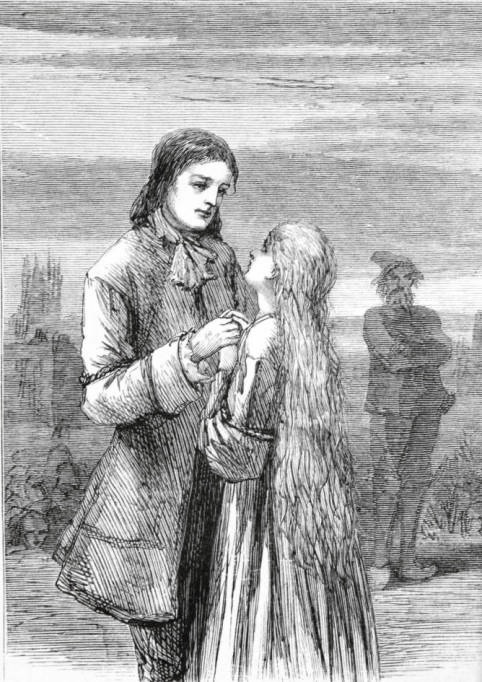
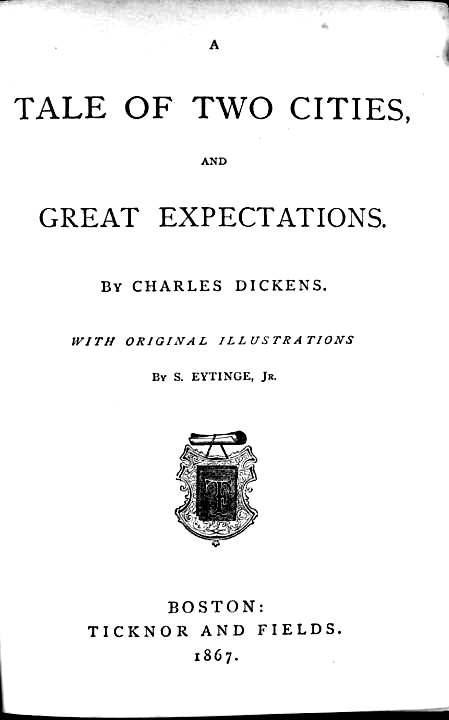
In anticipation of Dickens's long-awaited 1867-68 reading tour, which had been postponed by the American Civil War, the Boston publisher James T. Fields had commissioned from Eytinge ninety-six designs for wood-engravings to grace the pages of the exhaustive, fourteen-volume Diamond Edition of Dickens's works, each volume being of compact dimensions with very fine but sharp type. This seventh volume, however, antedates that momentous visit to American shores. On the verso of the title-page is the statement that James T. Fields, the author's friend and confidant, so valued since it authorized his firm as Dickens's sole representatives in the United States for volume publication:
Gad's Hill Place, Higham by Rochester, Kent, Second April, 1867. By a special arrangement made with me and my English Publishers (partners with me in the copyright of my works), MESSRS. TICKNOR AND FIELDS, of Boston, have become the only authorized representatives in America of the whole series of my books. CHARLES DICKENS.
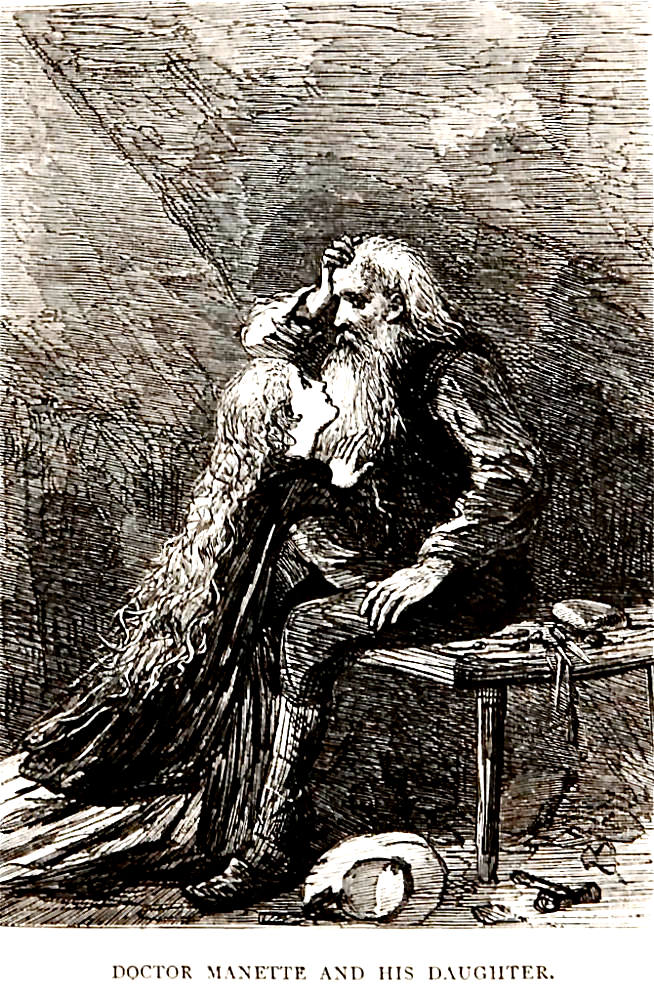
William Winter in his autobiography recalls that Sol Eytinge, Jr.'s illustrations for Dickens's works "gained the emphatic approval of the novelist" (318), although the pair did not actively collaborate on this series, as Hablot Knight Browne ('Phiz') and Dickens had done for so many of the full-scale novels. Among these, although not issued in the customary twenty monthly parts, were the illustrations for the Chapman and Hall seven-month serialisation of A Tale of Two Cities (June through December, 1859). This, their last collaboration, is marked by a new realism. Gone is the caricatural style of the early Victorian period. Likewise, one may appreciate the Eytinge composite woodblock portraits for the Diamond Edition as exemplars of the new realism of the Sixties' manner of book and magazine illustration:
The most appropriate pictures that have been made for illustration of the novels of Dickens, — pictures that are truly representative and free from the element of caricature, — are those made by Eytinge. . . . [Winter 317-318]
- Frontispiece, Sydney Carton and the Seamstress [A Tale of Two Cities, December 1859]
- Doctor Manette and His Daughter
- Jerry Cruncher and His Wife
- Monsieur and Madame Defarge
- Charles Darnay and the Marquis
- The Three Jacques
- Mr. Lorry and Miss Pross
- The Vengeance
- Title-page for the Diamond Edition of A Tale of Two Cities and Great Expectations (1867).
Additional Resources: Illustrations, 1859-1910
- Some Discussions of Dickens's A Tale of Two Cities
- A Tale of Two Cities (1859) — the last Dickens novel Phiz Illustrated
- A Note on Phiz's Wrapper Design for Dickens's A Tale of Two Cities (1859) in Monthly Serialisation
- Phiz's original serial illustrations for A Tale of Two Cities (1859)
- John McLenan's serial illustrations for A Tale of Two Cities (1859)
- John McLenan's Thirty-One Headnote Vignettes for A Tale of Two Cities in Harper's Weekly (7 May — 3 December 1859)
- Fred Barnard's 59 Household Edition illustrations for A Tale of Two Cities (1874)
- A. A. Dixon's illustrations for A Tale of Two Cities (1905)
- Harry Furniss's illustrations for A Tale of Two Cities (1910)
Scanned images and text by Philip V. Allingham. [You may use the images without prior permission for any scholarly or educational purpose as long as you (1) credit the person who scanned the image and (2) link your document to this URL in a web document or cite the Victorian Web in a print one.]
Bibliography
Allingham, Philip V. "'Charles Dickens's A Tale of Two Cities (1859) Illustrated: A Critical Reassessment of Hablot Knight Browne's Accompanying Plates." Dickens Studies. 33 (2003): 109-158.

Dickens, Charles. A Tale of Two Cities and Great Expectations. Illustrated by Sol Eytinge, Jr. The Diamond Edition. 14 vols. Boston: Ticknor & Fields, 1867. Vol. XIII.
_______. A Tale of Two Cities. Illustrated by Hablot Knight Brown. London: Chapman and Hall, 1859.
_______. A Tale of Two Cities. Illustrated by John McLenan (33 illustrations). Philadelphia: T. B. Peterson, 1859. 2 vols.
_______. A Tale of Two Cities. Illustrated by Fred Barnard. The Household Edition. 22 vols. London: Chapman and Hall, 1874. VIII.
Kitton, Frederic George. Dickens and His Illustrators: Cruikshank, Seymour, Buss, "Phiz," Cattermole, Leech, Doyle, Stanfield, Maclise, Tenniel, Frank Stone, Landseer, Palmer, Topham, Marcus Stone, and Luke Fildes. Amsterdam: S. Emmering, 1972. Re-print of the London 1899 edition.
Schlicke, Paul, ed. The Oxford Reader's Companion to Dickens. Oxford and New York: Oxford U. P., 1999.
Winter, William. "Charles Dickens" and "Sol Eytinge." Old Friends: Being Literary Recollections of Other Days. New York: Moffat, Yard, & Co., 1909. Pp. 181-202, 317-319.
Created 22 August 2011
Last updated 4 December 2025