
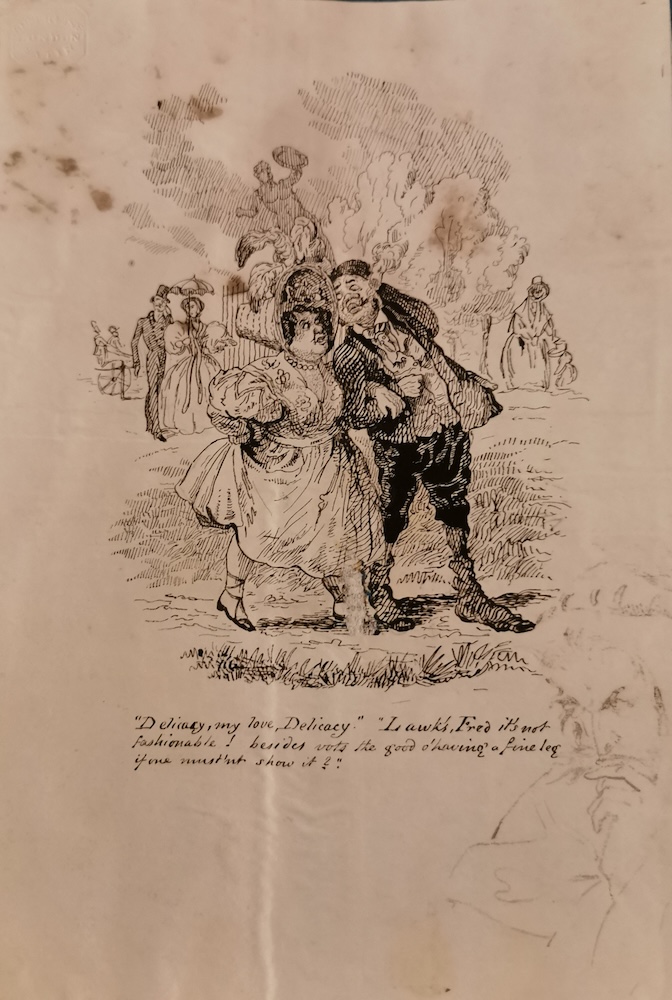
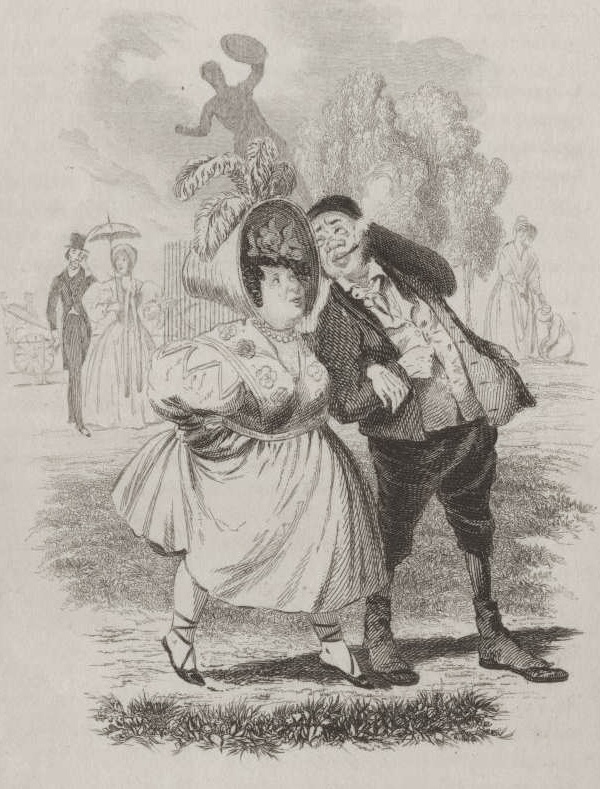
"Delicacy, my love, delicacy!". Left: The print study in a contemporary album (22.5 x 16 cm). Right: The illustration as it appears in Robert Seymour's Sketches by Seymour, as plate XIV in Vol. II of the "Miscellaneous" sketches. The full caption is: "'Delicacy, my love — delicacy' — 'Lawks, Fred!' replied the damsel, with a loud guffaw,' — 'it's not fashionable! — besides, vot's the good o' having a fine leg, if one must'nt show it?'"
Seymour's comic sketch here is about the recently erected Wellington Monument in Hyde Park, a statue of Achilles as a nude god of classical times waving his shield in the air with one hand, and brandishing a sword in the other hand:
The Sketch Illustrated
LOUNGING in Hyde Park with the facetious B____, all on a summer's day, just at that period when it was the fashion to rail against the beautiful statue, erected by the ladies of England, in honour of the Great Captain — “The hero of a hundred fights,”—
“How proudly must he look from the windows of Apsley House,” said I, “upon this tribute to his military achievements.”
“No doubt,” replied B____;" "and with all that enthusiasm with which one man of mettle ever regards another! At the same time, how lightly must he hold the estimation of the gallant sons of Britain, when he reflects that he has been compelled to guard his laurelled brow from the random bullets of a democratic mob, by shot-proof blinds to his noble mansion: this was: 'The unkindest cut of all,' after all his hair-breadth 'scapes, by flood and field, in the service. of his country, to be compelled to fortify his castle against domestic foes.”
“A mere passing cloud, that can leave no lasting impression on his great mind,” said I; “while this statue will for ever remain, a memorial of his great deeds; and yet the complaint is general that the statue is indelicate — as if, forsooth, this was the first statue exhibited in 'puris naturalibus' in England. I really regard it as the senseless cavilling of envious minds.”
“True,” said B____, laughing; “there is a great deal of railing about the figure, but we can all see through it!” at the same time thrusting his walking-stick through the iron-fence that surrounds the pedestal. As for delicacy, it is a word that is used so indiscriminately, and has so many significations, according to the mode, that few people rightly understand its true meaning. We say, for instance, a delicate child; and pork-butchers recommend a delicate pig! Delicacy and indelicacy depend on the mind of the recipient, and is not so much in the object as the observer, rely on't. Some men have a natural aptitude in discovering the indelicate, both in words and figures they appear, in a manner, to seek for it. I assure you that. I (you may laugh if you will) have often been put to the blush by the repetition of some harmless phrase, dropped innocently from my lips, and warped by one of these 'delicate' gentlemen to a meaning the very reverse of what I intended to convey. Like men with green spectacles, they look upon every object through an artificial medium, and give it a colour that has no existence in itself!
It was only last week, I was loitering about this very spot, when I observed, among the crowd of gazers, a dustman dressed in his best, and his plump doxy, extravagantly bedizened in her holiday clothes, hanging on his arm.
As they turned away, the lady elevated the hem of her rather short garments a shade too high (as the delicate dustman imagined) above her ankle. He turned towards her, and, in an audible whisper, said, 'Delicacy, my love — delicacy!' — 'Lawks, Fred!' replied the damsel, with a loud guffaw, —'it's not fashionable! — besides, vot's the good o' having a fine leg, if one must'nt show it?'"
So much for opinions on delicacy!
Commentary
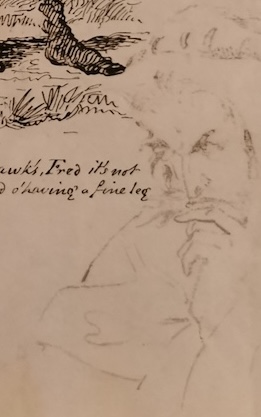
The statue's nudity was indeed controversial, but the implication in the sketch is that it is only the vulgar who make an issue of it — whether by finding it indelicate (like the dustman) or being inspired by it (like his companion). Typical here is the way the common speech of the couple is parodied, much as in the "sporting cockney" sketches. Incidentally, the faint outline shown on the right here, of a man seen three-quarter face, hand on chin, apparently frowning, is not a hint of Wellington himself, looking out from nearby Apsley House and reflecting on the responses to the statue — but simply the partial impress of an illustration on the next page of the album. This shows the famous work by Friedrich Moritz August Retzsch (German, 1779-1857) entitled Die Schachspieler (The Chess Players), in which the devil concentrates hard as he plays for a young man's soul. Thanks to Randall Wallace for this information.
Related Material
- The statue of Achilles
- Seymour's A Happy Chance and An Unhappy Chance, a pair of sporting sketches from the same album
- "A Man coming"! — "vich vay? do tell me vich vay!", also from Seymour's published Sketches and the album
Top (left-hand) image and lower right-hand image scan by Randall Wallace; top (right-hand) image scan, text and formatting, by Jacqueline Banerjee. You may use the images without prior permission for any scholarly or educational purpose as long as you (1) credit the person who scanned them, and (2) link your document to this URL in a web document or cite the Victorian Web in a print one. [Click on all the images to enlarge them.]
Bibliography
Seymour, Robert. Sketches by Seymour. London: Thomas Fry, c. 1836. Project Gutenberg. Ebook ed. David Widger. Web. 22 February 2026.
Wallace, Randall. "Album/Scrapbook (c.1838-1855): A Rich Source of Early Victorian Illustrations." Victorian Web. 22 February 2026.
Created 22 February 2026
Last modified 25 February 2026