

n John Milton in Nineteenth-Century Literature and Visual Culture, Laura Fox Gill explores the connections between nineteenth-century visual representations of Paradise Lost and novels and poems from the Romantics to the late Victorians. Gill looks at illustrations by John Martin , J.M.W. Turner, and William Blake, as well as paintings and sculptures that respond to Milton. Taking an interdisciplinary approach, she also examines marginal annotations of Milton's works by Herman Melville and Thomas Hardy, and her epilogue discusses The Cudmore Milton, a Victorian "volume of Milton's poems bound in human skin" (7). In her introduction, Gill notes that Charles Darwin was a keen reader of Milton's Comus (1634) and comments that "scholars continue to reveal the extent of Milton's influence in the emerging and developing nineteenth century sciences of evolutionary biology geology, and astronomy" (14). Yet, as she points out, more attention has been paid to Milton's influence from 1770-1830 than to the rest of the nineteenth century. Her excellent book seeks to redress this imbalance.
Gill's first chapter focuses on two paintings in the Walker Art Gallery: John Martin's The Last Man (1849) and and Louis Edouard Fournier's The Funeral of Shelley (1889). Gill argues that Martin's painting was inspired by Thomas Campbell's poem "The Last Man" (1823) but can also be read as a response to Mary Shelley's The Last Man (1826), a dystopian novel set in an imagined twenty-first century Europe, which appeared between the 1818 and the 1832 editions of Frankenstein. "In both The Last Man and in her life writing from this decade — letters and journals written in the 1820s — Mary Shelley makes use of Milton's Paradise Lost to imagine grief on both a universal and an individual scale" (27).
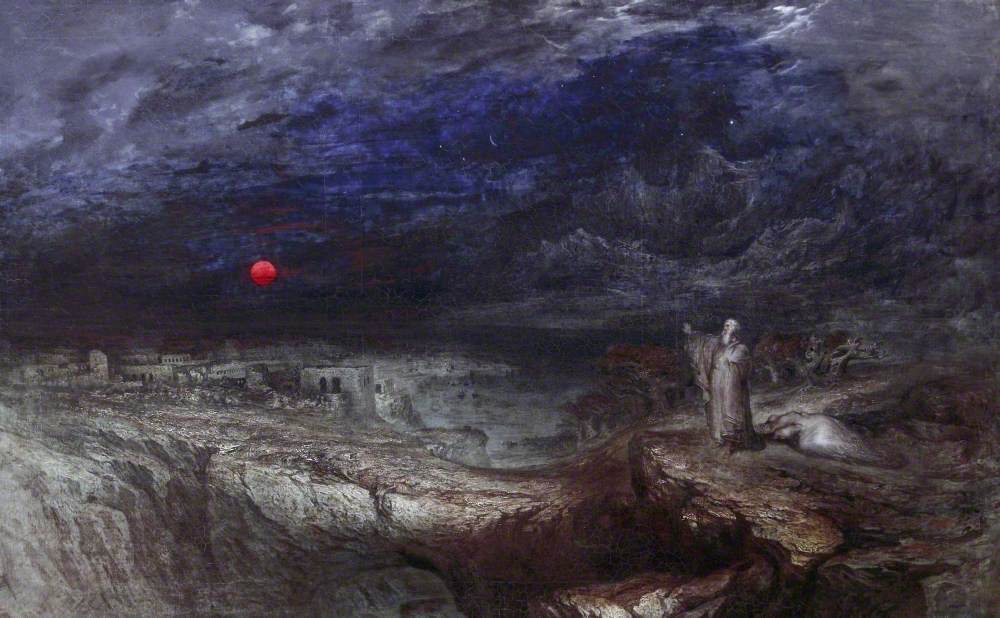
The Last Man, 1849, by John Martin. Oil on canvas. 137.8 cm x 214 cm. The Walker Art Gallery, Liverpool. Reproduced under the terms of Creative Commons.
Both Martin and Shelley, Gill suggests, "engage with Miltonic apocalyptic temporality" (54), and she points to Martin's use of darkness and light as being connected to this aspect of Paradise Lost (55). In Martin's Adam and Eve Driven out of Paradise (1824-27), Gill notes that "the central event of the Expulsion occurs against a backdrop that speaks to both future and past" (56). Even the mezzotint technique evokes Milton's use of light and darkness in the poem, specifically his description of light emerging from darkness (59). Gill argues that Shelley's "fragmented temporality" in The Last Man also appears in Martin's illustrations of Paradise Lost (60).
Moving from fragmented temporality to the idea of "conductive energy," Chapter 2 examines Herman Melville's annotations of Paradise Lost, Paradise Regained, and Milton's sonnet on his blindness. Melville's marginal notes, Gill argues "record his interest in a complex passivity" (72). She aligns the power of Bartleby's "prefer not" and his refusal to speak with Christ's power in Paradise Lost — the quiet centre of the poem. Satan talks the most, has the first spoken lines in the poem, and all his ability to sway and corrupt comes from speech. In the section on Turner in this chapter, Gill discusses a kind of visual incomprehensibility shared by Milton, Turner, and Melville and suggests that "the aesthetic of the indistinct in Melville's Moby-Dick" might show the influence of Milton (84).
In Chapter 3, "Cleaving Bodies and Erotic Liberty: John Milton, A.C. Swinburne and Intermedial Ekphrasis," Gill argues that boundaries of the body, liberty, and "the fluidity of sexual desire" form the centre of Swinburne's response to Milton. This chapter surveys influential queer readings of Paradise Lost, including "the Miltonic sublime as feminine," the "androgyny of the dove" at the opening of the poem when the Holy Spirit "satst brooding o'er the vast abyss," and "the androgyny and sexual activity of Milton's angels" (102). Gill cites the lines "spirits when they please / Can either sex assume, or both" (I.423-25) and further suggests that Adam and Eve have "androgynous unity" before the fall (106).
Gill's next chapter, "Edenic Wessex and Handed Moments: John Milton, Thomas Hardy, and Biblical Illustration," considers Thomas Hardy's extensive use of Milton in his fiction. Looking at some of Hardy's novels, Gill compares Tess to Eve and mentions The Hand of Ethelberta (1876), in which the eponymous Ethelberta and her friends visit Milton's grave and Ethelberta reads from Paradise Lost (Gill 133). On the connection of hands, or "handed moments," Gill notes that Adam and Eve leave the poem as they entered it (Book IV): hand in hand (152). She quotes the end of Tess with Angel and Liza-Lu hand in hand, watching from afar the black flag that signals Tess's execution is done (157). Gill here finds a clear echo of the final two lines of Paradise Lost, "They hand in hand with wand'ring steps and slow, / Through Eden took their solitary way," in "As soon as they had strength they arose, joined hands again, and went on," the final sentence of Tess of the d'Urbervilles (384).
As well as the imagery of hands, this chapter discusses Hardy's "predilection for the Miltonic obscure" (139) and the "grappling with spatial and temporal scale" in his fiction (140). As Gill acknowledges, many critics have explored Hardy's use of perspective and the cinematic aspects of his work, along with the theatrical: shows, pantomimes, and other kinds of performance (for example, Joan Grundy, cited on p. 142). Gill does not mention The Dynasts, perhaps because she's sticking to Wessex and fiction rather than poetry. She also doesn't cite John Barrell's "Geographies of Hardy's Wessex" (1982), an old but insightful essay on Hardy's use of perspective that might be helpful here. This chapter offers a valuable discussion of hands in Hardy's fiction, but I think that the pervasive voyeurism — which she briefly mentions — of his narrators and many of his characters (Gabriel Oak, Elizabeth-Jane Newson, and George Somerset, to name a few) could be considered further in terms of its connection to Satan's voyeurism in Paradise Lost.
The epigraph to the Epilogue of John Milton in Nineteenth-Century Literature and Visual Culture is from Milton's Areopagitica: "For books are not absolutely dead things, but do contain a potency of life in them to be as active as that soul was whose progeny they are; nay, they do preserve as in a vial the purest efficacy and extraction of that living intellect that bred them." As Gill's book makes clear, Victorians found Milton a particularly potent source of ideas about good and evil. As Gill says, "One of the ways in which Milton is kept present and distant in nineteenth-century texts is through their consistent acknowledgement of the inescapably post-lapsarian state of human existence" (166). Fittingly, Gill opens her Epilogue by recalling the event of Milton's body having exhumed from beneath St. Giles Church Cripplegate in August 1790, upon which some of his body parts, including hair, teeth, and bones, were taken and dispersed in a terrible act of desecration (166).
Perhaps even more post-lapsarian than the desecration of the poet's remains was the ghoulish practice of "anthropodermic" book binding (using human skin as the leather), especially when that skin was taken from a dead criminal. In the Epilogue, Gill also talks about a volume in the collections of the Devon Heritage Centre, near Exeter. At first glance, this appears to be an ordinary Victorian leather-bound book of Milton's poetry; however, it bears a disturbing inscription: "This Book is bound with a part of the skin of George Cudmore who with Sarah Dunn was committed to the Devon County Gaol on the 30th of October 1829 [...] for murdering & poisoning Grace Cudmore his Wife." Gill tells us that as of the date of publication, the Anthropodermic Book Project had tested 32 books thought to have been bound with human skin and found that 18 were. The Cudmore Milton had not been tested (170).
The point of alluding to this strange artifact of Victorian book binding in a discussion of Milton's influence upon nineteenth century writers and artists is to show, as Gill says, that Milton was both a towering cultural figure and one who could be questioned and dismantled by a later age (179). I don't know how Miltonic the gruesome subject of anthropodermic books is in general, but it's certainly Hardyesque and so forms a fitting end to this engaging, enjoyable, and scholarly book on Milton and the nineteenth century.
Links to Related Material
- A Biographical Sketch of Mary Wollstonecraft Shelley (1797-1851)
- Thomas Hardy: Literary Relations
- Victorian Illustration
Bibliography
[book under review] Gill, Laura Fox. John Milton in Nineteenth-Century Literature and Visual Culture. Cambridge: Cambridge University Press, 2026. 270 pp. $149.95
Barrell, John. "Geographies of Hardy's Wessex." Journal of Historical Geography 8.4 (October 1982): 347-361.
Created 8 September 2026 Last modified 10 September 2026