
The Star, 22 February 1893
"Logroller" [Richard Le Gallienne], "Mr. Oscar Wilde's 'Salomé,'" The Star, Wednesday, 22 February 1893, p. 2. A review of Salomé: Drame en un Acte, par Oscar Wilde (Paris: Librairie de L'Art Independent; Londres: Elkin Mathews et John Lane, 1893).
"Salome," Drame en un Acte, par Oscar Wilde(Paris: Librairie de L'Art Independent. Londres: Elkin Mathews et John Lane).

The play which the censor rejected, and which Mr. Wilde pretended was to lose English letters the prestige of his name, is now before us. The censor may no longer keep its exquisite blasphemies to himself. Though, alas, blasphemy, like that monster of so hideous mien inhabiting schoolbooks, soon loses its power to shock, and we find ourselves taking it as lightly as a new liqueur. It was shocking, maybe, at first to hear that the motive of Mr. Wilde's play was the love — or rather lust — of Salome for John the Baptist, and that she begged his head in a charger not to revenge her mother (for whom, like daughters in real life, she hadn't the least consideration) but to gratify her own desire for his beauty. In fact, she loved his head as Isabel her pot of Basil. There was no hope of kissing him with his head on, so she had no alternative but to content herself with kissing him with it off. The play is published under two appropriate signs. Its French printer has his address in the "Rue du Dragon," the volume being embellished with an engraved gem of a terrific dragon-woman, couched to spring on the sea-shore, and bearing the appropriate motto, "Non hic piscis omnium," and the sign of its English publishers is the Bodley Head. It is to be hoped that Mr. Wilde will never in his Cæsarian moods demand the Bodley Head on a charger. But
Mr. Wilde was not wrong in considering it his chef d'œuvre. It belongs indeed to the black art: its motives are monstrous, its color is evil, its language is lovely and accursed, the very harlotry of language, but it is a play for all that beautiful as the Black Venus, most cunningly wrought, and intensely dramatic. It seems built to music. Its gradual growth is exactly like the development of a theme in music. One by one the several motives cunningly steal in almost unnoticed. It is wonderful how many interests and how much color Mr. Wilde manages to suggest in so short a space — for the play covers but 80 pages — large type. I will try to sketch its main features. The scene, all the way through, is a great terrace outside the great hall of Herod's palace. Feasting is going on inside, and a few soldiers are on guard on the terrace, in the moonlight. A young Syrian, captain of the guard, is there, and he cannot keep his eyes from gazing in upon the beauty of Salome, as she sits feasting, though his friend, Herodias' page, warns him that evil comes of such infatuations. The page is taken up with the strange aspect of the moon, which he compares to a dead woman stealing from her tomb. But the Syrian, thinking of Salome, compares her rather to a princess with a yellow veil and silver feet. Nay, a princess with feet like little white doves. One would almost says [sic] that she was dancing. Suddenly there is a great uproar of voices in the banqueting hall. "It is the Jews," says one soldier to the other, "disputing about their religion. They are always at it." The soldiers agree that such discussions are absurd. Then once more comes in the refrain of the Syrian's love-stricken voice: "Comme la princesse Salome est belle ce soir!" Mr. Wilde is very
throughout. They recur again and again in most unexpected places and with subtle dramatic effect. The reader will remember how impressively Maeterlinck made use of the same device. "The tetrarch looks gloomy," remarks one of the soldiers, and again near the end we have the same remark — "Le tetrarque a l'air sombre" and the same answer. "Oui, il a l'air sombre," as though it was their watchword for the night. A Nubian and a Cappadocian start a conversation de natura dÊmon, and then another refrain strikes in, the voice of John (Jokanaan) crying, not in the wilderness, but from out an old well at the bottom of the terrace where he is imprisoned. He cries aloud of His coming whose shoe-latchets, &c., and prophesies sight to the blind, hearing to the deaf, &c. While he jeremiads intermittently the soldiers discuss him, the young Syrian still keeps his eyes on Salomé, and his friend the page antiphonally warns him, "Il peut arrive malbeur," and presently Salomé leaves the hall, disgusted with the company, a mixed gathering of Greeks, Romans, Egyptians, and Jews and comes out on the terrace. The young Syrian, delighted, hovers near her. But the moon-refrain is overdue. "How good it is to see the moon," cries Salome. "How cold and chaste she is! Surely she is virgin." "Je suis sure qu'elle est vierge. Elle a la beaute d'une vierge. Oui, elle est vierge. Elle ne s'est jamais souillee. Elle ne s'est jamais donnee aux hommes, comme les autres Deesses."
strikes on her ear. She listens, she inquires of him, "Is he an old man?" She grows more and more infatuated with the voice, and at last bids the soldiers set John free that she may see him. This, however, they dare not, and Salome bids in vain till, catching the eye of the young Syrian upon her, and divining his passion for her, she lures him to do her will as a snake lures a bird. She calls him by his name. "You will do this for me. Narraboth," she whispers, "and to-morrow when I pass in my litter under the gate of the sellers of idols, I will let fall a little flower for you, a little green flower." The reader will mark the color. And again, smiling, she beseeches him: "Vous ferez cela pour moi, Narraboth. Vous savez bien que vous ferez pour moi. Et demain quand je passerai dans ma litière sur le pont des acheteurs d'idoles je vous regarderai ‡ travers les voiles de mousseline, je vous regarderai, Narraboth, je vous sourirai, peut-être. Regardez-moi, Narraboth. Regardez-moi. Ah: vous savez bien que vous allez faire ce que je vous demande. Vous le savez bien, n'est ce pas? ... Moi je le sais bien." How one can imagine Sara's golden voice crooning out these lines! No wonder the poor Syrian succumbs, and presently Salome has her will, and Jokanaan rises like a jack-in-the-box from his prison, yelling prophetic curses. But of those Salome takes no heed. Whatever they mean,
His very voice intoxicates her: "Parle encore, Jokanaan. Ta voix m'enivre." He has as little regard for her beauty as John Knox of Mary Stuart's. "Ne m'approchez pas, fille de Sodome." But she tells him that his body is white as the lily of the field, and begs to touch his body: his hair is black as the grapes of Edom, and begs to touch his hair; and in turn she says that each of these is hateful, only his mouth, "a band of scarlet upon a tower of ivory," is her desire. "Laisse-moi baiser ta bouche." The young Syrian at this kills himself in despair, fulfilling the prophecy of his friend, and Herod, who mourns him in a touching speech, then breaking up the feast and coming out on to the balcony, slips in his blood — a bad omen. Herod, too, must pay his tribute to the moon. She is, he declares, a frenzied woman who goes everywhere seeking lovers. She is naked, too. She is quite naked. The clouds seek to clothe her, but she will not. She totters through the clouds like a drunken woman. But Herodias cuts him short. She is an unimaginative worldly creature. The moon is like the moon, that's all, she says. The domestic relations between Herod and Herodias are what such relations usually are in Mr. Wilde's philosophy. They cannot forbear bitter things, even in the presence of the Roman ambassadors. Herod is manifestly the cynical henpecked one, and Salome is a spoilt child, over whom neither father nor mother has control. And here steals in another motive of the play, the "Cenci" note one might call it. Herod loves his daughter
or rather uncle-fathers, for Herodias had been his brother's wife also. Herodias is continually bidding him take his eyes off the girl. Long custom has apparently made Herod pachydermatous to his wife, and he turns from her scolding, to discuss the young Syrian's suicide with the Roman ambassadors. A silly thing to kill oneself! The stoics in Rome make a cult of suicide, say the ambassadors, and the Emperor he made a satirical poem upon them. "Wonderful man Cæsar!" exclaims Herod, he can do everything!" and amid all the various interests comes the refrain of Jokanaan's voice from his pit proclaiming the day of the Lord. Herod inquires as to who this Son of Man is, and is told of the miracles at Cana and Capernaum and of his rising the dead.
Mr. Wilde is amusing here. Herod exclaims that he has no objection to Christ's changing water into wine, and healing the blind — on the whole, they are meritorious actions — but he cannot allow him to raise the dead. It would be terrible if the dead were to return! The characterisation all through the play is very clever, and done with remarkably few strokes, but the character of Herod is especially well drawn. Weak and tyrannical as he is, there is yet in him a glimmering of something better, he is at least superstitious, and is as far as possible for compromise — especially with prophets, who may, after all, come from God. Who knows? Herodias has no such fears, and when, far in his cups, and wrought upon by Jokanaan's vivid prophecies, Herod fancies he hears a beating of wings, as of the angel of death, in the house, and that the moon has turned red, she mocks him, indeed, one part of the prophecy is true: the kings of the earth are taken with fear. But I must pull up. Every page is strewn with temptations by the way to beguile the reviewer from the strait and narrow path of reviewing, and I am afraid I have fallen into all too many of them. From the very beginning Mr. Wilde shows
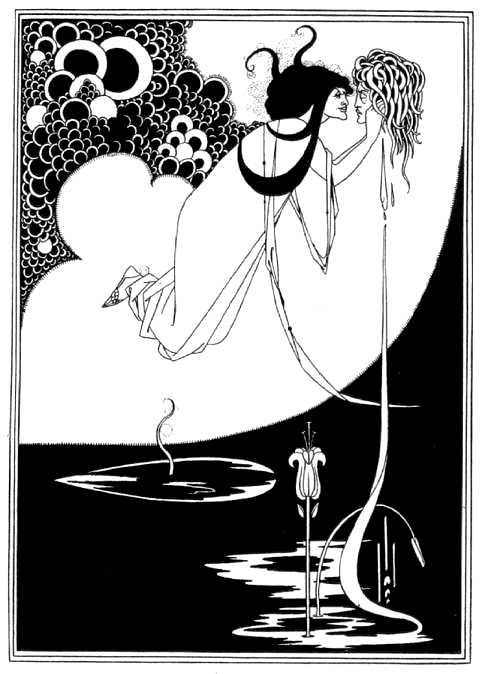
deftly thickening the plot, motive after motive, and the culmination is no less striking. Salome's passionate love-speech as she holds Jokanaan's bleeding head in her eager hands is a triumph of monstrous art. "Ah, you would not let me kiss thy mouth, Jokanaan. Ah, well, I shall kiss it now. I shall bite it with my teeth as one bites a ripe fruit yes, I shall kiss thy mouth, Jokanaan." The play ends by Herod, in terror of the wrath to come, ordering his soldiers to slay Salomé, which they thereupon accomplish with all the gusto of Eastern soldiery. "Salome" is nothing if not horrible, nothing if not fascinating; it is all that is wicked, and it is all that is clever. To those who talk of sacrilege, however, Mr. Wilde can point to a very reverent and dignified treatment of John, it is history, not Mr. Wilde, that is sacrilegious; and to those who talk of the immorality of the theme, Mr. Wilde might well ask: Is it not a virtuous act to transform evil things to beauty? Doesn't one thus, so to say, redeem them?
The Star, 18 November 1893
"Logroller" [Richard Le Gallienne], "Books and Bookmen," The Star, Wednesday, 18 November 1893, p. 1. This column is headed "Mr. John Davidson's 'Sentences and Paragraphs' — Mr. Wilde's 'Lady Windermere's Fan' — A New Edition of Hans Andersen" but the last item was apparently not published due to a lack of space.

Another book, which is practically a collection of epigrams cast into dramatic form is Mr. Oscar Wilde's "Lady Windermere's Fan: A Play about a Good Woman" (Mathews and Lane). Mr. Wilde did well to patronise his actors as puppets, for his play, though containing striking situations, and skilfully constructed, is obviously but the setting for certain brilliants and paste diamonds of his wit.
As the Gospel was once presented in the guise of morality plays, so Mr. Wilde chooses the dramatic form to preach his gospel of the world, the flesh, and the devil. "A Didactic Play in Four Acts" would have been a good sub-title, and more descriptive than that which Mr. Wilde has adopted: "A Play About a Good Woman." It would be interesting to discuss the recent craze for printing plays, and how far the demand that a play should be literature is just. To me, I confess, the demand is quite irrelevant. A play properly exists only when acted, as a musical composition exists only when interpreted by a musician, and there is a measure of the same irrelevancy in asking that a play should be literature as there would be in asking that a musical composition should be literature. That literature and the stage were once associated is no reason why they should continue to be associated when evolution has declared so unmistakably for their going their own ways. One might as well say that poetry should continue to be dramatic because so much of Elizabethan poetry happened to be presented in dramatic form. However, this question does not really arise in regard to "Lady Windermere's Fan," for while it contains some admirable characterisation of certain aspects of "society," and has an ingenious if somewhat strained central motive, it is really less a play than a four-act sermon by Mr. Worldly-Wiseman. It is, nevertheless, an extremely entertaining one, and if plays must be published by all means let them be written by Mr. Wilde and published by Messrs. Mathews and Lane, for the format of this volume is not its least attraction.
Related Material
- Introduction to Le Gallienne's Reviews of Wilde, with contents list
- Le Gallienne's (and others') reviews of Wilde's The Sphinx
Created 13 November 2026