
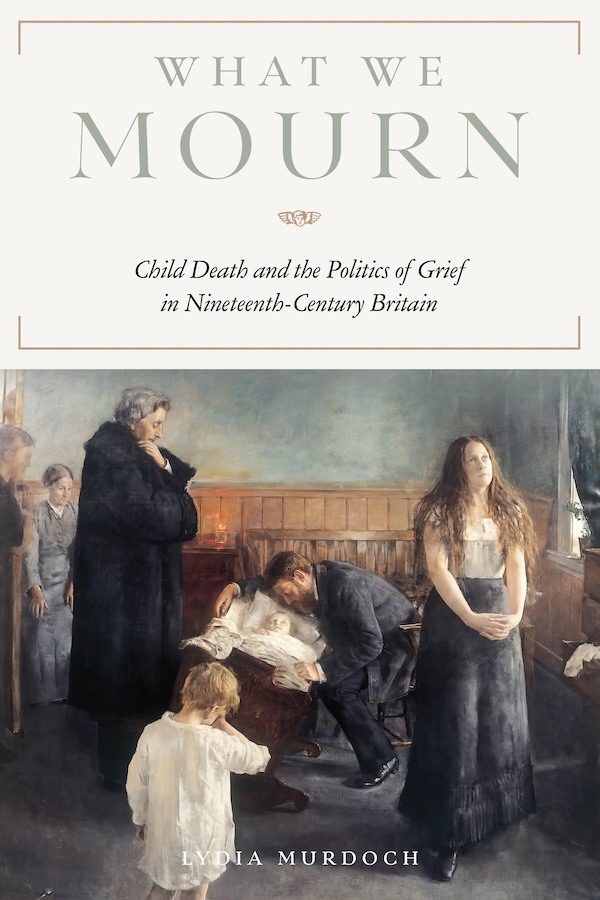

ydia Murdoch's What We Mourn: Child Death and the Politics of Grief in Nineteenth-Century Britain discusses the history and rhetoric surrounding the deaths of Victorian children. Through a wide-ranging series of well-chosen and well-arranged case studies, Murdoch calls attention to "the public mourning for children" in order to "explor[e] how collective grief for children shaped major political debates and discourses of the long nineteenth century" (10). Both argumentative and exploratory, her book achieves this purpose by analyzing case studies of public grief over child death in the long nineteenth century. Murdoch traces a shift in perceptions of child death, from an inevitability to a tragedy with "political significance and power within British, imperial, and transatlantic contexts," as "public grief for lost child life became a means to assert and even reimagine British rights and citizenship," particularly for the marginalized (2). Murdoch effectively argues that child death became increasingly important as the concept of childhood was itself reshaped across the century.
Murdoch's introduction draws the reader in, setting the stage for her clear and nuanced historical case studies. Murdoch neatly situates the book within extant scholarship without burdening readers with superfluous citation. She lists examples of prominent Victorians who experienced child loss before providing some bleak statistics about eighteenth- and nineteenth-century child death, which was devastatingly common. Murdoch aligns her work with other scholars who reject "earlier theories claiming that high child death rates discouraged parents from developing affectionate bonds with children" (5). Murdoch notes that this scholarship has tended to focus on the personal, while her book emphasizes the ways in which grief over child death became public as "childhood came to be redefined during the nineteenth century as a life stage associated with innocence, domesticity, and protection" (5). These qualities and values associated with childhood held political influence, not just personal weight. In all of Murdoch's examples, "collective grief for dead and dying children became politicized" (10). In subsequent chapters she persuasively demonstrates how, where, and why.
Murdoch's first chapter examines the rhetoric around child death in factories, showing how "new understandings of childhood, child life, and child death served as arguments for political reform" (14). Her first example, Michael Sadler's 1832 speech to the House of Commons and poem "The Factory Girl's Last Day" (1830) used the deaths of children in factories as the foundation for political reforms that would include the working class and bring awareness to "systemic exploitation" (11-12). Not all were receptive to this message, and both sides of the debate about child labor deployed ideas of child welfare as rhetorical tools. Those who defended child labor depicted "factory children as happy and healthy," while reformers depicted them as suffering (13). Murdoch argues that the politicization of childhood and particularly of child death was used "to amplify conditions that affected all workers" and to advocate for their rights (13). Murdoch's analysis of these petitions constitutes a unique scholarly contribution, as does her argument that petitions to Parliament allowed workers to "publicly" advocate for the value of working-class children's lives as a "basis for government intervention" as well as their own rights as workers (14). Murdoch concludes that the Factory Act (1833) passed "largely because of pressure from these now forgotten petitioners" (29). The deaths of children strengthened the argument for improved conditions for all laborers suffering under terrible conditions. Writers built a basis for political rights by shifting child death from "individual domestic tragedies" to "collective grief" (33). Murdoch insightfully concludes this chapter with a reading of Elizabeth Barrett Browning's "The Cry of the Children" (1843), suggesting parallels between the poem and the petitions.
In Chapter Two, Murdoch turns her attention to the Transatlantic Antislavery Campaign. Abolitionists used children's suffering and death as an argument in their quest for abolition, drawing on ideas about "the essential innocence of all children," declaring "the denial of modern childhood a fundamental injustice of slavery" (37). Murdoch engages Mary Prince, Elizabeth Barrett Browning, and Sarah Parker Remond as she outlines four discourses of children in abolitionist campaigns: 1) deaths of actual enslaved children, 2) the experience of enslavement "as a kind of figurative death signified primarily by the lack or loss of domestic protections and freedoms that should be extended to all children," 3) the image of the enslaved as desiring an early death, and 4) stories of "enslaved parents, almost always mothers, killing their own children" (37). Murdoch demonstrates how these varying discourses carried disparate "political meanings" (38). White abolitionists frequently framed child death as an ultimate release from the tortures of a life of enslavement, their passing a "natural outcome of slavery" and a potential haven where they could enjoy childhood, suggesting "that with the intervention of Christian morality and British imperial guidance, the existing social structure could be maintained" (48). Murdoch complicates easy assumptions by showing how this emphasis on innocent children could prompt action while also enabling people to avoid "any fundamental restructuring of the political body that would bring equality or true emancipation" (53-4).
This wasn't true for all abolitionists, however. The narratives of child death told by Elizabeth Barrett Browning and American "freeborn Black abolitionist" Sarah Parker Remond protested child loss as a byproduct of enslavement as well as rejected "the more dominant narratives of enslaved children's childhood achieved through limited reforms or heavenly redemption" (38). Both emphasized the links between child and adult rights, particularly in their tales of infanticide. Barrett Browning's "Runaway Slave at Pilgrim's Point" (1848) does not relieve the tension through a "Christian death," emphasizing the connections between enslaved children and adults and reiterating a need to go beyond simply freeing children "while leaving the underlying economic and political structures of slavery intact" (61). Sarah Parker Remond also "underscored the human destruction of slavery, particularly for women, and the need for a new political foundation" in the form of her written account of the story of Margaret Garner, a historical fugitive slave who killed her oldest daughter in 1865 (63). In detailed specificity, Remond outlines "the specific political transformation essential to create a world in which a mother would not feel forced to kill her own" (63). Remond also resists alleviating the tension through either "Christian resurrection or imperial assimilation," instead explaining "Garner's infanticide as the outcome of sexual violence and political injustice" (63), intimately connecting the death of Garner's child to "structural inequality" (68). Barrett Browning and Remond resist the formulations that allowed a resurrected childhood to erase past and present injustice; instead, they ground themselves "in Christian morality" but avoid "divine or imperial resolutions" (70). While this chapter was well-argued and persuasive, I found the book's references to Christianity somewhat unspecific.
Chapter Three examines how grief over the loss of children in the 1857 Indian Rebellion, transformed from a rhetorical tool to an embarrassment that destabilized ideas about British identity and the imperial project. This chapter's wide-ranging texts include high-quality reproductions of cartoons from Punch that deftly illustrate Murdoch's argument: that the deaths of British children were depicted as assaults against innocents, "reinforc[ing] understandings of the conflict as a mutiny against legitimate authority" (76) and justifying "the violent retaliation of the British army against rebel forces and Indian communities" (77). After the siege of Lucknow, however, narratives of the siege "presented a view of British domesticity and civilization as internally fractured, weakened, and at times even questioned" (83). Notably, the Lucknow stories differed from others insofar as writers "expressed deep distress over how the conflict overturned British domestic life [...] and even raised serious doubts about British policies in India" and "the British imperial project" itself (86). Child death during the siege became a devastating blow to British identity and to idealizations of British domesticity.
Murdoch argues that these deaths particularly distressed Britons partly due to the extent to which they departed from typical Victorian mourning practices for children. First, the deaths of children "underscored that Britons were powerless to protect their own"; second, they emphasized a British inability "to maintain their cultural practices in a foreign land," and third, were painted as a sacrifice that, while made "for Britain's imperial mission," was simply "too great" (89). And great this sacrifice was. Many children died suddenly, traumatically, and violently; others from malnutrition or disease related to a war that prevented parents from mourning them according to British standards. These deaths sparked cognitive dissonance about the war, British superiority, domesticity, and the empire itself. Murdoch points out that after the siege ended, these deaths were minimized in public accounts because they destabilized support for the empire. Only those child deaths that reaffirmed "British communal and Christian values" were publicized (95). Murdoch notes that in the memorials one can see a desire to reinforce "the foundations of the British imperial project"; to do so, they needed to occlude "the magnitude, violence, and hopelessness of child death in wartime" (98).
Murdoch opens her next chapter with an example from an 1871 pamphlet by Mary Catherine Hume-Rothery condemning public health initiatives and vaccines, an oddly prescient inclusion that effectively raises the stakes for modern readers. Throughout Women and Doctors: or Medical Despotism in England, Hume-Rothery used child death "as the ultimate signifier of male medical authorities' and the state's overreach, while public grief for dead children gave voice to political resistance" (101). As Murdoch shows, Hume-Rothery's rhetoric was both pro-woman and anti-science. With the ascendancy of public health initiatives over the course of the century, child death became a rhetorical tool for both "medical reformers and their opponents" (101). In this chapter, Murdoch examines three different instances of the politicization or weaponization of child loss in the sphere of public health. First, she considers Minister and activist Reverend Andrew Mearns's use of child loss to urge both state and church to address abysmal conditions among London's working poor. Second, she discusses feminist reformer Josephine Butler's own daughter's tragic death, which bolstered her activism against the Contagious Diseases Acts, defending against claims that opposers did not value the lives of infants. Finally, she turns to anti-vaccinationists' use of child death to protest mandatory smallpox vaccination through weaponization of child death in dramatic funeral processions that framed loss as a consequence of the state's "medical tyranny" (122). Murdoch's exploration of three very different rhetorical uses of child death highlight the utility of child loss "to gain a public voice" as advocates "set out to define the limits and responsibilities of the modern medical state" (130). This clear and well organized chapter provides an excellent history of these public health initiatives through the lens of the rhetoric of child death.
In her final chapter, Murdoch looks at working-class women's experiences with child loss. She discusses Maternity: Letters from Working Women (1915), an edited collection of 160 letters written by 286 working-class women, in which collective grief became a basis for working women's "social and political rights first as a necessary foundation for future generations" (132-3). The public mourning in these letters supported ideas about recognizing citizenship as well as "the guild's demands for municipally run national maternity care centers and women's suffrage" (134). As in other arenas, the deaths of children legitimized claims to political rights. The letters additionally pinpointed effects of labor, a lack of basic resources, and systemic problems as the cause of child mortality, advocating for state reform. Finally, children became a means through which women could "assert their own bodily integrity" through appeals to "child welfare" (142).
Murdoch's conclusion provides a neat, clear summary of her book. She reiterates that even to this day ideals about human rights descend from Victorian "understandings of child innocence and child death" (157). These understandings developed and were in some ways new to the century as society began "to understand young death as ‘premature' rather than the work of God's will," a world where child death became intimately linked to rights (158). Murdoch's conclusion also brings out an important nuance by showing how childhood innocence itself as a concept is "a selective trope, never universal" (158). Her case studies illustrate how the lives of some children, depending on social status, imperial status, and race, are "grievable" but how others are easily forgotten when they "disrupted narratives of British imperial strength and benevolence" (159). The discourse around child death became rhetorical across the nineteenth-century, and Murdoch shows how and why.
Murdoch's excellent book might have been even stronger, had she paid more attention to specific religious differences in approaches to child death. For example, Murdoch writes, "A devout Anglican, [Butler] emphasized that spirituality required worldly action" (110). This belief is not inherently Anglican, and if it were, there are (at least) three significant branches of nineteenth-century British Anglicanism. It's not that Murdoch gets religious facts wrong; it's that the level of attention paid to religious specificity or particularity is not quite as high as Murdoch's level of attention to other historical matters. Religious terminology and reference are often used, but in generic terms that don't match the level of nuance applied in the rest of the book's subjects. But this is a minute, nit-picky complaint, and the monograph is quite excellent overall.
I especially admired how Murdoch illuminates a broad range of texts. I was impressed by her depth and attention to nuance, as well as by the book's overall readability and its gripping prose. The images, which are both well chosen and finely reproduced, strengthen the argument and add visual appeal. The book provides a really useful history of child death in various realms, with clearly stated and interesting historical information about child labor, enslaved children, and public health initiatives, to name just a few topics that Murdoch effectively explores. The book does a nice job of being both historical and literary, making it useful to both historians and literature specialists as well as to lay-readers with interest in the subject. I was also impressed by how Murdoch positioned her own work within the relevant body of scholarship without relying too heavily on those scholars or omitting them altogether. I highly recommend What We Mourn anyone interested, personally or professionally, in Victorian topics. Her book is also obviously relevant (at least, to American audiences) familiar with modern child death and its disparate rhetorical usage. The book implicitly yet effectively calls us to consider how public grief over child loss continues to shape (or not shape) political action today.
Links to Related Material
- Victorian Infant Mortality: A Bibliography
- Public Health in Nineteenth-Century Britain
- Infant and Child Mortality in Late-Victorian Leeds
- Pregnancy and Childbirth in the Age of Victoria
Bibliography
[Book under review] Murdoch, Lydia. What We Mourn: Child Death and the Politics of Grief in Nineteenth-Century Britain. Charlottesville, VA: University of Virginia Press, 2025. xv + 268 pp. Paperback: $35. ISBN 9780813953823.
Created 11 October 2026
Last modified 18 October 2026