
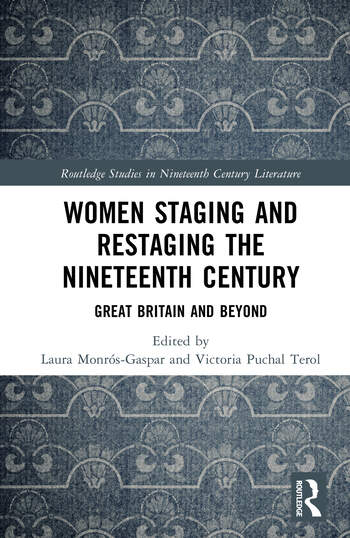

s Laura Monros-Gaspar and Victoria Puchal-Terol explain in their introduction, Women Staging and Restaging the Nineteenth Century seeks to revisit forgotten histories of theatrical women. The editors see their task as filling in the "holes" of theatre history so that they become "meaningful 'wholes.'" At the same time, the editors admit that the "immeasurable" dimensions of "all that is missing" from their study makes it necessarily "partial and incomplete" (13). The resulting two-part volume of essays and articles draws on sources from around the globe relating to theatre and literature created, produced or otherwise influenced by women of the nineteenth century.
Part One centres on nineteenth-century theatre. In these chapters, actresses like Ellen Terry, Mrs. T. P. Cooke, and Joanna Baillie jostle for attention alongside early Japanese musicals and theatrical networks. In Part Two, the focus becomes more contemporary, shifting from Lou Tellegen's production of Oscar Wilde's The Picture of Dorian Gray in the 1900s to the far-reaching influence of Pre-Raphaelite Elizabeth Siddal in today's culture, together with neo-Victorian fiction and group narratives. Commentary on modern performance and media dovetails with in-depth observations relating to nineteenth-century actresses, managers, and performers. Indeed, there is a pleasing degree of overlap running throughout the volume, with individuals and works cross-referenced, adding to the volume's overall consistency and continuity.
The opening chapter, "Staging the Invisible" by Miriam Borham-Puyal, takes readers back to the turn of the nineteenth century by exploring the life and work of Scots playwright Joanna Baillie (1762-1851), her work on "sympathetic curiosity,"(19) and her otherness as both a Scots playwright in England and as a successful female writer. It also illuminates Baillie's lesser-known work set in Sri Lanka, The Bride (1828), drawing connections with Aphra Behn's Imoinda from her play Oroonoko, and Western narratives such as the legend of Tristan and Isolde. Borham-Puyal concludes that Baillie's work "reflects the context in which she wrote. One could maybe go as far as to suggest that Baillie, as a Scottish female playwright, is also doubly foreign and might have experienced displacement from the centre of the stage panorama of her time" (31).
The next chapter, "Mrs T.P. Cooke" by Victoria Puchal Terol, considers the life and work of Louisa, wife to the actor T.P. Cooke (1786-1864). Thomas Potter Cooke was a popular actor in early Victorian theatre, noted for largely nautical heroic roles; his archetypal roles, including Frankenstein's Monster in Presumption (1823) and Captain Vanderdaeken in The Flying Dutchman (1826), make him an important figure in early nineteenth-century drama. After examining the influence Louisa Cooke had on her husband's acting decisions, Terol focuses on Mrs Cooke's sole play The Forced Marriage, translated and adapted from Desnoyer's original French work, Le Mariage Forcé (1833). Set in Russia at the Czarist court of the 1790s-1800s, it follows the relationships, marriages, and divorces of the courtiers, in particular the forced marriage of Countess Fedora Ozeroff. Terol compares the play with the nearly identical The Sledge-Driver by playwright Elizabeth Planché (née St. George, 1796–1846), explores the borrowed dialogue, and unravels the play's evolution, examining complexities of translation, adaptation, and staging of the play in 1842, with her husband, T.P. Cooke, taking the lead role. Terol considers the commentary on female social expectations and self-discovery within the framework of the play, observing how Mrs. Cooke handled contradictions through her female protagonist, and suggests that there are questions still to be answered about Mrs. Cooke's life and writings, particularly "the collaborative dynamics that lie behind Mrs. Cook's substantial borrowing" from Planché.
"Staging a Victorian Marriage" by Sarah McCarroll jumps to the late nineteenth century to examine Ellen Terry's "wifely" (61) portrayal of Lady Macbeth opposite Henry Irving's Macbeth at the Lyceum Theatre in 1889. Drawing on Terry's own thoughts, conveyed through her stage notes, this article gives an intimate peek into the actress's mindset. She perceived the character of Lady Macbeth "as a small, slight, woman of acute nervous sensibility" and envisions her as "all over a woman" (58-9) expressing the potential for evil existing not in a fiendish serpent form nor in the mould of Siddons' "fiend-like queen" consumed by ambition (55) "but in the body of a Victorian wife" (63).
With Amanda Nelson's "Performing Management Through her Pen," the volume moves from historical bodies to influential ones. In this chapter Nelson focuses on Mrs. Minnie Maddern Fiske, an American "producer, agitator and advocate" (67). The chapter's title aptly describes Mrs. Fiske's remote yet effective way of working. She was clearly successful at shaping perceptions of theater, while her practical knowledge of theatre and commitment to nurturing talent bolstered her as an in-demand dramaturg and mentor; meanwhile, outside of the theatre, she also advocated such causes as animal rights and conservation. Examples of her effective campaigning include a letter to Mark Twain against bull-fighting which inspired him to write The Horse (1906). The correspondence also includes letters to her husband that testify touchingly to a busy, happy marriage, with both partners united in support of common goals such as supporting Fiske's Actors Fund charity. In conclusion, Nelson finds that "Minnie Maddern Fiske [...] embodied the contradictions of her time, as she lived and worked in the space between Victorian ideals and New Woman ideas" (75).
From America we are whisked off to London and Japan, through the eyes of Japanese performer Ritsuko Mori, in the fascinating chapter "Silenced Negotiations of a Modern Japanese Female Performer" by Ayumi Fujioka. This intriguing and informative article compares Victorian musical comedies with the new Japanese "actress plays," in which leading roles were performed by actresses. The chapter is packed with details about Masudo Taro (1875-1953), author of actress plays such as A Silent Journey (1908), and about Ritsuko Mori (1890-1961), who performed many leading roles in these plays. Fujioka gives glimpses of Mori's stay in pre-WWI London while studying British theatre, experiences Mori later recounted in A View of the West: My Journey (1913). Fujioko considers examples of British and Japanese musical theatre, and compares A Shop Girl (George Edwards, 1894) with Which Do You Prefer (Masudo Taro, 1917) in the context of cultural encounters and dynamics between the British and Japanese empires. The chapter offers insight into early twentieth-century Japanese theatre and performance, within their past and present cultural frameworks while encompassing their innovations and influences.
The following article,"Emily Caroline Massingberd" by Laura Monros-Gaspar, considers the theatrical world in connection with women's clubs at the end of the nineteenth century. She is particularly concerned to show how the Pioneer Club, founded and managed by Emily Massingberd, served professional women from the arts and sciences, while also showcasing the theatrical talents of Massingberd, who presided over the club from 1892 until her death in 1897. Monros-Gaspar ends by asking whether "embracing women's clubs within the history of both professional and amateur theatre of the late nineteenth century might help us expand our historiographical research methods on the period"(109).
Part 2 opens with "Women and the Nineteenth Century at the National Theatre of London" by Sarai Ramos-Cedres. This is an informative reference text, rich in infographics, charts and tables, that illustrates the history of the National Theatre and its relationship with women writers and directors. Ramos-Cedres concludes that while these tended to focus on more modern topics and new pieces of writing, their recent participation in the staging of nineteenth-century plays and/or works inspired by the nineteenth century "may be a slight indication of women starting to approach the past in order to talk about the present" (143).
The theme of approaching the past to talk about the present continues in the chapter "Re-membering the Nineteenth Century English Stage in Lolita Chakrabarti's Red Velvet (2012)" by Ana Fernandez-Caparros. This rich and detailed article offers a condensed portrait of the actor Ira Aldridge (1807-1867) through the lens of the play Red Velvet by Chakrabarti, considering her as a performer "unconstrained by heritage [...] at once exotic, polite, professional, [and] charismatic" (158). Fernandez-Cabarros places the huge success of the play in the context of obscured historical personalities, the arrival of new works, overcoming prejudices and hidebound theatrical networks, reclaiming "the crucial roles of theatre in fostering a deeper understanding of the nation and its past within the context of a globalised present" (161).
Bridging the past with the present is also the core of "19th Century Caring in Contemporary Biodrama" by Beth Palmer, which opens with the words: "Our fascination with the 19th century is characterised, [...] by a sense of reiteration, of repetition and re-assertion." This same fascination, Palmer continues, has contributed to the production of neo-Victorian biodramas that often mix fact and fiction or involve multiple timelines. Palmer suggests their popularity may be partly due to their "commentary [on] the past to inform the present" (165). In this context she explores the ethics and practises of care, both emotional and physical, in connection with two plays based on Victorian figures: Marys Seacole (2019) and The Ballad of Maria Marten (2021). Both plays, she finds, operate within "relational networks of care and communities of other women" (168). Palmer clarifies that these playwrights are not writing as historians. Rather, they are using their creative interventions to support an understanding of historical individuals and events through a contemporary lens, exploring how attention to historical figures "can create a "temporal bridge that connects the past to the future" (177).
Biodramas, neo-Victorianism, and group narratives come together in Chapter 10, "Bruising Encounters," by Benjamin Poore. In this chapter, Poore observes that contemporary historical theatre is dominated by biography. Like Palmer, he refers to Gupta's The Empress as well as Ira Aldridge in Red Velvet. He then presents a lively discussion of four examples of neo-Victorian group narratives by female playwrights (Blue Stockings (2013), The Empress (2013), Scuttles (2015), The Sweet Science of Bruising (2018)), and notes the presence of "connections between these group narratives, re-examining the relationship between individual characters, groups, and meaning as expressed through a play's dramaturgy" (181). Poore draws on Bertolt Brecht as well as his own works on staging the Victorians, analysing and tracing the influences of Victorian heritage and post-Victorian appropriation of Victorian tropes as well as neo-Victorianism itself. He proposes that the "arrangement of characters — how they are deployed, distributed, and disposed of — is inseparable from meaning in these group historical dramas," and ends by suggesting the wider, more global perspective on the Victorians (as exemplified by The Empress) seems the way forward for future neo-Victorian theatre (193).
With "Two Portraits of Dorian Gray" by Victoria Duckett, the volume shifts from neo-Victorianism back to the Decadents. In this chapter, Duckett explores the creative use of stage and screen with Oscar Wilde's The Picture of Dorian Gray in two productions a century apart: Lou Tellegen's in 1913 and the Sydney Theatre Company in 2020. Duckett indicates the importance of Tellegen's version as an international production and notes its use of animation to illustrate the changing appearance of Gray's portrait, comparing the technological challenges and innovations with the 2020 production. There are several interesting details about Tellegen's unsuccessful production of Gray, his relationship with Sarah Bernhardt, and his film debut. Of particular interest is Tellegen's use of magical illusion in the live staging of Dorian Gray's portrait. Duckett compares this with the use of technology (screens, real-time video and live theatre) of the 2020 production, during the Covid-19 pandemic, in Sydney, and she concludes that there are more similarities than differences between productions despite the years between them, proposing that "we acknowledge surprising points of overlap" (210).
The next two chapters leave stage and screen for neo-Victorian fiction and ideas of assemblage. In Chapter 12, Rosario Arias takes a look at Barbara Ewing's The Mesmerist (2008), and shows the connecting threads between real-life mesmerist Miss Preston and Ewing's fictionalised Cordelia. Arias concludes by observing the alternative take on mesmerism as "opening new ways of dealing with power dynamics, thus depicting Cordelia's self-and-life as a network, as an assemblage of people, ideas, places, feelings" (227). In Chapter 13, "Powerful Women and Assembled Bodily Strength," Lin Pettersson explores neo-Victorian novels with entertainment at their core—notably scenes involving the circus and the music hall—and seeks to demonstrate how assemblage theory "recognises the embeddedness of the female body in networks of dualisms and how the female body has been shaped by ideological forces." Petterson suggests that the sub-genre of spectacle fiction provides "a fruitful venue for further development" of this line of thought (244).
The volume closes with "Reframing Lizzie" by Cristina Santaemilia who offers a comprehensive overview of the many works inspired by the Pre-Raphaelite artist, muse and poet Elizabeth Siddal. Essentially this reads as an informal catalogue of novels and works for stage and screen, along with their critical reception; as such, it is very handy for devotees of each genre/media, and several golden nuggets may be discovered here, such John Hale's The Love School (1975), companion piece to the television series of the same name. It also serves as a reinforcement of the enduring influence of Elizabeth Siddal and the Pre-Raphaelite Brotherhood, nearly two hundred years on.
While it is addressed primarily to academics and students of English Studies and drama, the volume nevertheless also offers much to interest non-specialist readers. Altogether these essays offer fresh information on nineteenth-century historical individuals and their works, with occasional insights into the perspective of those individuals. Clearly where archives lack evidence, only conjecture is possible, and we are fortunate that professionals such as Ellen Terry and Mrs. Fiske left behind copious written documentation of their lives that has survived into the present day.
The first half of the book fulfils the promise of its title by focussing on the nineteenth-century stage and illustrating the era and its performers: a reference book, after all, ideally supplies knowledge, along with ideas for further discussion, and on the whole this book functions well in these respects. Several chapters in the second part might have benefitted from less convoluted phrasing; it did feel at times as if some authors were hiding their ideas behind the padding of academic terminology. Nevertheless, despite its occasionally obtuse language, there are plenty of treasures to be found in this book.
Related Material
- Victorian Drama
- Ellen Terry (sitemap)
- Dramatic Adaptations of Victorian Fiction (sitemap)
- Review of Marina Cano's Theatrical Afterlives: Nineteenth-Century Women’s Novels on the Stage
Bibliography
[Book under review] Monros-Gaspar, Laura and Victoria Puchal-Terol. Women Staging and Restaging the Nineteenth Century. New York: Routledge, 2026. ISBN 9781032997384. Hardcover. 292 pages.
Created 22 October 2026
Last modified 25 October 2026