
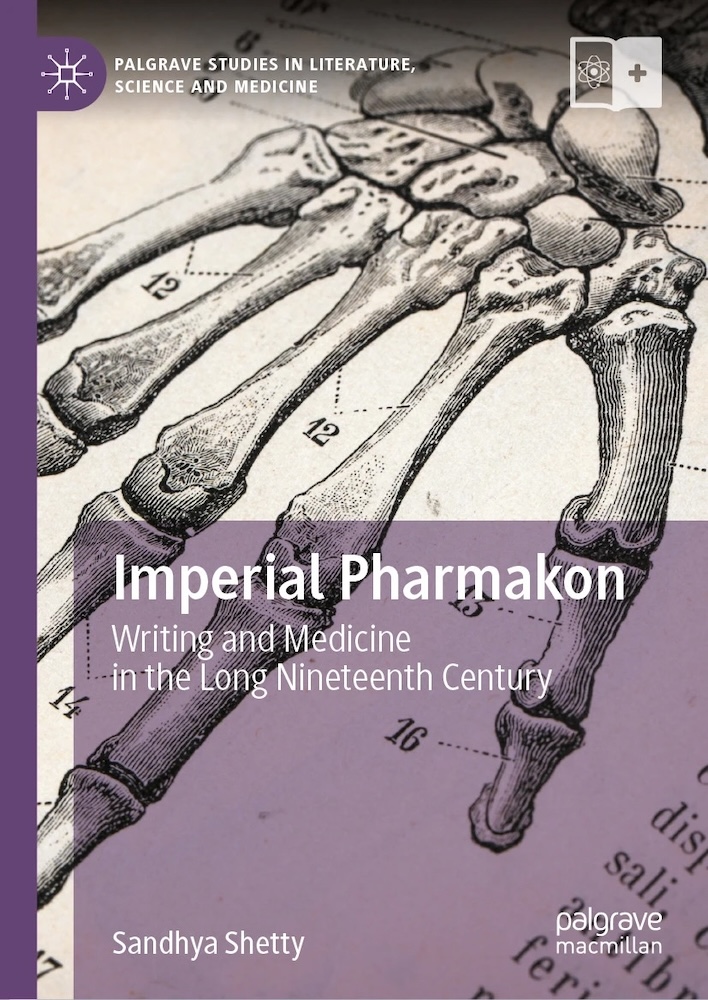

hile recent scholarship on British-Indian imperial medicine has focussed on pivotal events, such as the developments of germ theory and sanitation, or emergent specializations like tropical medicine, or on readings of medical metaphors in literature, Sandhya Shetty’s Imperial Pharmakon: Writing and Medicine in the Long Nineteenth Century (2025) offers an innovative assemblage-oriented reading of British imperial medicine, positing the intervention of Western medicine in India as an ecology of epistemic divisions and disparate practices (25). Featuring wide-ranging analyses that edge even into the interwar period, Shetty’s work yields an original picture of Western medicine in British India that acknowledges the racial and cultural violence of colonial medical intervention while explicating sites of systemic rupture within this history.
The introductory chapter, "Imperial Pharmakon: Writing/Medicine," outlines the monograph and previews Shetty’s medical humanities-oriented methodology of combining theory, often Derridean, with close readings of moments in which the intervention of Western colonial medicine is either bolstered or critiqued through rhetoric, calling into question disciplinary divisions between literature, science, and medicine (17). In this first chapter, Shetty discusses the process by which Western medicine became naturalized within nineteenth-century trans-imperial ecosystems. More specifically, Shetty argues that Frantz Fanon (1925-1961) and Mohandas Karamchand Gandhi (1869-1948) should be seen as revolutionary figures responding to colonial medical intervention in French Africa and British India respectively.
Tracing the etymology of the word pharmakon, Shetty skillfully integrates the term within the assemblage-oriented nature of their project. Starting with Derrida’s argument, in "Plato’s Pharmacy" (1983), for the drug-like ambiguity of writing, considered as "both remedy and poison, cure and intoxicant," Shetty articulates the semiotic confusion inherent to the term pharmakon, which signals both medical therapeutics and rhetorical treatment simultaneously (6). In addition to pharmakon, Shetty cites entanglement as the other unifying metaphor of Imperial Pharmakon (31). For Shetty, both figures offer means of thinking "ecologically," "offer[ing] fertile conceptual ground from which to trouble the default anti-ecological bias of the culture of medicine" (31). This "anti-ecological bias" includes the negation of non-human animals in medical historiography and philosophy, which Shetty moves toward recuperating through the inclusions of Gandhi’s vegetarianism and the mosquito in the scientific-poetic writing of Ronald Ross (1857-1932; see chapters 7 and 3, respectively). Both pharmakon and entanglement allow for the relationality that grounds this project, with pharmakon "refusing to foreclose" on, or exclude consideration of, connections between distinctions such as culture/biology, history/fiction, and rhetoric/biopolitics (10).
This ecologically-oriented approach extends even to the organizational structure of Imperial Pharmakon. After the three sections that present chapters thematically ("Chemistries," "Enmities," and "Quackery"), Shetty divides chapters, once again, into overlapping categories. In Chapters 3, 5, and 6, Shetty investigates moments in which Western medicine held a triumphant and univocal position in India. Meanwhile, Chapters 3 and 4 highlight instances where colonial medical modes of production seem "sluggish" or "anxious"; and Chapters 2, 3, 4 respectively consider unexpected exchanges between Western medical methodologies and foreign enthusiasm, poetic rhetorics, and subversion of gendered expectations (8). While the chapters in Imperial Pharmakon might seem disparate on their surface, the cross-sectional commonalities that Shetty uncovers successfully emulate the assemblage model by which she reads British imperial medicine, proving the author's point that these seemingly unrelated episodes are connected in surprising ways within this ecology of colonial medical rhetoric.
The following chapter, "Necrospheres of Empire: Anatomy in the Age of Enterprise, 1835-1849" centers on the establishment of the Calcutta Medical College (CMC) in 1835 and the trans-imperial implications of cadaveric and anatomical dissection in 1830s colonial India (25). In 1836, the first cadaver dissection in India took place at the CMC, which Shetty claims was positioned by the East India Company as a "momentous event marking the birth of modern India" (47). This major intervention of Western science centered on the Pandit Madhusudan Gupta (1800-1856), the inaugural Demonstrator of Anatomy at the CMC (49). Gupta’s accomplishments in the "modernization" of Indian medicine, Shetty argues, were recognized through the paired unveiling of a commemorative portrait, by Madame Sophia Charlotte Belnos (1795-1865), titled "The First Hindoo Anatomist of British India" (1849), and a medical oration by John Drinkwater Bethune (1801-51) on July 15, 1849 (57). Shetty reads Belnos’ painting as a "visual paratext" to Bethune’s speech. This example of the ritualistic medical orations that took place at the CMC leaned particularly on English literary culture, including allusions to poets Abraham Cowley and John Milton (81-82). Together, Shetty concludes, Belnos’s painting and Bethune’s oration exemplify the ways in which the CMC's leaders were less concerned with humanitarianism than with the rhetorical work of framing the CMC as a promising beginning to a new age of medicine in India (97).
Late nineteenth-century parasitology and tropical medicine are the concerns of Chapter 3, "Malaria and Melancholia: Writing Life in Colonial India." Shetty focuses on the writing of Ronald Ross (1857-1932), the British-Indian doctor and poet known for his discovery of the malarial parasite in mosquitoes in 1897. The bibliography of this "poet-scientist" includes essays, lectures, laboratory notes, letters, and poetry (121; 125). Shetty reads the discovery of the malaria parasite’s double life cycle — the result of a collaboration between Ross and parasitologist Patrick Manson (1844-1922) — and the inaugural cadaver dissection in India at the CMC as bookending events for the medical history of British India. While the CMC demonstrated the extractive aims of early colonial activity, Ross and Manson’s discovery occurred just as the focus of British imperialist attention turned to Africa (121). Considering Ross’s work across a variety of genres, Shetty's analysis follows that of philosopher Michel Serres on the figure of the parasite. Shetty suggests that Ross’s "hybrid practice of nonscientific writing about science [...] bears the logic of the parasite understood not in the usual human or animal terms, but as commotion, noise," by injecting poetic subjectivity into the assumptions of objectivity surrounding the medical historian (130). Textual examples that Shetty highlights include In Exile, Ross’ 1931 long poem, which Shetty reads as "the much alluded-to residue of the creative process of poetic composition that shadowed the investigation of malaria all the way to its culmination in 1898," and Ross’s Memoirs (1923), in particular his tendency to mix autobiography, memoir, and scientific monograph (161, 171-3).
In Chapter 4, "Dying to Be a Lady Doctor: Anandibai Joshi and the Gyn/Ecology of Colonial Medicine," Shetty expands the ecology of her examples to include embodied gender alongside the disciplines of obstetrics and gynecology. Anandibai Joshi (1865-1887), "a young Brahmin child-wife from Western India," was the first Indian woman to travel to the United States for medical education, receiving her M.D. from Women’s Medical College of Pennsylvania in 1886; Joshi would die from pulmonary tuberculosis a year later, before being able to take up her anticipated post as Physician-in-Charge at a hospital in Kolhapur (185). Shetty describes how Joshi’s position as the first "high-caste Hindu Lady Doctor" was revised to fit colonial narratives of Western Indian social reform in the latter half of the nineteenth century; this positioning persisted despite her transgressive behaviour, such as arguing for her own right to Western medical education (185-7, capitalization Shetty’s). Relative to colonial historical documentation, Shetty argues that the "rupturing" of norms that Joshi represents can be best understood through her private letters sent between Philadelphia and India, written in both Marathi and English (190). The rhetorical ecology that Shetty traces in Joshi’s history also includes a public speech that Joshi gave at Serampore in 1883, on the eve of her departure for the United States, which Shetty terms an "apologia for a high-caste woman’s travels abroad" while offering glimpses of a desire for cosmopolitanism that was forbidden by standards of Brahmin femininity. Shetty reads Joshi's M.D. thesis, "Obstetrics Among the Aryan Hindoos" (1886), through Derrida’s lens of the mal d’archive elaborated in Archive Fever (191-93). "The key to uncovering the impalpable imprint of the mal d’archive," Shetty writes of Joshi, "is recognition of the ill female body that mutely disorders the patriarchy that [her] M.D. thesis retrieves" (195).
Chapter 5, "Kipling’s Medicine: In Camp and Gynaeceum," opens the second section of Imperial Pharmakon, entitled "Enmities." In this section, Shetty shifts from the experimentation of Part I to an examination of sites which demonstrate how the intervention of Western language of public health into colonial oppression produced hostility rather than a biopolitics of care (36). Opening a chapter that references Rudyard Kipling’s novels and poetry, Shetty cites "The Song of the Women" (1888), which praises the efforts of the Countess of Dufferin Fund to supply medical care to Indian women, as an entry to the trend of Kipling’s journalism leading into literary projects that centre on the administration of public health (239-40). While Shetty’s engagement with "Song" is (perhaps too) fleeting, Shetty’s close reading of Kipling’s The Naulakha: A Story of East and West (1892) is the most capacious and detailed of any in Imperial Pharmakon, drawing out the assemblage of biological, economic, and political meaning in the text (243). The Naulakha, Shetty argues, maps the concerns regarding pediatric and obstetric care that Kipling evinces in "Song" onto the adventure fiction structure for which he is so well known and further serves as a rare example of Kipling giving the curative capacity of Western medicine sustained attention in his fiction (240).
Shetty’s close reading of the The Naulakha places it on the spectrum of Kipling’s shifting feelings towards Anglo-American women’s entry into colonial medicine. Other texts mentioned here include "William the Conqueror" (1895-6) and "City of Dreadful Night" (1885). While "The Song of the Women" celebrates the role of medical women from the West, The Naulakha is more ambivalent, entertaining but ultimately resisting endorsement of female medical labour in India (245). Shetty argues that Kipling’s depiction of Indian life and death concentrates issues of gender and medicine in a way that reveals an anxiety about "demographic excess" that is evident, for instance, in his representation of the "sickly" gynaeceum that becomes bio-politically worthless (246, 253). The Naulakha, to Shetty, therefore narrativizes the "aggregate and the biopolitical" rather than clinical or individual processes in a way that is forecast by Kipling’s journalistic work and other late nineteenth-century fiction concerned with the New Woman and her role in the colonial medical field (246). Yet, even with this aggregate focus, Kipling’s placement of the Western woman doctor character alongside a male Indian doctor positions them as equally ineffectual (255-256).
The next chapter,"Incontinent Subcontinent: Nations Must be Defended," reads Mother India (1927), a polemic by the American journalist Katherine Mayo (1867-1940), as a counterinsurgent project that echoes Kipling’s vision of an "incorrigible India" and poses Indianization as an "alarming global Emergency" due to its resistance of British intervention (307). Shetty notes that Mayo's insistence, in Mother India, on the familiar trope of India as a contagious bastion of infection was contested by many, including by Gandhi, the subject of the following chapter (312). Shetty contextualizes Mayo’s text by putting it in conversation with the politics of the interwar period, citing events such as Britain’s 1919 Government of India Act, which endorsed electing Indian officials to provincial administrative positions (315). Shetty positions Mother India alongside a contemporaneous argument, made by the German political theorist Carl Schmitt (1888-1985), that enmity is inherent to politics, tracking the shifts in Mayo’s writing from Eurocentric visions of public health to what Shetty terms Mayo’s "genocidal reveries" (307). As Shetty observes, Mayo’s American perspective is noteworthy for its evangelical approach to public health relative to the British colonial administrative efforts that unite the other chapters of Imperial Pharmakon, Shetty does not explore the implications of Mayo’s worldview. This was one of a few moments in the monograph that left this reader wishing for more detail (317).
Chapter 7, "‘The Quack Whom We Know’: Experiments in Nursing Hospitality," along with Shetty’s Conclusion, make up the monograph’s third section, "Quackery." Here, Shetty enlists Gandhi’s notion of quackery to characterize his critique of the colonial modernization of medical care (361). "Quackery" first appeared in Gandhi’s Autobiography: The Story of My Experiments with Truth (1925-1929) and, for Shetty, the term brings together the assemblage of Gandhi’s medical life: a principled, if inconsistent, rejection of modern medical treatment in favour of an ethical approach to care (361). Through Gandhi’s polemic against Western medicine, Hind Swaraj and Other Writings (1910), his Autobiography, and other texts, Shetty identifies and explicates Gandhi’s commitment to an embodied, self-cultivated ethics, one that combined asceticism with respect to both illness and care with a nursing hospitality that professed a "love" for the ill (360, 364). To the former, Shetty argues that Gandhi saw diet as a "central remedy" in his ethical caregiving, with vegetarianism contributing to an ecological understanding of life and illness that respects human entanglement with nonhuman life (362). Shetty contends that this dietetic asceticism, and Gandhi’s "excitement at the prospect of intimacy with diseased bodies," grounds his alternative to Western medicine’s divestment from the moral (364).
Altogether Shetty has certainly achieved her aim of highlighting those episodes from British-Indian history and literature that lend themselves to a reading of imperial medicine as a "changeful complex of orientations, relations, and effects" rather than a straightforwardly "dry, prohibitive, and stigmatizing" exercise of Western powers (399). The fascinating choice to include the monograph’s conclusion within the section titled "Quackery" reiterates the ways in which Shetty’s reading follows the Gandhian "quack" approach to medicine by drawing out episodes whose apparent lack of cohesion may seem risky or "radically ad hoc," but together convincingly suggest the ways in which paratextual and rhetorical analysis offers a more inclusive picture of the medical landscape of British India (316). Indeed, Shetty’s ecological reading is most original in terms of the capacious range of rhetorical genres — oration, poetry, polemic, novel, autobiography, and even visual art — enlisted to either advocate for or to critique Western imperial medicine in the long (long!) nineteenth century.
Links to Related Material
Bibliography
[Book under review] Shetty, Sandhya. Imperial Pharmakon: Writing and Medicine in the Long Nineteenth Century. London: Palgrave Macmillan, 2025. 462 pp. ISBN 78-3-031-90876-7
Bethune, John Drinkwater. General Report of Public Instruction in the Lower Provinces of the Bengal Presidency, 1849-1850. Kolkata: Military Orphan Press, 1851.
Derrida, Jacques. Archive Fever: A Freudian Impression. Translated by Eric Prenowitz. Chicago: University of Chicago Press, 1996.
—. "Plato’s Pharmacy." Dissemination. Translated by Barbara Johnson. Chicago: University of Chicago Press, 1981. Pp. 61-171.
Gandhi, M.K. Hind Swaraj and Other Writings, ed. Anthony Parel. Cambridge: Cambridge UP, 1997.
—. Autobiography: The Story of My Experiments with Truth . Translated by Mahadev Desai. Garden City, NY: Dover Publications, 1983.
Joshee, Anandibai. "Obstetrics Among the Aryan Hindoos." MS. Archives of the Special Collection of Women in Medicine, University of Pennsylvania. 1886.
—. Anandi Gopal: Aprakashith Sadhanathoon Disnare. Edited by C.M. Parchure, Supriya Atre, and M.M. Omkar. Bharatiya Itihasik Sankalan, 1999.
Kipling, Rudyard. "Song of the Women." Pioneer Mail, April 1888.
Kipling, Rudyard and Wolcott Balestier. The Naulakha: Story of East and West. London: Macmillan and Company, 1892.
Mayo, Katherine. Mother India. Garden City, NY: Blue Ribbon Books, 1930.
Ross, Ronald. Memoirs: With a Full Account of the Great Malaria Problem and its Solution. London: John Murray, 1923.
—. In Exile. London: Harrison & Sons Ltd, 1931.
Serres, Michel. The Parasite. Translated by Lawrence R. Schehr. Baltimore: The Johns Hopkins University Press, 1982.
Created 9 March 2026; last modified 10 March 2026