
"[M]y whole soul is devoted to building this church here," wrote Pugin to the Earl of Shrewsbury. "I have got a scite (sic) and am collecting materials. I have a deliful (sic) plan of a flint Sea side church and everything gives way to that" (Belcher 270).
Exterior

St Augustine's Abbey Church, next to St Edward's Presbytery. Listed Building. Augustus Welby Pugin (1812-1852), with George Myers (builder), John Powell Hardman (stained glass and metalwork), Herbert Minton (tiles) and John Gregory Crace (fabrics). 1845-52, with work continuing until 1893 and involving Edward Pugin (1834-75) and Peter Paul Pugin (1851-1904). Knapped flint with bandings and dressings of Whitby stone; interior also lined with Whitby stone. St Augustine's Road, Ramsgate, Kent.
St Augustine's Abbey Church was part of the group of buildings that included The Grange, the home that Pugin built for himself and his family in Ramsgate, Kent. The church was at the very heart of his vision of a life well lived. He built it at his own expense, with the best materials and craftsmanship he could lay hands on, taking account of local traditions — for example, using flint as his main building material, and giving the church only a single transept. It was both his "own child" (qtd. in Powell 26) and his gift to the Catholic community, for he always intended it to be "a Parochial church" (Belcher 265). As St Augustine's grew, it became his pride and joy, but also a constant challenge. "A vast undertaking, both physically and financially, it became a symbol for his battle of existence as an architect, a struggle to the death" (Hill 412).
The church makes little impact at first. From the top of the road it is overshadowed by the adjacent presbytery or priest's house, which links it to the courtyard of The Grange: note Edward Pugin's entrance gates to The Grange on the right in the photograph above. The presbytery itself is a picturesque, rather cottagey building, with its pointed gables enhanced by tall finials, and the feature oriel made prominent by its painted wooden apron (see Newman 422). Edward Pugin later had his studio in this part of the St Augustine's complex, and Jane Pugin, Augustus's third wife and widow, died here in 1909. The spireless church tower can just be seen behind it on the right.


Left: The church from the churchyard, at the rear. Right: Oak-carved capitals by the north porch entrance.
Built from rugged flintstones all individually hand-cut and variously faceted "to look precious" (Powell 36), the church is only seen as a separate entity from the rear. Here, from across the churchyard, it looks rather uncompromisingly stubby, although the narrow stone bandings and irregular quoins give it character. It also looks tantalisingly asymmetrical, with the roofs to the east and west at slightly different heights, and a single porch leaning against the single transept. Behind that transept (which houses the Pugin Chantry) the low blunt tower speaks poignantly of a dream never fully realised. It never acquired its full height, let alone its spire. The pyramidal tower on St Augustine's Road is not part of the main church building, but of the north cloister range, and is not visible from this angle.
Interior


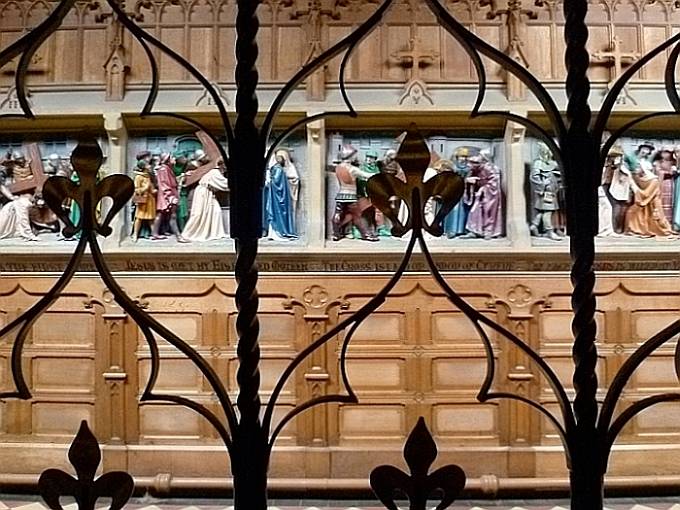
North Cloister, left to right: (a) The Stations of the Cross (partial view). (b) The Altar of the Sacred Heart, designed in neo-Gothic style by Pugin's youngest child, Peter Paul Pugin. (c) The Stations of the Cross panel viewed through John Hardman Powell's delicate fleur-de-lys screen.
There is no west entrance as such. Entry is through the north porch beside the pyramidal tower, and this brings the first surprise, the colourful terracotta panel shown below, depicting the Stations of the Cross along the north cloister. This was to the design of the Flemish sculptor Alois De Beule, and was added after Pugin's time, in 1893. De Beule and his brothers designed many works of this kind (see "Alois de Beule," and Tahon Van-Roose 524); the figures here look more medieval than Roman. Like all churches, Pugin's "own child" was always a collaborative effort and became more so after his death.


Left to right: (a) Below the east window here, the Digby Chantry, or St John's Chapel. (b) Stained glass in an internal quatrefoil window. (c) Stout double columns with leaf-carved capitals contrasting with delicate metalwork.
The Digby Chantry was designed by Edward Pugin for the Catholic convert and religious writer Kenelm Digby, as his family's last resting-place, and its lavishly decorated altar is very much in Edward Pugin's flamboyant style — compare it, for example, to his Knill Chantry at St George's Roman Catholic Cathedral, Southwark. The internal window, with its more restrained beauty, allows in light from the windows in the south wall (the window in the background here is the one depicting St John and St Thomas, in their red and green robes respectively). Beyond that splash of colour is an open doorway, and just a glimpse of the stairs leading to the west cloister.
In restricted confines like these the stout stonework of the church might have seemed overpowering, but the graceful intricacy of the metal and wood screens lightens the effect, as does the dazzle of light though the many windows. The pattern of small spaces, glimpses, vistas and unexpected treasures persists throughout.


Left to right: (a) Charles Locke Eastlake's view of the interior. (b) The rood screen. (c) Powell's intricate metalwork with candleholders surrounds the altar in the Lady Chapel, with the Lady Chapel window above it.
Eastlake's view, taken from underneath the central tower and looking south, shows (from left to right) the screen of the Pugin Chantry, the arch in front of the Lady Chapel, and a portion of the rood screen (since moved from the Chancel to the Lady Chapel). Above these can be seen the rich oak-panelled roof extending over this part of the church. The fine wrought-iron free-standing candelabrum is probably the one designed by Pugin and now in the Pugin Chantry. [Click on this image for a full commentary by Eastlake.]
The rood screen, beautifully carved from oak in Myers' workshop, is a work of art in itself. At one time it framed the splendid tabernacle on the High Altar (as illustrated in Powell 37). At the end of the north cloister, fitted tightly into the narrow space, is the neo-Gothic Altar of the Sacred Heart, designed later by Pugin's youngest son Peter Paul Pugin, also perfectly in keeping with the spirit of the church. Peter Paul Pugin also designed the small chapel to St Joseph beyond the Digby Chantry. Each of these chapels has its own character.

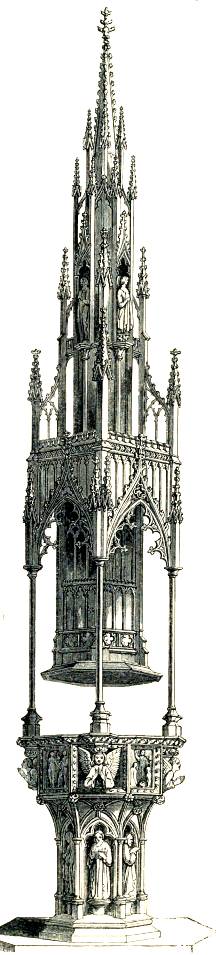


(a) The font at the end of the south aisle, with its immensely tall carved oak canopy, designed by Pugin and made in Myers' workshop. (b) The font as illustrated in the Art Journal catalogue of the Great Exhibition (p.320), with its soaring canopy. (c) One of the angels around the base of the font. (d) One side of the pedestal, showing the Virgin Mary on the left.
The nave, entered at the back from the end of the west cloister, is short — necessarily so because of the size of the plot that Pugin was able to acquire. There is only one aisle, to the south. The chancel is rather narrow, with the Lady Chapel on its south side. So even here the feeling is of ingenuity in the use of space rather than of space itself. But every corner has its interest.
At the west end of the south aisle, opposite the entrance from the west cloister, is the spectacular octagonal font, the cost of which was waived by Myers after Pugin's death (see Wedgwood 4). Carved from a single piece of Caen stone, "perhaps by Myers himself," it shows four Biblical scenes on its octagonal base: the Temptation in the Garden of Eden, Christ's Baptism, the Crucifixion, and St John preaching in the wilderness), interspersed with angels. The figures on the pedestal are those of the Virgin Mary, disciples and saints ("Baptismal Font"). Together with its canopy, the font would have matched in splendour and scale the tabernacle that Pugin designed, probably for the high altar in the chancel and originally placed there, but now to be seen in the Harvard Chapel of Southwark Cathedral. The loyal Myers waived the cost for this item as well. An early guidebook suggested that both tabernacle and font were too grand for their setting in St Augustine's (again, see Wedgwood 4). John Newman also describes the font as "of cathedral proportions" (423). But Pugin was unlikely to have opted for meaner church furniture.
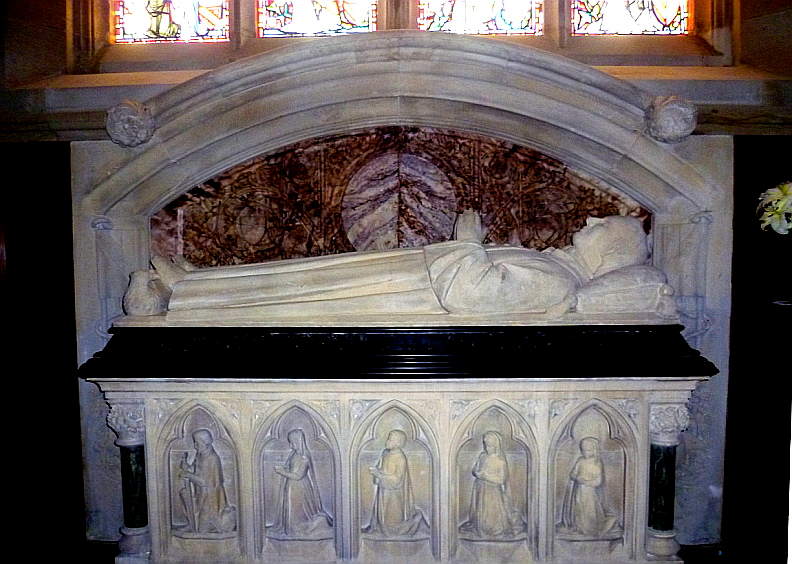

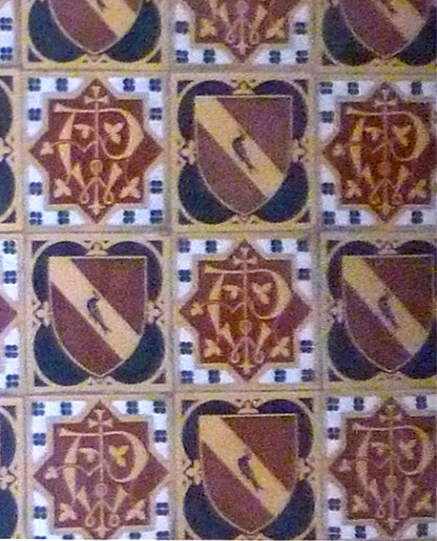
(a) Pugin's tomb chest and effigy in the Pugin Chantry, by E. W. Pugin. (b) Close-up of Pugin. (c) Minton encaustic floor tiles, emblazoned with Pugin's arms and monogram, similar to but not quite the same as those in parts of The Grange.
Perhaps the most important part of the church for many visitors, the Pugin Chantry is in the single transept. It contains Edward Pugin's touchingly dignified tomb chest for his father. Carved in relief along the front of the chest are Jane Pugin and the children, kneeling in prayer and evidently mourning their loss. The effigy itself lies in front of a tympanum of carved and veined alabaster in a rich reddish brown and pink. It is almost stylised, with the architect wearing a simple robe reminiscent of a cassock. "No one was ever allowed to enter the chancel of St Augustine's without wearing a cassock," says Powell; "even the organist had to wear a surplice" (50). Just above the tympanum is the St Augustine window. The highly personalised floor tiles here are particularly impressive.
Pugin had gifted the church in his own lifetime to the "vicars apostolic of the London district" (Hill 319; latterly the Southwark Diocese), and from 1856 it was used by the Benedictine monks of St. Augustine's Abbey opposite. It was finally consecrated in 1884, and Grade 1 listed only in 1988 (see "Church of St Augustine of England"). It has taken some time for this building with its "undistinguished" exterior and "crowded" interior to be fully appreciated (Clark 118). But Eastlake could see even in 1872 that it was "one of his most successful achievements" (162), and concluded that "No student or lover of old English Architecture can examine this interesting little church without perceiving the thoughtful, earnest care with which it has been designed and executed, down to the minutest detail" (163). The church has recently been refurbished and its east cloister now hosts a "Pugin and St Augustine Education, Research and Visitor Centre," which opened in 2017
Photographs by the author. You may use these images without prior permission for any scholarly or educational purpose as long as you (1) credit the photographer and (2) link your document to this URL in a web document or cite it in a print one. [Click on the images to enlarge them.]
Related Material
- Stained glass windows in St Augustine's Church
- The Grange, Ramsgate
- St Augustine's Abbey
- "Augustus Welby Northmore Pugin" (by Charles Eastlake)
- "A Marvellous Man" (Review of Rosemary Hill's God's Architect: Pugin and the Building of Romantic Britain)
Bibliography
"Alois de Beule (1861-1935)." Web (in Flemish, unfortunately). 5 June 2019.
Art Journal Illustrated Catalogue: The Industry of All Nations. London: Bradbury & Evans, 1851. Internet Archive. Web. 4 December 2010.
"Baptismal Font" (information available in the church).
Belcher, Margaret. The Collected Letters of A. W. N. Pugin, Vol. 2. 1843-45. Oxford: Oxford University Press, 2003.
"Church of St. Augustine of England (Roman Catholic) with Cloisters Attached" (British Listed Buildings listing text). Web. 1 December 2010.
Clark, Kenneth. The Gothic Revival. Harmondsworth: Penguin (Pelican), 1964.
Eastlake, Charles L. A History of the Gothic Revival. London: Longmans, Green, 1872. Internet Archive. Web 3 December 2010.
Hill, Rosemary. God's Architect: Pugin and the Building of Romantic Britain. London: Penguin, 2008.
Newman, John. North East and East Kent (Pevsner Architectural Guides: The Buildings of England). 3rd ed. London: Penguin, 1983.
Powell, John Hardman. Pugin in His Home: Two Memoirs by John Hardman Powell. Ed. Alexandra Wedgwood. New enlarged edition. Ramsgate: The Pugin Society, 2006.
Tahon-Van Roose, Monique. "Sculpture," in Flemish Art from the Beginning till Now. By Herman Liebaers et al. Brussels: Mercatorfonds, 1985. 521-534.
Wedgwood, Alexandra. "Pugin's Tabernacle in Southwark Cathedral," in True Principles: The Voice of the Pugin Society. Vol. 2, No. 4 (Summer 2002): 3-5.
Updated 5 June 2019