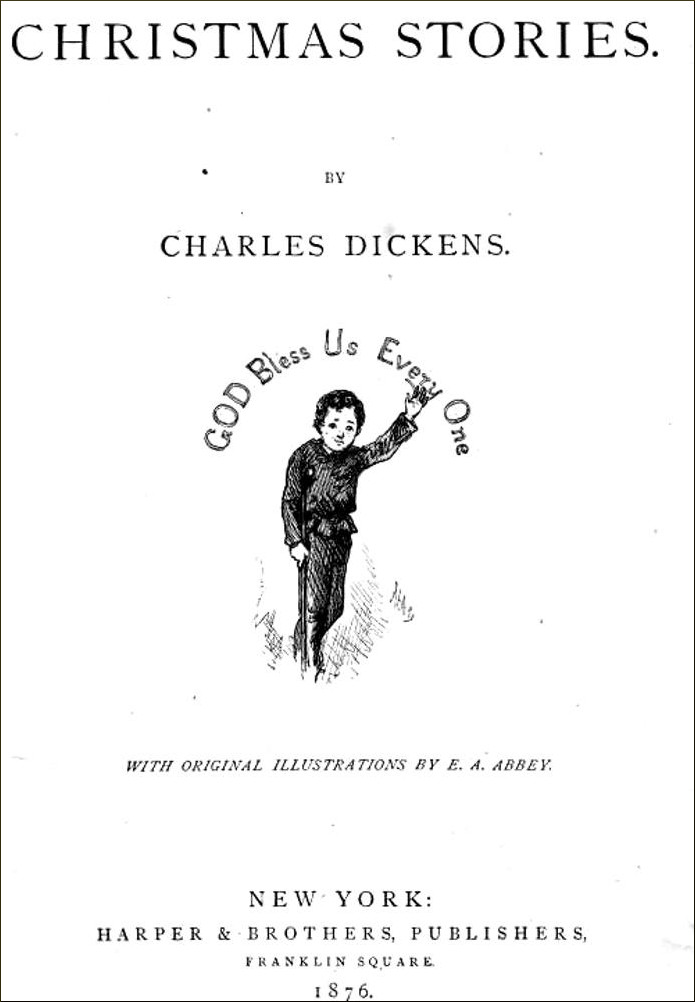
"God Bless Us Every One!"
E. A. Abbey
1876
7 cm high x 5.5 cm
Title-page vignette for Dickens's A Christmas Carol in Christmas Stories (1876)
[Click on image to enlarge it.]
Details
Scanned image and text by Philip V. Allingham. Formatting, color correction, and linking by George P. Landow.
[You may use these images without prior permission for any scholarly or educational purpose as long as you (1) credit the photographer and (2) link your document to this URL in a web document or cite the Victorian Web in a print one.]
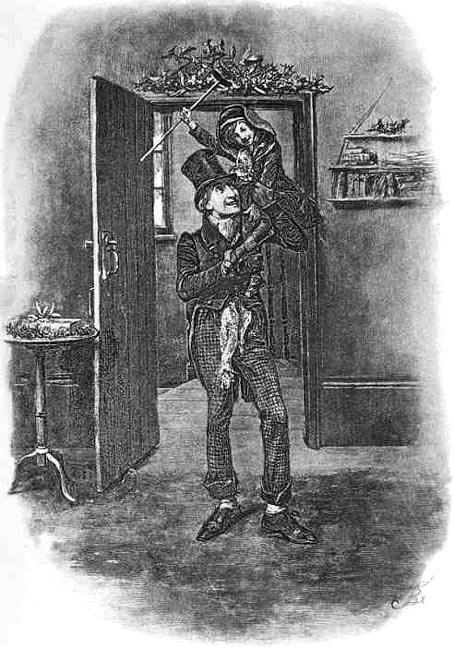
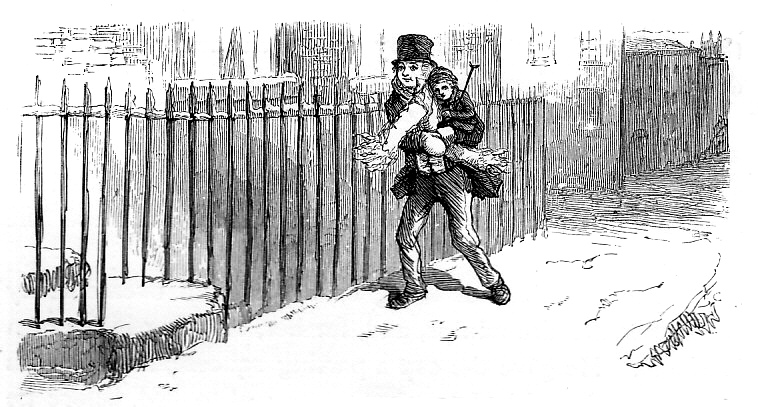
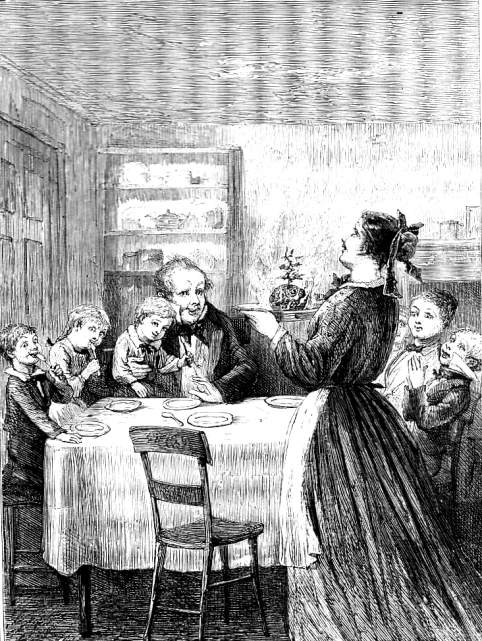
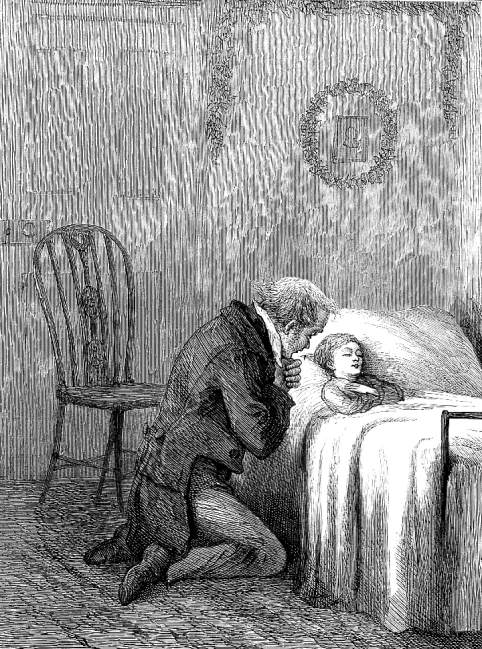
In the title-page vignette, marking the simultaneous opening of A Christmas Carol and the American Household Edition of Dickens's collected Christmas Stories, E. A. Abbey prepares the reader for the final moment of the novella, reiterating one of Dickens's most famous tag lines for his characters. Significantly, although his fate is closely connected with that of the story's protagonist, Tiny Tim does not appear in the original sequence of eight images by Dickens's original illustrator, the Punch cartoonist John Leech. However, Abbey may have seen the scene of Bob and Timothy Cratchit on their way home from church in Sol Eytinge, Junior's "Tiny Tim's Ride". In this chapter-heading illustration in the narrative-pictorial sequence for the Ticknor and Fields A Christmas Carol — A Ghost Story of Christmas (Boston, 1868), at the start of Stave Three ("The Second of the Three Spirits") Eytinge depicts the pair returning home through the snowy streets of Camden Town together. Eytinge again features Tim in his father's arms in "Bob Cratchit at Home", and in a death-bed scene entitled "Poor Tiny Tim", but does not accord the poor man's child any particular prominence. In contrast, although Barnard depicts Bob's younger son but once in his series of five woodcuts for the British Household Edition, he places the boy squarely in the centre of the full-page frontispiece "He had been Tim's blood-horse all the way from church". Abbey's thumbnail study of a rather sturdier and less restrained Timothy Cratchit, against no backdrop and accompanied by no other characters, points to no one specific moment in the text about to be read. Rather, through the vignette Abbey alludes to two passages in the novella, the first at the Cratchit Christmas dinner, and the second, the narrator's quoting Tim in the very last line, which thus becomes a parting benediction on all the story's readers:
"A merry Christmas to us all, my dears! God bless us!" Which all the family re-echoed.
"God bless us every one !" said Tiny Tim, the last of all. [Stave Three, "The Second of the Three Spirits," p. 27]
and
[Scrooge] had no further intercourse with Spirits, but lived upon the Total Abstinence Principle, ever afterwards; and it was always said of him, that he knew how to keep Christmas well, if any man alive possessed the knowledge. May that be truly said of us, and all of us! And so, as Tiny Tim observed, God bless Us, Every One! [Stave Five, "The End of It," p. 39]
Thus, although the initial scene, the frontispiece describing the momentous meeting of Scrooge and the ghost of his business partner on Christmas Eve, introduces the reader to the most famous of The Christmas Books with which the American Household Edition volume begins, the title-page vignette of Tiny Tim, saluting us with his iconic crutch and oft-repeated tag line, welcomes us to Dickens's annual tributes to Christmas, both in the Christmas Books of the 1840s and in his more journalistic and collaborative seasonal pieces of the 1850s and 1860s in Household Words and All the Year Round.
The semi-circular shape of the caption above the figure is interesting in several respects: none of the other Household Edition title-page vignettes has any sort of caption; moreover, this quotation is given in a shape suggestive of both a halo (suitable to the angelic child who, returning home from church, reflects upon Christ's message about caring for the disadvantaged and physically challenged) and perhaps a wreath or a portal — to the Christmas message and the "lived" holiday experience of those among the lower orders whose commonplace lives were rarely the subject of fiction.
Illustrations of Bob Cratchit's younger son by Fred Barnard and Sol Eytinge, Jr. Left: Barnard's conceptions of Tim — detail from the frontispiece of the British Household Edition (1878), and of Tim arriving home from church (1885); detail from "Tiny Tim's Ride" by Sol Eytinge, Jr. (1868). [Click on images to enlarge them.]
For other nineteenth-century images of Tiny Tim, see the diminutive figure in four illustrations by Sol Eytinge, Jr., for the 1868 Ticknor and Fields edition, and Fred Barnard's wood-engraving of Tim and his doting father in the frontispiece for the British Household Edition, and his 1885 photogravure for the third series of Characters from Dickens. Although both Eytinge and Barnard associate the crutch with the appealing child, both illustrators render him as exceedingly small in relation to his father, who is a middle-aged man of but medium height:
Tiny Tim arrives home, enjoys Christmas dinner in his father's arms, and lies on his deathbed (Eytinge). [Click on images to enlarge them.]
References
Guiliano, Edward, and Philip Collins, eds. A Christmas Carol. The Annotated Dickens. Vol. 1. New York: Clarkson N. Potter, 1986.
Davis, Paul. Charles Dickens A to Z: The Essential Reference to His Life and Work. New York: Facts On File, 1998.
---. The Lives and Times of Ebenezer Scrooge. New Haven and London: Yale U. P., 1990.
Dickens, Charles. A Christmas Carol — A Ghost Story of Christmas. Il. Sol Eytinge, Jr. Boston: Ticknor and Fields, 1868.
---. Christmas Books. Il. Fred Barnard. The Household Edition. London: Chapman and Hall, 1878.
---. Christmas Stories. Il. E. A. Abbey. The Household Edition. New York: Harper and Brothers, 1876.
Guida, Fred. "A Christmas Carol" and Its Adaptations. Jefferson, NC: McFarland, 2000.
Parker, David. Christmas and Charles Dickens. New York: AMS Press, 2005.
Last modified 20 November 2012