
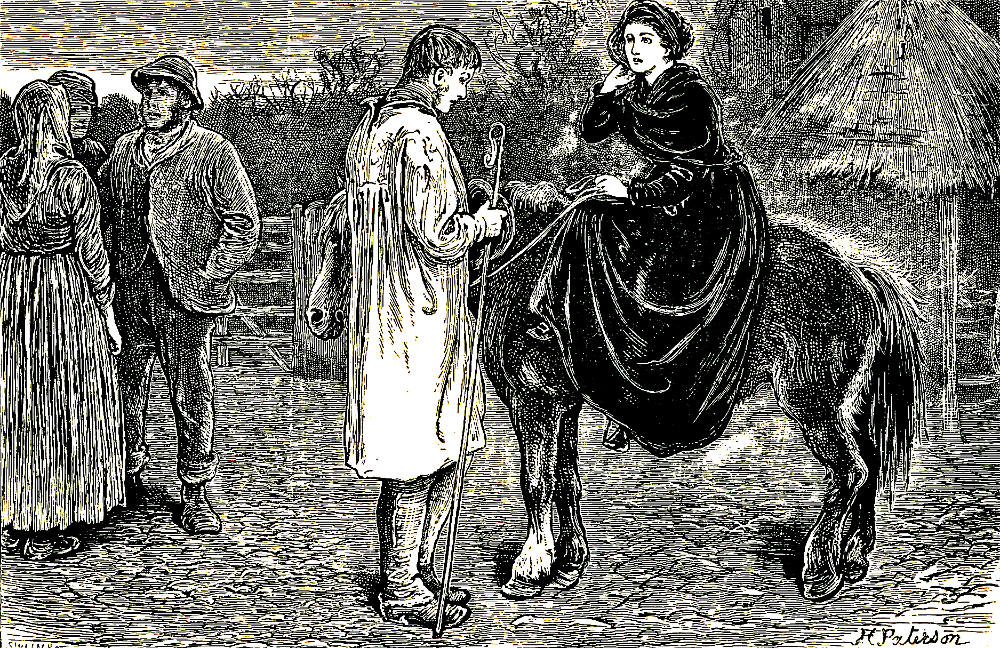
"Do You Happen To Want a Shepherd, Ma'am?" in Chapters 6 ("The Fair: The Journey: The Fire.") through 8 ("The Malthouse: The Chat: News.") in Vol. 29: pages 129 through 153 (24.5 pages in instalment); plates: initial "T" (6.3 cm wide by 7.5 cm high) signed "H. P." in lower-left corner, and "Do You Happen To Want A Shepherd, Ma'am?" (facing page 129) vertically-mounted, 10.5 cm high by 16 cm wide, signed "H. Paterson" in the lower-right corner. The wood-engraver responsible for this illustration was Joseph Swain (1820-1909), noted for his engravings of Sir John Tenniel's cartoons Punch. [Click on the image to enlarge it; mouse over links.]
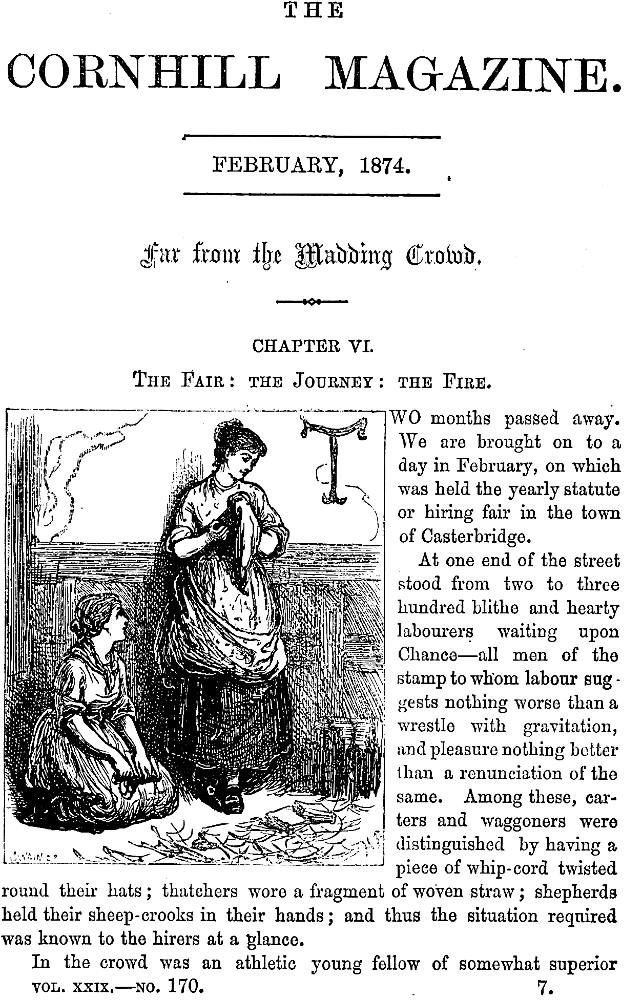
Right: The initial-letter vignette and first full page of the second instalment of the story: T.
The relative positions of Gabriel and Bathsheba have been reversed in the February instalment, but once again Bathsheba is depicted above him and in the act of rescuing him, this time from unemployment. Like Cinderella, she has been miraculously transformed from a girl with "hardly a penny in the world" (p. 22) a mere two months before, when she moved to Weatherbury, into an heiress on a pony, so elevated that Gabriel in his shepherd's linen smockfrock dare not raise his eyes to her. By the time he reaches her farm after his disappointment at the Casterbridge hiring fair, darkness has fallen on the landscape, as the second plate suggests by the shadowy vegetation and close lines in the sky. However, Allingham depicts neither stars nor lingering smoke from the recently extinguished rick-fire. In concentrating on their reversed social positions, the illustrator has neglected such details as the holes burnt into Gabriel's linen smock, and his "grimy" (p. 136) visage, but has included his hat, although the latter article Hardy describes him raising out of respect, rather than actually taking off. Allingham has captured the moment immediately after Bathsheba has drawn back her thick Shetland woollen veil, but before Gabriel regards her face. Although not "charred" as in the letter-press, his shepherd's crook seems "six inches shorter" than it should be. The overall effect of the plate is tranquil, and communicates none of the "abashed" surprise that characterizes this reunion in the letter-press.
On horseback and looking down upon Gabriel, Bathsheba is his social superior — but the height afforded her by the pony is not so great as to place her beyond Gabriel's reach. In contrast, to the left, Bathsheba's messenger to the unknown saviour, Maryann Money, converses with a male farm-labourer face to face and on equal footing. Out of the plate Bathsheba stares, suggesting detachment rather than, as in the text, concern at the awkwardness of the situation or amusement "at the singularity of the meeting" (p. 136). That Bathsheba is, in contradiction to the celebrated 1967 film adaptation starring Julie Christie, dark-haired rather than blonde or brunette Hardy establishes early in the text, and Allingham in the early plates and vignettes. Hardy is specific about her "black hair" (p. 4), but not about the hair colour of her companion, Liddy Smallbury, in the second instalment. Allingham's March plate and February vignette help the viewer to distinguish maid from mistress by depicting Liddy as lighter-haired. Allingham strengthens the narrative continuity of this sequence of illustrations by giving Liddy the same profile in the second vignette and the third plate. The same consistency of approach as to facial features is evident in the principals, although Bathsheba and Gabriel seem to age over course of the program and Troy remains the same. The exception is Paterson's Farmer Boldwood, who is literally a different man in each plate in which he appears (he is in none of the vignettes).
By mid-August, 1874, Allingham must have completed the illustrations for all but the last two instalments of the novel, suggesting that The Cornhill turned out its proofs very early indeed, for illustrators would not have been entrusted with the author's manuscript. Hardy signed with the magazine in the first week of December, and must have seen proofs by the middle of the month, because he did not expect to see the first instalment in print until the February number. In that number, Helen Allingham chooses for her initial letter a subject that does not actually occur until the third instalment (Ch. 9, mid-p. 258, Bathsheba and Liddy clearing away James Everdene's papers upstairs). Possibly the proofs for February which Allingham received contained Ch. 9, which was subsequently moved to the third (i. e., the March) instalment, which is only 22.6 pages long plus plate as we have it, whereas the second instalment is somewhat longer (23.5 pages plus plate), suggesting that editor Stephen felt he needed to cut from no. 2 in order to lengthen no. 3.
Scanned images and text by Philip V. Allingham. [You may use these images without prior permission for any scholarly or educational purpose as long as you (1) credit the person who scanned them and (2) link your document to this URL in a web document or cite the Victorian Web in a print one.]
Bibliography
The Collected Letters of Thomas Hardy. Volume One: 1840-1892; Volume Three: 1903-1908, ed. Richard Little Purdy and Michael Millgate. Oxford: Clarendon, 1978, 1982.

Hardie, Martin. Water-colour Painting in Britain, Vol. 3: The Victorian Period, ed. Dudley Snelgrove, Jonathan Mayne, and Basil Taylor. London: B. T. Batsford, 1968.
Hardy, Thomas. Far From the Madding Crowd. With illustrations by Helen Paterson Allingham. The Cornhill Magazine. Vols. XXIX and XXX. Ed. Leslie Stephen. London: Smith, Elder, January through December, 1874.
Holme, Brian. The Kate Greenaway Book. Toronto: Macmillan Canada, 1976.
Jackson, Arlene M. Illustration and the Novels of Thomas Hardy. Totowa, NJ: Rowman and Littlefield, 1981.
Turner, Paul. The Life of Thomas Hardy: A Critical Biography. Oxford: Blackwell, 1998, 2001.
Created 12 December 2001 Last updated 22 October 2022