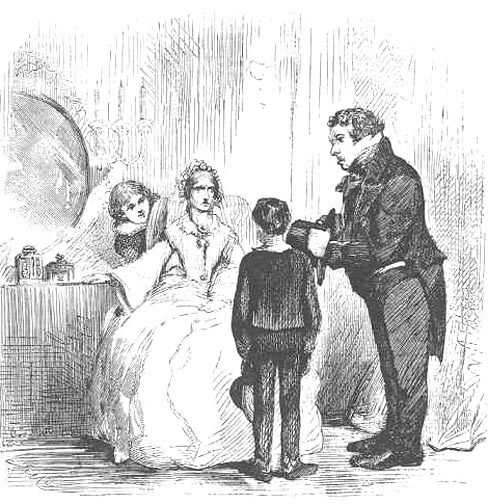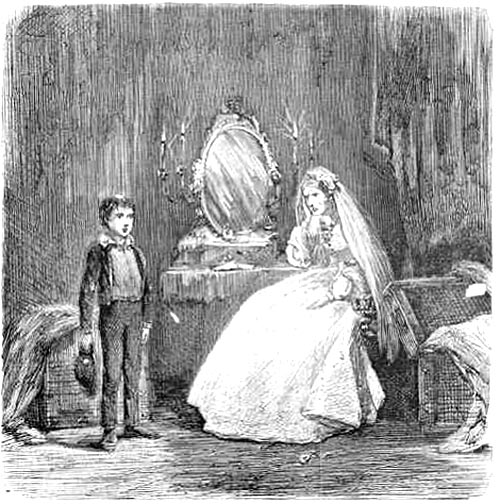
"'Who is it?' said the lady at the table. 'Pip, Ma'am.'"
John McLenan
1860
11.3 cm. by 8.9 cm wide
Dickens's Great Expectations,
Harper's Weekly 4 (22 December 1860): 804
Plate 8 (facing p. 48) in the T. B. Peterson single-volume edition of 1861
Scanned image, caption, and commentary by Philip V. Allingham.
[You may use this image without prior permission for any scholarly or educational purpose as long as you (1) credit the person who scanned the image and (2) link your document to this URL.]
Commentary
Neither space nor time permits an exhaustive comparison of the two illustrators' treatments of Dickens's transatlantic novel, but a detailed discussion of several of Marcus Stone's plates which parallel those in John McLenan's series is possible within a small space. The logical place to begin, given the eccentricity of her dress and her prominence in both the plot and the British editions of 1862 and 1864, is Miss Havisham.
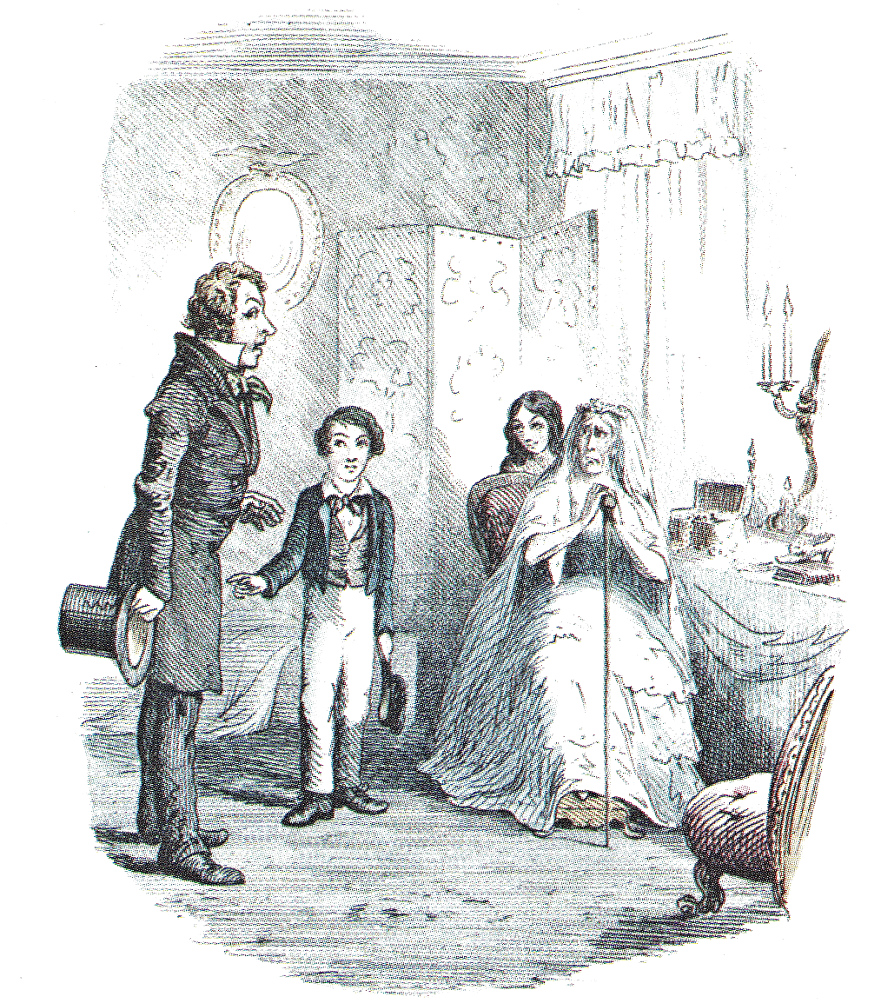
Let's compare Marcus Stone's "Pip Waits on Miss Havisham to John McLenan's Three Early Miss Havisham Plates (Pages 49, 63, and 70 in the 1861 T. B. Peterson edition). Specific letter-press illustrated:
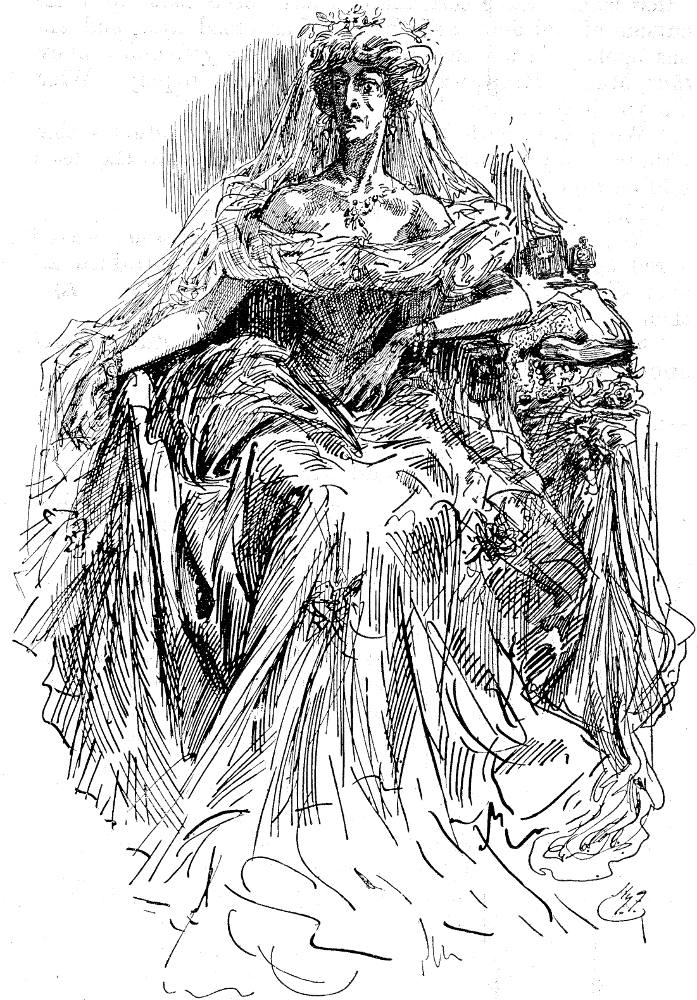
In an arm-chair, with an elbow resting on the table and her head leaning on that hand, sat the strangest lady I have ever seen, or shall ever see.
She was dressed in rich materials — satins, and lace, and silks — all of white. Her shoes were white. And she had a long white veil dependent from her hair, and she had bridal flowers in her hair, but her hair was white. Some bright jewels sparkled on her neck and on her hands, and some other jewels lay sparkling on the table. Dresses, less splendid than the dress she wore, and half-packed trunks, were scattered about. She had not quite finished dressing, for she had but one shoe on--the other was on the table near her hand--her veil was but half-arranged, her watch and chain were not put on, and some lace for her bosom lay with those trinkets, and with her handkerchief, and gloves, and some flowers, and a prayer-book, all confusedly heaped about the looking glass. . . . I saw that the bride within the bridal dress had withered like the dress, and the flowers, and had no brightness left but the brightness of her sunken eyes. I saw that the dress had been put upon the rounded figure of a young woman, and that the figure upon which it now hung loose had shrunk to skin and bone. [Ch. 8, T. B. Peterson, p. 49]
Of Marcus Stone's eight plates, only two present Miss Havisham ("Pip Waits on Miss Havisham" and "A Rubber at Miss Havisham's"), whereas all Stone's plates graph Pip's journey from childhood to maturity, indicating that the bildungsroman aspect of the novel was uppermost in the British illustrator's mind. Of McLenan's thirty-four full-size plates (in other words, those reprinted in the T. B. Peterson single-volume edition), four depict Miss Havisham in her boudoir (facing pages 48, 64, 70, and 204), one shows her candle in hand in a corridor (facing page 176), and one depicts her ablaze in the dining-room (facing page 224). Thus, Miss Havisham is featured prominently in five of McLenan's plates while, for example, Magwitch occurs in five, Joe in seven, and Pip in 29.
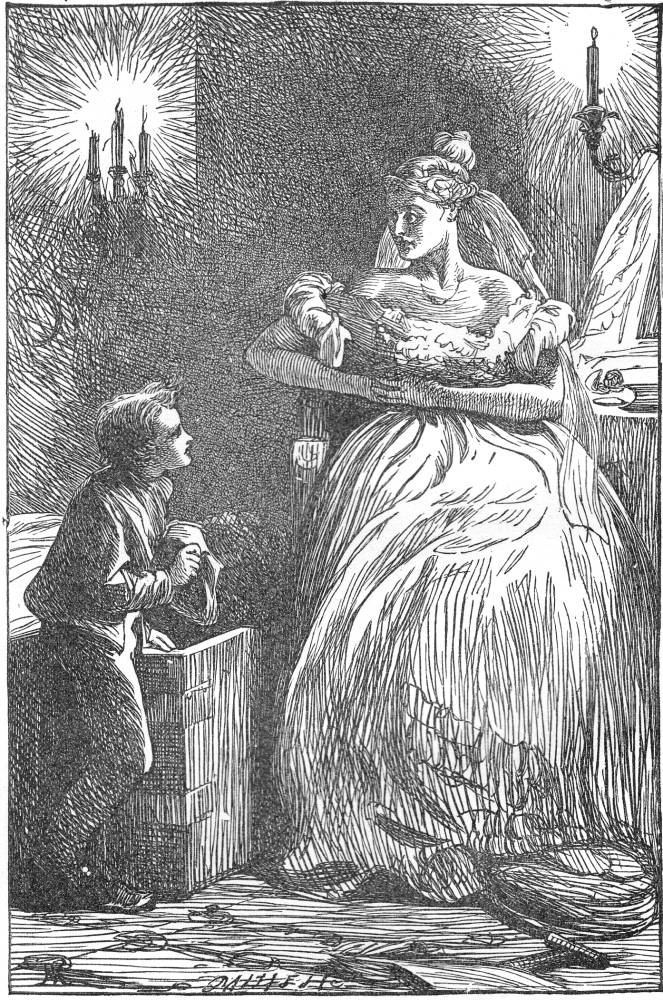
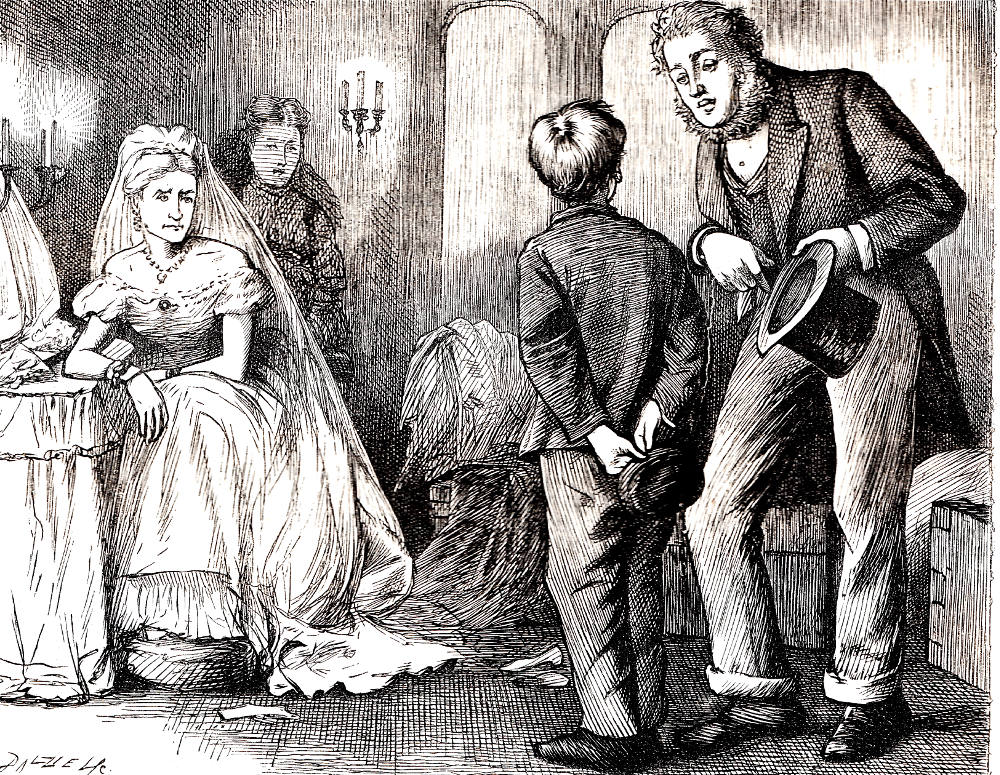
In "Pip Waits on Miss Havisham," in contradiction to the letter-press, Stone depicts her as youthful and attractive. Commanding in presence, she is lit by candelabra, enthroned as it were before her humble supplicant, the blacksmith's boy. Cap in hand, Pip slightly bends at the knees, while the large-eyed, imperious woman with the elaborately arranged blonde hair and bare-shouldered, voluminous wedding dress (apparently no worse for a number of years of wear), her mirror just disappearing off the right-hand margin. Contrast this glowing image from Pip's memory with the despondent, introverted, somewhat elderly and angular bride in front of her mirror given us by McLenan, who has responded more accurately (if less delightfully) to the letter-press.
As we turn page 48 in the 1861 Philadelphia volume we encounter the vignetted illustration "'Who is it?' said the lady at the table. 'Pip, ma'am.'--Page 49" before we actually find the same moment in the letter-press. Whereas Stone had filled the frame with the enchanting fairy godmother, McLenan sets his crone in the midst of her furnishings and belongings. As in the text, open trunks (left and right) covered with clothing frame the scene, and an inward-gazing Miss Havisham in an attitude of despondency, hand supporting her head, sits before an oval mirror which has four candlelabra attached. Faithful to his copy, the illustrator has included such details as the white shoe on the dressing table (Pip indicates that he can see the other white shoe on her foot, which McLenan conceals beneath her skirts). Although neither artist has depicted the faded flowers, the watch and chain are evident just to the right of Miss Havisham's left elbow in Stone's version, important symbols of her rejection of the passage of time. An interesting if minor detail which varies in the two plates is Pip's hat: in Stone's plate, it is a cloth cap such as was worn by the British working class, whereas in McLenan's plate it is a brimmed felt hat, which the American artist supplied from his own experience and period.
Whereas the American artist has depicted the jewels that the text twice mentions, these are not present in Stone's plate, which nevertheless glimmers by the light of four powerful candles in contrast to the faint glare of the four tapers in McLenan's. Without unnecessarily dwelling upon such minutiae, one may simply note that the overall effect of the American periodical illustration is awkward and stilted, although technically accurate, whereas that of the English illustration is dramatic and powerful because Stone has reduced the scene to its essentials, and placed the contrasting figures in close proximity, balancing the difference in their heights by placing three candles above Pip and creating a sense of the numinous that the American plate entirely lacks.
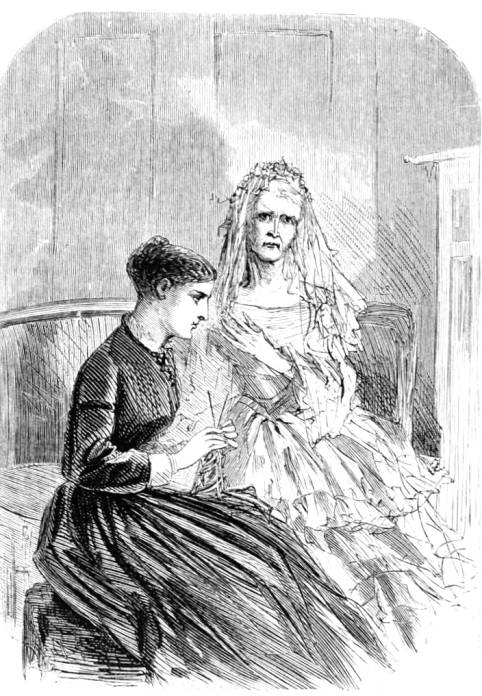
Miss Havisham remains a static, almost blind figure in McLenan's 'It's a great cake. "'A bride-cake. Mine!'--Page 63" and "'Which I meantersay, Pip.'--Page 70," both of which are nevertheless accurate in the details of each scene, the dining room and the boudoir, although Pip is perhaps too well dressed for a mere labouring boy and one wonders how the latter scene is lit, considering that the windows are covered but the candles above Estella are unlit. Interestingly, all three Havisham plate make mirrors central features, though none of them actually reflects anything. These "blind" mirrors may reflect the psychological blindness of Miss Havisham to her true condition; in David Lean's 1946 film, Miss Havisham is, as Regina Barreca notes, "framed next to mirrors in a number of scenes, making visual the way the spinster wishes to multiply her image through Estella" (41). However, McLenan's mirrors return no image, suggesting the sterility of lifelessness of Satis House which accords well with the static, rigid depiction of the figures, rotund Joe furnishing in his darkly clad amplitude a sharp contrast to Miss Havisham's severe whiteness, stark thinness, and pronounced angularity.
The dessicated figure who serves as a chronometer for the mature Pip, Herbert, and Estella in Stone's "A Rubber at Miss Havisham's" is still not quite the fairytale crone who becomes her own candle in McLenan's plate opposite page 224 in the Peterson edition (bottom, p. 286, Harper's, 4 May 1861), but one has the distinct sense that she has aged and shrunk considerably since Pip first encountered her in Stone's narrative-pictorial sequence; although she is still associated in Stone's plate with lighted tapers, our view of Miss Havisham is blocked by the youthful figure of Estella, who is now the real power over Pip. As the smoke billows (right) and flames engulf her skirts in McLenan's plate, we are still struck by the awkward rigidity of the figures: although Miss Havisham's look of horror is utterly convincing, her waist is not. In contrast, real bodies seem to have sat as the originals for all of Stone's plates, which convey a pronounced tendency towards realistic portraiture: "Stone worked from models, and his naturalistic portrayals of characters suited the academic tastes of the times" (Cohen 204). Perhaps nowhere else in his series of plates for Great Expectations is Stone's departure from what Cohen terms the outmoded "Hogarth-Cruikshank-Browne tradition" (204) of the steel etching more evident and effective than his last, with the mature Pip and Estella in the ruined garden at Satis House.
References
Barreca, Regina. "David Lean's Great Expectations." Dickens on Screen, ed. John Glavin. Cambridge: Cambridge U. P., 2003. Pp. 39-44.
Cohen, Jane Rabb. "Chapter 16, Marcus Stone." Charles Dickens and His Original Illustrators. Columbus: Ohio State University Press, 1980. Pp. 203-209.
Dickens, Charles. Great Expectations. Harper's Weekly: A Journal of Civilization. Il. John McLenan. Vol. IV.
Dickens, Charles. ("Boz."). Great Expectations. With thirty-four illustrations from original designs by John McLenan. Philadelphia: T. B. Peterson (by agreement with Harper & Bros., New York), 1861.
Last modified 20 November 2007