
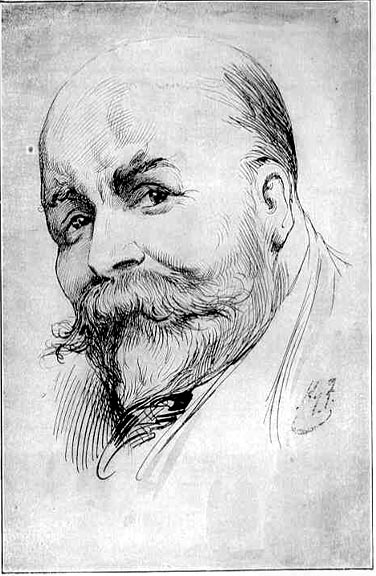

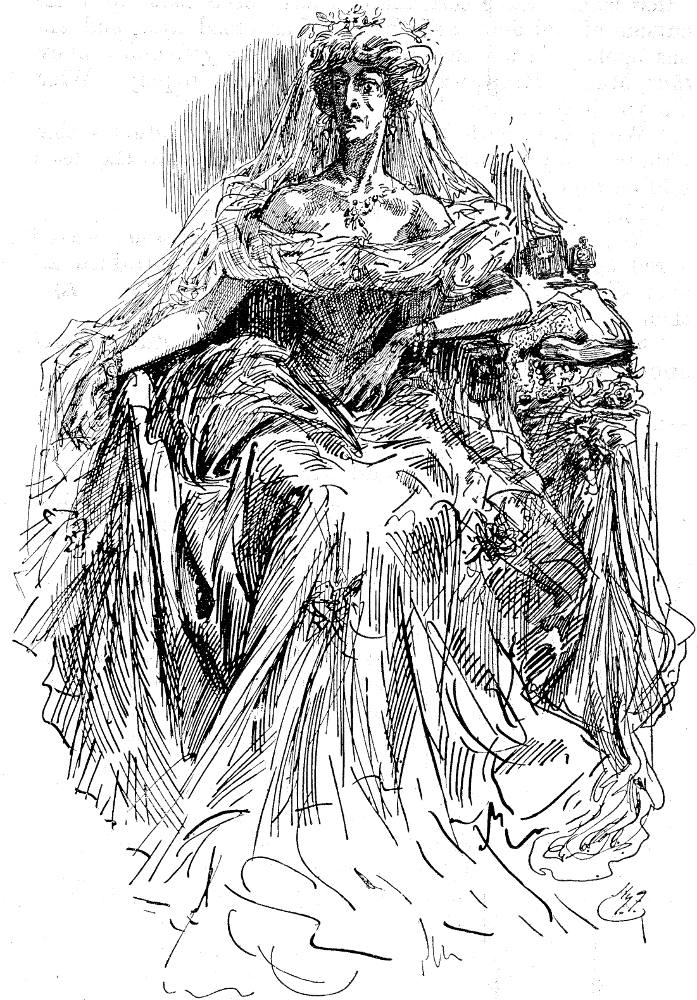
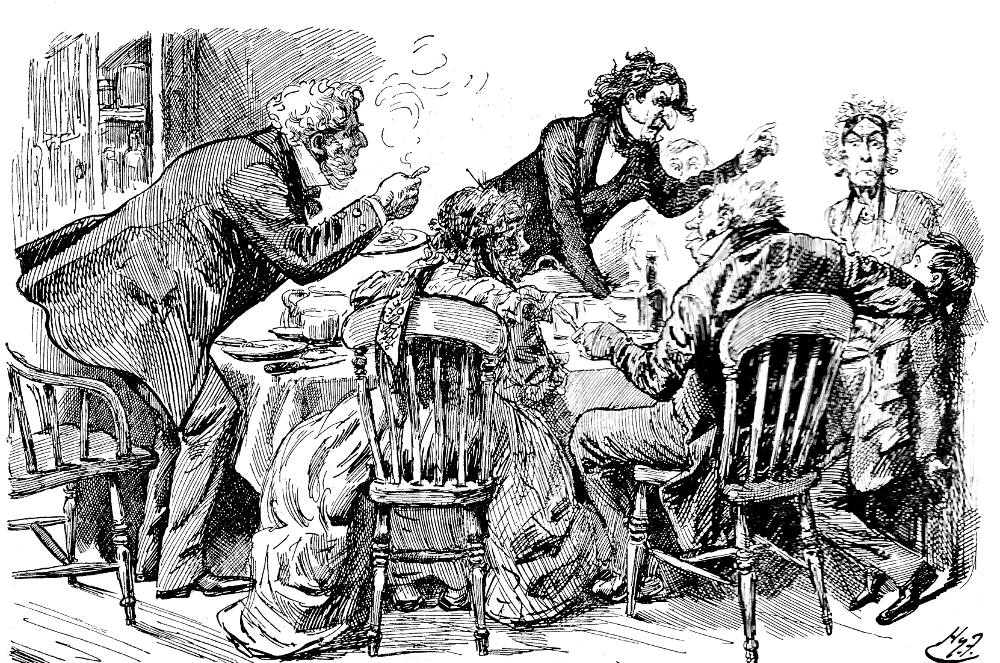
Furniss's Illustrations for Great Expectations (1910)
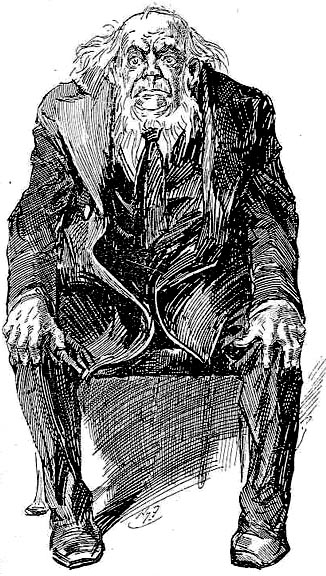
Harry Furniss's eighteen-volume edition of The Charles Dickens Library Edition (London: Educational Book Company, 1910) contains some 500 special plates (part of the total of 1200 illustrations) and two volumes of commentary. Volume 17, by series editor J. A. Hammerton, is entitled The Dickens Picture Book: A Record of the Dickens Illustrators. In this volume, Hammerton compares the impressionist work of Furniss with the more conventional realisations of the great Household Edition illustrator Fred Barnard and the great recorder of London life, French illustrator Gustav Doré, in "The Art of Mr. Harry Furniss." Inevitably, he compares the renderings of Dickens's characters by these roughly contemporary artists with those of Dickens's greatest partner in illustration, Phiz, or Hablot Knight Browne:
It is not too much to assert that in every case where our artist has chosen a scene originally treated by Phiz and later by Fred Barnard, he has touched it to new life. In comparison with Phiz, the splendid vigour of his line, his superior sense of character, his more refined and subtler humour, his infinitely greater sense of beauty, and the general feeling of actuality resulting from drawing from the life, make Mr. Furniss's illustrations so vastly to be preferred that it is needless to emphasise the contrast. [XVII, 33]

That Barnard rarely chose to assail a scene already rendered by the great Phiz Hammerton does not pause to consider; nor is he inclined to see the value in Phiz's detailism. An admirer of Fred Barnard's Household Edition illustrations, he still gives the nod to his contemporary, Harry Furniss: "There is little to choose between the two artists in the beautiful confidence and grace of their lines, and still less in their portraiture of individual characters" (30), he concedes, but disparages Barnard's handling of group scenes as "tame and lifeless" (30). The title-page vignettes of the seventeenth volume contain approximately forty of Dickens's best known characters, ranging from such early comic studies as Samuel Pickwick (top centre) to later figures such as the indefatigable Wilkins Micawber (upper right), the hyperbolic hypocrite Seth Pecksniff (lower right), and the irascible Wackford Squeers (upper left).
Although all the plates of Volume 14, Great Expectations and Reprinted Pieces, contain captions, some offer quoted text and refer to page numbers in the edition while others do not. Since each page is 12 by 18.2 cm (4.75 by 7.25 inches) and their margins of 2 cm (3.125 inches by 6.375 inches), with a caption below each in upper-case, and often below that a quotation in upper and lower case, each plate is effectively 14 cm by 8 cm (5.5 inches by 3.25 inches).
Illustrations for Dickens's Great Expectations by other artists
- Edward Ardizzone (2 plates selected)
- H. M. Brock (8 lithographs)
- J. Clayton Clarke ("Kyd") (2 lithographs from watercolours)
- Felix O. C. Darley (4 photogravure plates)
- Sol Eytinge, Jr. (8 wood engravings)
- Marcus Stone (8 wood engravings)
- John McLenan (40 wood engravings)
- F. A. Fraser in the Household Edition (1876) (30 wood-engravings)
- Frederic W. Pailthorpe (21 lithographs)
- Charles Green (10 lithographs)
Scanned image, colour correction, sizing, caption, and commentary by Philip V. Allingham. [You may use this image without prior permission for any scholarly or educational purpose, as long as you (1) credit the person who scanned the image, and (2) link your document to this URL in a web document or cite the Victorian Web in a print one.]
Bibliography
Allingham, Philip V. "The Illustrations for Great Expectations in Harper's Weekly (1860-61) and in the Illustrated Library Edition (1862) — 'Reading by the Light of Illustration'." Dickens Studies Annual, Vol. 40 (2009): 113-169.

Bentley, Nicolas, Michael Slater, and Nina Burgis. The Dickens Index. Oxford and New York: Oxford U. P., 1988.
Dickens, Charles. Great Expectations. Illustrated by John McLenan. [The First American Edition]. Harper's Weekly: A Journal of Civilization, Vols. IV: 740 through V: 495 (24 November 1860-3 August 1861).
______. ("Boz."). Great Expectations. With thirty-four illustrations from original designs by John McLenan. Philadelphia: T. B. Peterson (by agreement with Harper & Bros., New York), 1861.
______. Great Expectations. Illustrated by Marcus Stone. The Illustrated Library Edition. London: Chapman and Hall, 1862. Rpt. in The Nonesuch Dickens, Great Expectations and Hard Times. London: Nonesuch, 1937; Overlook and Worth Presses, 2005.
_____. Great Expectations. Illustrated by Sol Eytinge, Junior. Diamond Edition. 14 vols. Boston: Ticknor & Fields, 1867. XIII.
______. Great Expectations. Volume 6 of the Household Edition. Illustrated by F. A. Fraser. London: Chapman and Hall, 1876.
_____. Great Expectations. Illustrated by Frederic W. Pailthorpe with 17 hand-tinted water-colour lithographs. The Franklin Library. Franklin Center, Pennsylvania: 1979. Based on the Robson and Kerslake (London) edition, 1885.
______. Great Expectations. The Gadshill Edition. Illustrated by Charles Green. London: Chapman and Hall, 1898.
______. Great Expectations. The Grande Luxe Edition, ed. Richard Garnett. Illustrated by Clayton J. Clarke ('Kyd'). London: Merrill and Baker, 1900.
______. Great Expectations. "With 28 Original Plates by Harry Furniss." The Charles Dickens Library Edition. 18 vols. London: Educational Book Co., 1910. Vol. XIV.
Paroissien, David. The Companion to "Great Expectations." Westport, Conn.: Greenwood, 2000.
Created 28 January 2013
Last modified 17 August 2025