[Home —> Visual Arts —> Illustration —> James Abbott Pasquier —> Next]
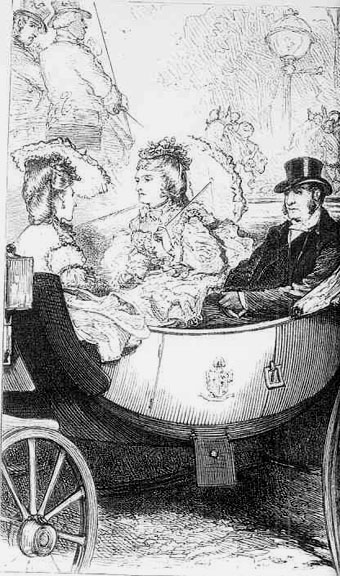
The Swancourts in The Drive
James Abbott Pasquier
Tinsley's Magazine, Vol. XI, chapters XII-XIV, p. 139
December 1872
Illustration for Thomas Hardy's A Pair of Blue Eyes
11.4 cm wide and approximately 17.6 cm high
Scanned image and text by Philip V. Allingham.
[This image may be used without prior permission for any scholarly or educational purpose.]
[See commentary below]
Fourth Instalment: December (Vol. XI, chapters XII-XIV) [p. 139]: Pasquier's caption "The Swancourts in The Drive" is a condensed version of the following passage:
The Hyde-Park shrubs had been transplanted as usual, the chairs ranked in line, the grass edgings trimmed, the roads made to look as if they were suffering from a heavy thunderstorm; carriages had been called for for the easeful, horses for the brisk, and the Drive and Row were again the groove of gaiety for an hour. We gaze upon the spectacle, at six o'clock on this midsummer afternoon, in a melon-frame atmosphere and beneath a violet sky. The Swancourt equipage formed one in the stream. [From serial chapter XIV, the last of three in the December 1872 instalment.]
Reverend Swancourt's black top-hat (a "gossamer" rather than a "beaver" in all likelihood) and gloves, the barouche with the aristocratic insignia on the door-panel, the liveried driver and lackey beside him all imply a sudden rise in wealth, class, and sophistication, while the caption's mentioning "The Row" indicates the London setting of Hyde Park, Kensington. The illustration makes plain that the rural parson has somehow been transformed into an urban sophisticate, and that the older, fashionably-dressed lady beside him may be the fairy who has effected this transformation. The blinkered horses are appropriate to the socially restricted "tunnel vision" of the moneyed Swancourts. The paired parasols that keep the unruly sun off delicate, upper-class feminine faces underscore this element of class-consciousness (Lucetta Templeman in The Mayor of Casterbridge imports a similar pair for herself and her companion); no tanning or burning by the sun's rays must be allowed to impair the genteel paleness of the ladies' complexions.
In the nine months that have intervened since the last instalment, the life of the little family of the widower, Rev. Swancourt, and his socially isolated daughter, has been materially and socially elevated by the parson's marriage to his neighbour Charlotte Troyton. However, as the physical juxtaposition of the trio in the plate suggests, the widow has come between the father and daughter. Whereas Rev. Swancourt and his daughter were independent riders before, now they are transported by an extension of the elderly lady's wealth and rank. The initial scene of Mrs. Troyton and her maid in her "plain travelling-carriage" (Ch. XI), hastening to the "small watering-place" of Stratleigh, is thus replayed, with Elfride replacing the maid, and the magnificent barouche the more modest equipage. Ironically, thanks to his "handsome face" (Ch. XIV), the self-styled "poor squire" of Endelstow Vicarage has been "commodified" and sought after by a wealthy lady, but has rejected Stephen out of hand as not being a suitably elevated suitor for his daughter. Although the purchaser of the fair masculine commodity is not depicted as speaking in Pasquier's tableau, the accompanying letter-press indicates that she is "a talker of talk of the incisive kind."
The novel's final shape of the three volumes set very precisely over four years (1864-1867), from Elfride's first romance to her death as the second Lady Luxellian, would not have been apparent to serial readers since the chapters are continuously numbered rather than divided into "book." However, the symmetry of two locations and two lovers, reflecting not so much Elfride's duality as her ambivalence, is already established by the December illustration's pairings of coachmen, horses, female riders, and sunshades.
Last modified 6 June 2003