
[Home —> Visual Arts —> Illustration —> James Abbott Pasquier—> Next]
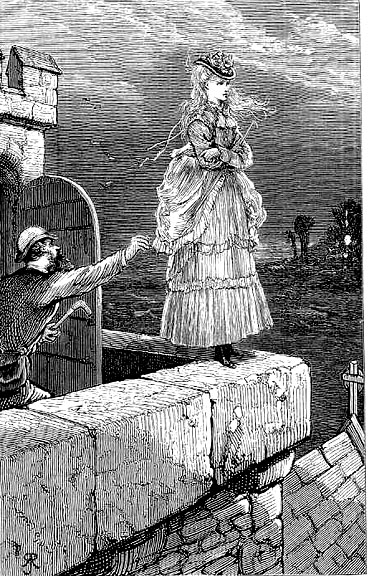
Elfride's Freak on Endelstow Tower
James Abbott Pasquier
Tinsley's Magazine, Vol. XI, chapters XV-XVIII, p. 164
January 1873
Illustration for Thomas Hardy's A Pair of Blue Eyes
11.4 cm wide and approximately 17.6 cm high
[See commentary below]
Scanned image and text by Philip V. Allingham.
[This image may be used without prior permission for any scholarly or educational purpose.]
Pasquier's caption "Elfride's Freak on Endelstow Tower." is a condensed version of the following passage:
"She reddened a little and walked on. 'Miss Swancourt, I insist upon your coming down,' he exclaimed. 'I will in a minute. I am safe enough. I have done it often.'" from serial chapter XVIII (the last of four in the January 1873 instalment).
In fact, the fifth plate combines this passage's depiction of a hubristically self-confident Elfride with Knight's darting forward, right arm extended, a moment later, after she has lost her balance: "Knight sprang forward with a face of horror." Pasquier implies Elfride's stubborn rebelliousness at male domination through her wind-swept ringlets and "his placement of arms in a defiant position in the church parapet scene" (Jackson 74). However, as if to convey disapproval at her unreasonable intransigence in contrast to Knight's common sense, the artist has seized upon the term "freak" to describe Elfride's conduct in his caption -- precisely the same word which Stephen used in the cliff scene to suggest youthful indiscretion or impropriety, namely taking advantage of their isolation to kiss her. Whereas he declared himself not given to such "freaks," Elfride apparently is -- especially with Stephen's friend and mentor, the domineering Henry Knight, who finds himself a guest at Endelstow Vicarage in his capacity as Charlotte Swancourt's (née Troyton) cousin. Pasquier employs aerial perspective as in the illustration of the cliff scene, with distant birds, and maintains the same juxtaposition, with Elfride to the right and higher up and her male companion in the lower left. The height of the ruinous church tower is suggested by the diminutive cross below Elfride, right. Again, despite the height and the narrowness of her ledge, Elfride is fearless--to the point of being reckless here. Even though she has not yet lost her balance, Pasquier depicts Knight as already attempting to pull her back into the parapet. Elfride is not caught in motion in making her "elevated promenade" (Ch. XVIII), so that the illustration implies that Henry Knight is easily alarmed and that he may even be the cause of Elfride's losing her balance, whereas the actual cause (according to the letter-press) is "a little tuft of grass growing in the joint of the stonework" (which Pasquier has omitted) upon which she trips.
Because Knight's face is given in profile and is additionally shrouded by his beard (in contrast to Stephen's complete lack of facial hair in the third plate) m we cannot discern the look of "horror" that Hardy describes as accompanying his springing forward to Elfride's rescue. The artist's focus, then, is upon the body and face of the haughty, careless, "wilful" maiden who acts out of feeling dictated to and belittled, "without reflecting in the least upon what she [is] doing" (Ch. XVIII). Whereas we have seen her as supremely self-confident with Stephen, she feels anything but free when she is in the company of the older Knight. That she is unconsciously treading the line between youthful high spirits and calamity is underscored by the darkening sky behind her. She stands, obstinate, pillar-like, in a momentary burst of sunlight into which Knight's sleeve and hand pass, a light and delicate beauty amidst the gloom. Although modern readers may interpret her conduct as resulting from her asserting her independence from male domination, Knight (treated sympathetically by Hardy here) describes her behaviour as a "freak" (the very term Pasquier has chosen for his caption of her) and "great folly" as he sets her upon her feet again. Opposing his common sense, she abjures the accusation of youthful foolishness, and refuses to permit her "rescuer" to carry her as if she is a naughty child. Pasquier invests the moment with an awful stillness by capturing on Elfride's face an out-of-body, unemotional expression that precedes a flood of petulance.
Last modified 22 June 2003