[Home —> Visual Arts —> Illustration —> James Abbott Pasquier—> Next]
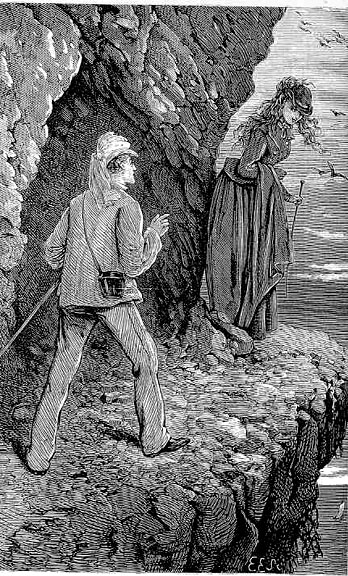
Elfride's Attempt to Help Knight
James Abbott Pasquier
Tinsley's Magazine, Vol. XI, chapters XIX-XXI, p. 208
February 1873
Illustration for Thomas Hardy's A Pair of Blue Eyes
11.4 cm wide and approximately 17.6 cm high
[See commentary below]
Scanned image and text by Philip V. Allingham.

[This image may be used without prior permission for any scholarly or educational purpose.]
"Elfride's Attempt to Help Knight" is a condensed version of "She ventured upon the treacherous incline, propped herself with the closed telescope, and gave him her hand before he saw her movements." from serial chapter XXI (the last of three in the February 1873 instalment). Arlene M. Jackson notes in Illustration and the Novels of Thomas Hardy (1981) that this illustration is often misread as a bowdlerization of Hardy's text in that Elfride actually rescues Henry Knight from The-Cliff-Without-a-Name with the aid of her petticoats, which she tears into a rope. The misreading lies in failing to understand the textual moment realized, which comes at the end of the February instalment rather than early in the March instalment -- an error natural enough if one is not reading the text with regard to where the original serial curtains occurred.
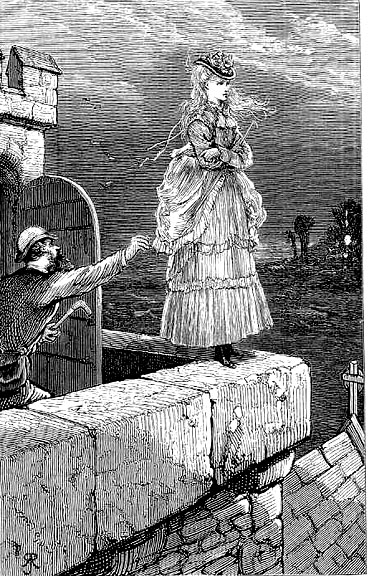
The artist's delineation of the attempted rescue, complete with out-stretched hands clutching the air, is a great deal more dramatic than the later scene would have been, since the later one is successful, and since the hands would lose their position of importance to Elfride's use of the undergarment rope. Tinsley's Magazine may have been guilty of Victorian prudery -- but not in this instance. The dramatic impact of the drawing, its ironic reversal of the situation in the earlier scene with Elfride on the church parapet, its revelation of Elfride's strength of character, and its emphasis on the two human beings unsuccessfully reaching for each other, make it one of the most powerful of the Pasquier graphics. [77]
Jackson asserts that Elfride's inability to reach Knight in this first attempt "forecasts their later separation." In fact, had Pasquier illustrated the actual rescue as the subject of his seventh plate he would not have sustained the reader's interest throughout the March instalment since the petticoat rescue occurs in Ch. XXII, "Love Will Find Out The Way," the first of four in that number. The trick of the successful illustrator is to complement the movement of the serial letter-press by raising and sustaining the reader's anticipation of a crucial moment late in the instalment, so that the structure of the novel in serial militated against Pasquier's choosing the more sensational second rescue. Perhaps at Hardy's own prompting and supplied with a sketch of the terrain by the novelist, Pasquier depicts a scene late ion the February instalment that both parallels and contrasts scenes in earlier instalments, namely those of Elfride and Stephen on the cliff path (October) and of Elfride and Knight on the church tower (January). The serial text and its illustrations thus invite the reader to keep earlier scenes in mind as he or she progresses through Chapters XIX through XXI. On the grass-covered, wind-battered "Cliff-without-a-Name" (in contrast to the tranquil conditions of the rocky pathway on which we saw her lead Stephen) Elfride is finally in a superior position with Henry Knight, although opposite the illustration, at the beginning of Ch. XIX, "Elfride's mind had been impregnated with sentiments of her own smallness . . . " Knowing of Stephen's impending return to England by the steamer Amaryllis, bound for Canning's Basin, Elfride sets out with a telescope to watch Stephen make his last nautical leg of his journey to her on board the local steamer named The Puffin. While she is following the course of a stream down into a coastal valley, Knight (apparently on a bird-watching expedition) appears from the other side of the hill. Looking through "the old-fashioned but powerful telescope" (CH. XXI) while standing near the cliff's edge, Elfride catches sight of the vessel from Bristol approaching the port of Stranton. Through the spy-glass she and Knight see a young man on deck (probably Stephen) who seems to be regarding them through a glass, a duplication which prepares us for several significant overheard conversations later in the story. Then comes catastrophe:
From where they had been loitering, a grassy path wound along inside a bank, placed as a safeguard for unwary pedestrians, to the top of the precipice, and over it along the hill in an inland direction. (Ch.XXI)
Gallantly, Knight commands that Elfride take his arm to brace herself, but accepts only the offer of his hand to assist her up the remaining slope.In discussing the eddies of wind that have left them in a calm, Knight makes the error of leaning over the bank to demonstrate the force of the backflow -- and has his hat sucked off his head and blown seaward. In attempting to retrieve his hat, he falls over the edge of the precipice and finds himself unable to ascend because the shaley ground has become slippery as the result of a sudden shower. Now, as she attempts to assist Knight, Elfride just after the moment captured in the sixth illustration, slips closer to the cliff's edge while Knight's foot holds firm "propped by a bracket of quartz rock" (Ch. XXI). Both confront the very real possibility of being precipitated over the margin and onto the rocks 650 feet below. "Not least singularly, neither hill, chasm, nor precipice has a name" (Ch. XXI) at this dangerous spot, so that the narrator dubs the place "the Cliff without a Name," where at the beginning of the March instalment, struggling for his life against muscle fatigue, Knight confronts a trilobite fossil eye to eye (Ch. XXII). The fossil itself, which excites in the geologically-minded Knight the momentary Darwinian panorama at the opening of the March instalment, must be just beyond the lower frame, right.
At the close of the February instalment, Elfride is safe, but at Knight's expense, for in climbing up and over him she has added her weight to his and thereby dislodged the supporting chunk of quartz under his foot. The illustration, then, contributes the building suspense even at the instalment's "cliff-hanger" conclusion. Help is 45 minutes away at Endelstow, but Knight tells Elfride that he believes that he will be able to hold on for just another ten minutes. "On a sudden the blank and helpless agony left her face. She vanished over the bank from his sight"(Ch. XXI), leaving the reader to wonder if she has suddenly hit upon a solution to Knight's dilemma. Thus, the February illustration and letter-press together precipitate the reader forward a month. The narrator maintains the reader's hope--founded on the illustration--that Elfride will prove herself heroic and succeed in her attempt to rescue Knight. In the sixth plate, she still has her prop, the telescope, and her right hand is within inches of Knight's right hand, which has a signet ring (not mentioned by Hardy) on the third finger. A detail also not provided by Hardy, the binoculars' case slung over his shoulder, suggests that Knight was (at least ostensibly) on a bird-watching expedition. The line of the strap across the back of Knight's morningcoat and the gestures of Knight and Elfride reinforce the sharp diagonals of their bodies, echoed visually by the diagonals of the hillside, the cliff, and the vegetation. The rope-like pattern of of the smaller flounces on Elfride's dress suggest not only her internal agitation but also offer a visual clue as to her mysterious disappearance at the very close of the February instalment. Since the errant hat is no longer on his head, we must surmise that it, like the spyglass shortly, has been sucked "to the dizzy depths beneath them"--a depth into which they, too, may yet be sucked.
Animated by the danger of the situation, Elfride, intent upon rescuing her superior suitor, is at her most beautiful in the whole series. Her hair is unrestrained, blowing seaward in more than "a little backward current" to reinforce the strong diagonal. The flounces in her skirt and the ground vegetation to which Knight clings with his left hand are as agitated as the distant waves, upper right, charging the whole scene with emotion. Since we cannot see Knight's face, we are left to supply his facial expression, which according to the text shifts from optimistic to pessimistic as he comes to accept the implausibility of his rescue.
Last modified 23 June 2003