
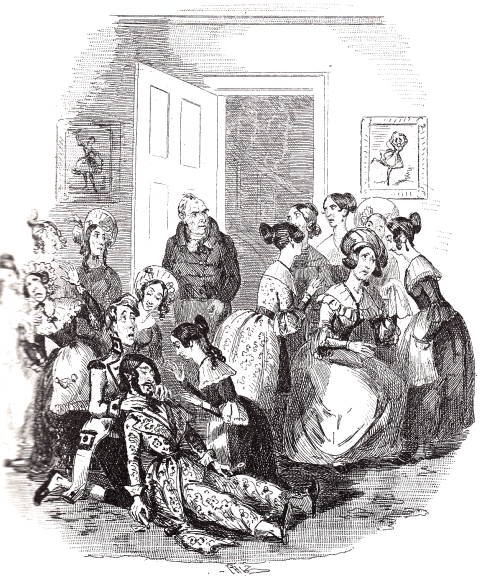
Mr. Mantalini Poisons Himself for the Seventh Time
Phiz (Hablot K. Browne)
Dickens's Nicholas Nickleby
May 1839
Etching
Source: J. A. Hammerton, The Dickens Picture-Book, p. 164.

Image scan and text by Philip V. Allingham.
1839
Wood engraving
Source: J. A. Hammerton, The Dickens Picture-Book, p. 164.
Image scan and text by Philip V. Allingham.
[You may use this image without prior permission for any scholarly or educational purpose as long as you (1) credit the person who scanned the image and (2) link your document to this URL.]
Phiz and Boz continue to enjoy describing the domestic chaos of the Mantalinis, in particular, the emotional volatility of the dress-maker's handsome, spendthrift Italian husband, a characterization of the emotional makeup of Italians common enough in the England of the 1830s and 1840s, as were the artistic sensibilities of that nationality, suggested by the picture of the ballerina on the wall (right). Mr. Mantalini's elongated figure connects him to the book's other wastrels, Sir Mulberry Hawk and Lord Frederick Verisopht. To enhance the physical comedy, Phiz may have modelled the focal point of the scene, the fallen Mantalini, upon the traditional Renaissance Pieta, the lamentation of the women over the body of the dead Christ, just taken down from the cross. The poisoning scene is a mere comic relief from Ralph's plans of vengeance:
'Done what?' said Ralph, tartly, 'what d'ye mean?'
'I knew he would if he was drove to it' cried the girl. 'I said so all along.'
'Come here, you silly wench,' said Ralph, catching her by the wrist; 'and don't carry family matters to the neighbours, destroying the credit of the establishment. Come here; do you hear me, girl?'
Without any further expostulation, he led or rather pulled the frightened handmaid into the house, and shut the door; then bidding her walk upstairs before him, followed without ceremony.
Guided by the noise of a great many voices all talking together, and passing the girl in his impatience before they had ascended many steps, Ralph quickly reached the private sitting room, when he was rather amazed by the confused and inexplicable scene in which he suddenly found himself.
There were all the young lady-workers, some with bonnets and some without, in various attitudes expressive of alarm and consternation; some gathered round Madame Mantalini, who was in tears upon one chair; and others round Miss Knag, who was in opposition tears upon another; and others round Mr. Mantalini, who was perhaps the most striking figure in the whole group, for Mr. Mantalini's legs were extended at full length upon the floor, and his head and shoulders were supported by a very tall footman, who didn't seem to know what to do with them, and Mr. Mantalini's eyes were closed, and his face was pale, and his hair was comparatively straight, and his whiskers and moustache were limp, and his teeth were clenched, and he had a little bottle in his right hand, and a little teaspoon in his left, and his hands, arms, legs, and shoulders, were all stiff and powerless. And yet Madame Mantalini was not weeping upon the body, but was scolding violently upon her chair; and all this amidst a clamour of tongues, perfectly deafening, and which really appeared to have driven the unfortunate footman to the utmost verge of distraction.
'What is the matter here?' said Ralph, pressing forward. [Chapter 44, "Mr. Ralph Nickleby cuts an old Acquaintance. It would also appear from the Contents hereof, that a Joke, even between Husband and Wife, may be sometimes carried too far," Part 14, May 1839].
References
Hammerton, J. A. The Dickens Picture-Book. London: Educational Book, 1910.
Last modified 5 May 2009