

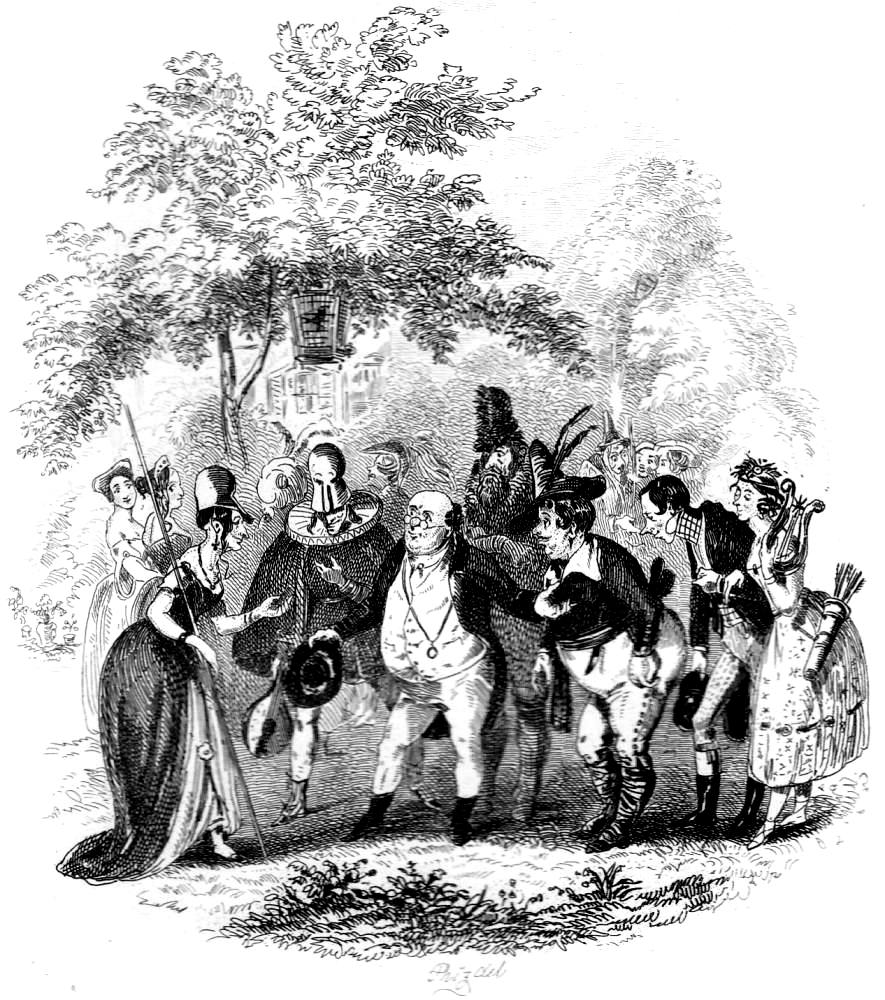
Mrs. Leo Hunter's Fancy-Dress Déjeûné by Phiz (Hablot K. Browne) — sixteenth steel engraving for Charles Dickens's The Posthumous Papers of the Pickwick Club; two versions for the September 1836 (sixth monthly) number and the 1838 bound volume, in Chapter XV, “In which is given a faithful Portraiture of two distinguished Persons; and an accurate description of a Public Breakfast in their House and Grounds; which Public Breakfast leads to the Recognition of an old Acquaintance, and the commencement of another Chapter,” facing page 154.
Bibliographical Note: Transposed Page Numbers
The original illustration is 12.7 cm high by 10.4 cm wide (5 inches high by 4 inches wide), accompanying the novel's sixth instalment. In the initial engraving (Plate A), the birdcage rests high up among the overshadowing canopy, and Mr. Tupman has no feathers in his cap. As Johannsen (1956) notes, "The page numbers below the designs in this and the following plate [The unexpected breaking up of the Seminary for young ladies] were inadvertently transposed, and a few copies of plate 14 bear the page number 169 and a few of plate 15 bear 154" (28). Phiz, del appears lower centre with the caption in the second version. [Click on the images to enlarge them.]
Details
Passage Illustrated: The Pickwickians attend a Fancy-Dress Déjeûné
"Mr. Pickwick, ma'am," said a servant, as that gentleman approached the presiding goddess, with his hat in his hand, and the brigand and troubadour on either arm.
"What! Where!" exclaimed Mrs. Leo Hunter, starting up, in an affected rapture of surprise.
"Here," said Mr. Pickwick.
"Is it possible that I have really the gratification of beholding Mr. Pickwick himself!" ejaculated Mrs. Leo Hunter.
"No other, ma'am," replied Mr. Pickwick, bowing very low. "Permit me to introduce my friends — Mr. Tupman — Mr. Winkle — Mr. Snodgrass — to the authoress of "The Expiring Frog."
Very few people but those who have tried it, know what a difficult process it is to bow in green velvet smalls, and a tight jacket, and high-crowned hat; or in blue satin trunks and white silks, or knee-cords and top-boots that were never made for the wearer, and have been fixed upon him without the remotest reference to the comparative dimensions of himself and the suit. Never were such distortions as Mr. Tupman's frame underwent in his efforts to appear easy and graceful — never was such ingenious posturing, as his fancy-dressed friends exhibited.
"Mr. Pickwick," said Mrs. Leo Hunter, "I must make you promise not to stir from my side the whole day. There are hundreds of people here, that I must positively introduce you to."
"You are very kind, ma'am," said Mr. Pickwick. [Chapter XV, “In which is given a faithful Portraiture of two distinguished Persons; and an accurate description of a Public Breakfast in their House and Grounds; which Public Breakfast leads to the Recognition of an old Acquaintance, and the commencement of another Chapter,” 154]
Commentary: A Satire on High Culture in the Countryside
Having heard a travelling salesman recount "The Bagman's Story" at the Peacock Inn, where all the Pickwickians but Pickwick himself have been staying while observing the Eatanswill by-election (Plate), the group attend Mrs. Leo Hunter's costume party, a féte champetre, where their hostess recites her original poetic composition "Ode to an Expiring Frog." Pickwick is astounded to discover that Jingle, too, is attending the event under the pseudonym "Charles Fitz-Marshall." Pickwick and Sam then pursue the confidence man and his devious servant, Job Trotter, to the Angel Inn at Bury St. Edmunds. The twin plates of the sixth monthly part (September 1836) therefore underscore the theme of subterfuge and deception, innocently through the elaborate and somewhat ridiculous costumes of Mrs. Hunter's garden party and more malevolently through the consequences of Trotter's deceiving Pickwick into believing that Jingle is planning to elope with an heiress from Miss Tomkin's School, a deception that results in Pickwick's being found in a highly embarrassing situation at night behind the walls of the ladies' seminary, Westgate House.


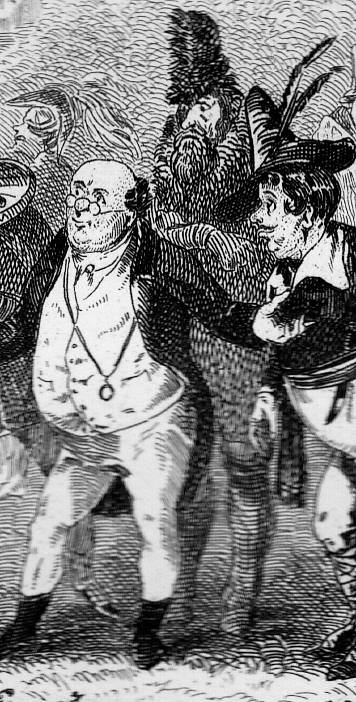
Above: (a) Mrs. Leo Hunter; Tupman and Winkle in costume; (c) Pickwick, Pott, and Tupman. [Click on the images and those below to enlarge them.]
Prior to going to the party, Pickwick and Tupman have a falling out over the issue of Tupman's proposed costume: a frog. To show his romantic sympathies, Tupman proposes — to Pickwick's chagrin — to wear a costume suggestive of an alpine bandit: velveteen shorts and "a green velvet jacket, with a two-inch tail. . ." (chapter 15), the very getup in which we see him (face browned with burnt cork) in Phiz's 1836 and 1873 illustrations. In the American Household Edition, Thomas Nast chose to focus on the quarrel between Tupman and his chief over the matter of the frog costume in "'Come on Sir!' replied Mr. Pickwick" (p. 91), whereas Phiz elected in that later edition to reprise his 1836 steel engraving in a full page wood-cut (facing page 101).


Left: Thomas Nast's cartoonish "Come on, Sir!" replied Mr. Pickwick in the American Household Edition (1873). Right: Phiz's 1874 British Household re-interpretation of the same scene: Permit me to introduce my friends — Mr. Tupman — Mr. Winkle — Mr. Snodgrass &c.. [Click on the images to enlarge them.]
In the 1836-38 illustrations, the poetess "in the character of Minerva" (patroness of the arts) is wearing "a white satin gown with gold spangles," exactly as her husband had described to Pickwick when he delivered the invitation earlier in the chapter. Among her guests are "half a dozen lions from London — authors, real authors, who had written whole books and printed them afterwards" — although not a single "lion" is evident in Phiz's plates. The woman accompanying Winkle is none other than Mrs. Pott (the young wife of the editor of the Eatanswill Gazette) in the character of Apollo (hence, her lyre and quiver). According to the text, Mr. Snodgrass must be the figure in the Grecian helmet. By process of deduction, Pott is appearing in the character of a "Russian officer of justice," behind Tupman and Pickwick in the right foreground, but has a full beard only in the version that appeared in the 1838 bound volume.
Balding, spectacled Pickwick, thin Winkle (beside Mrs. Pott), and chubby Tupman are obvious, both from their juxtapositions and their figures. But where are Snodgrass and the newspaper editor, Mr. Pott (whom Mrs. Hunter as Minerva taps with her fan occasionally) if the tall man (bearded and looking like a Russian noble in the revised version) is the German-accented Count Smorltork? He is indeed “well whiskered,” and therefore likely the tall man in the second row. Tupman is accoutred as a brigand in a tight jacket and velvet shorts. Dickens specifies that Snodgrass is the figure in a silk cloak and Grecian helmet, presumably the uniform of a Troubadour. The problem is that Dickens specifically describes Pott as being costumed as “a Russian officer of Justice.” Thus, the missing figure is neither Pott nor Snodgrass, but the curious, note-taking Count Smorltork.
As always, in both Phiz illustrations, Pickwick is readily identifiable, and, by virtue of their close proximity to him, so are Tupman ("fat," as Pickwick says, and looking decidedly uncomfortable in his ridiculous getup), the tall Pott (as a blend of a bearded Cossack and a judge, in the background in the modified 1836 plate, but brought forward in that for 1873), and the slender Winkle, as usual, wearing gaiters, and a red jacket appropriate to a huntsman — or a postman. The background in Phiz's earlier plates suggests the kind of outdoor and natural setting that the French court of the eighteenth century would have required for such an affair, but Phiz has filled the 1873 illustration's background with two tents and nine figures in "fancy dress." In both, the elderly Mrs. Hunter looks very much "mutton got up as lamb," in contrast to the younger women whose beauty the skimpy costumes complement.
More significantly, in the 1874 revision of this illustration, Phiz has pushed Mrs. Hunter to the right margin, giving greater prominence to Pickwick and his associates. Having a larger field to fill (13 by 17.4 cm for 1874; 12 by 10.5 for 1836), in the composite woodblock engraving Phiz has been able to make his figures much larger, but the change in medium (and probably his partial paralysis and blindness) has meant a loss in the delicacy of line and subtlety of shading in the later illustration. Subtle changes are obvious upon closer inspection: for example, the young Mrs. Pott, dressed as Apollo with quiver and lyre (right), does not hold her musical instrument up in the 1873 plate, and has a more natural pose. The later plate presents figures modelled with a greater sense of three-dimensional space, emphasizing, for example, the trunks and boughs of the trees in the backdrop, whereas the original illustration created a Watteau-esque setting by focusing the trees' foliage and by showing the trees in their entirety. In essence, then, Phiz's treatment in the 1836 steel-engravings is panoramic, but that of the 1873 woodcut is a close-up in which the principals crowd out the background detail: note, for example, the figure in the helmet between Pickwick and his hostess — in bringing the bearded editor forward in the Household Edition woodcut, Phiz has forced that other-worldly figure in the helmet (Snodgrass) into the background.

Sol Eytinge, Jr.'s Diamond Edition (Boston) closeup of the curious Count and his hostess, Mrs. Leo Hunter's Party (1867).
The essential point of both Dickens's text and Phiz's 1836 illustration is the satirising of society lady poets and their bad poetry, Dickens's model, according to Philip Collins and Edward Guiliano in The Annotated Dickens, being the Honourable Miss Mary Monckton (1746-1840), afterwards, Lady Cork, "a renowned and conversationalist, whose passion was to throw parties for the most eminent people of her day" (Vol. I, p. 150). Dickens has appropriately dubbed her "Lion-Hunter," for she glories in catching literary lions and celebrities such as Count Smorltork and Samuel Pickwick. According to Kathleen Tillotson in the Literary Times Supplement for 22 November 1957,
Dickens based his depiction of the Count on Prince Puckler-Muskau and Professor Friedrich von Raumer, both of whom had recently written books about England after short tours of the country. [Cited in The Annotated Dickens, Vol. I, p. 152]
Likely through conversations with the author, Phiz would have been aware of the originals who sat for the portraits of Mrs. Leo Hunter and the Count, for as Jane Rabb Cohen notes, Dickens gave his illustrator very explicit suggestions for the September 1836 garden-party picture in a 19 October 1836 letter, in which Dickens comments upon the juxtapositions of the characters and the ladies. In particular, he stipulated that "Minerva" (that is, Mrs. Hunter) should look "a little younger (like Mrs. Pott — who is perfect)" (cited in Cohen, p. 64), as if Browne were trying to make Mrs. Hunter as old as Miss Monckton (i. e., 90!).

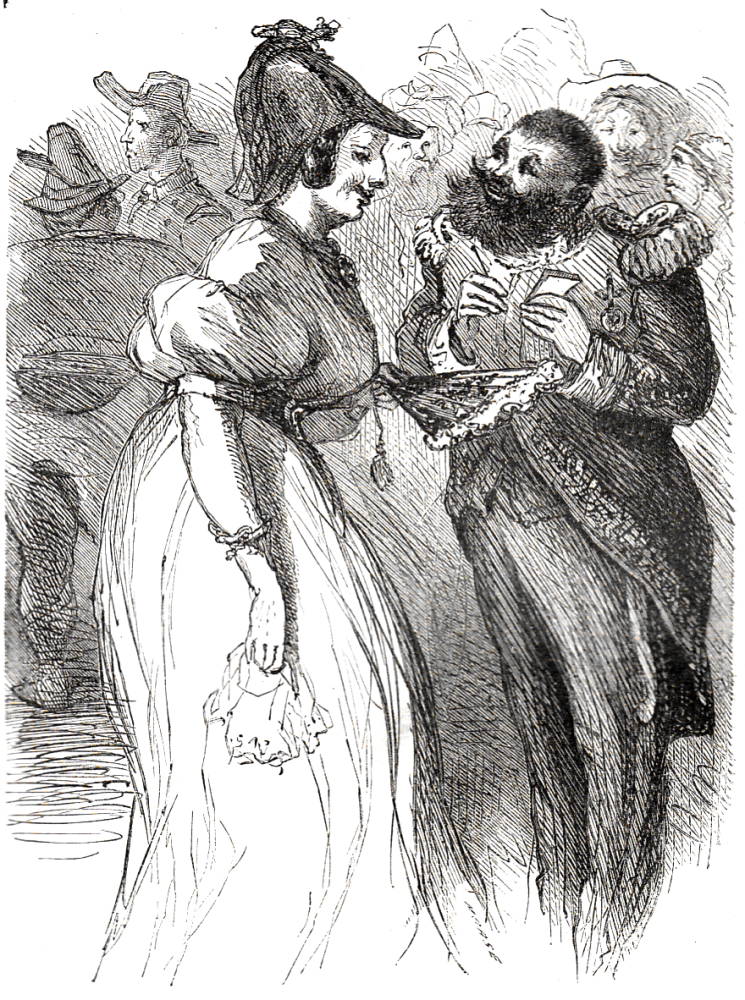
Left: Harry Furniss's highly animated version of the same scene: Mrs. Leo hunter's Garden Party in the Charles Dickens Library Edition (1910). Right: Sol Eytinge, Jr.'s Diamond Edition (Boston) closeup of the curious Count and his hostess, Mrs. Leo Hunter's Party. [Click on the images to enlarge them.]
Other artists who illustrated this work, 1836-1910
- Robert Seymour (1836)
- Thomas Onwhyn (1837)
- Felix Octavius Carr Darley (1861)
- Sol Eytinge, Jr. (1867)
- Thomas Nast (1873)
- Harry Furniss (1910)
- Clayton J. Clarke's Extra Illustrations for Player's Cigarettes (1910)
Scanned images and text by Philip V. Allingham. [You may use these images without prior permission for any scholarly or educational purpose as long as you (1) credit the person who scanned the images, and (2) link your document to this URL in a web document or cite the Victorian Web in a print one.]
Bibliography
Cohen, Jane Rabb. Charles Dickens and His Original Illustrators. Columbus: Ohio State U. P., 1980.
Davis, Paul. Charles Dickens A to Z: The Essential Reference to His Life and Work. New York: Facts On File, 1998.

Dickens, Charles. The Posthumous Papers of the Pickwick Club. Illustrated by Robert Seymour, Robert Buss, and Phiz. London: Chapman and Hall, November 1837. With 32 additional illustrations by Thomas Onwhyn (London: E. Grattan, April-November 1837).
Dickens, Charles. The Posthumous Adventures of the Pickwick Club. Illustrated by Sol Eytinge, Jr. 14 vols. The Diamond Edition. Boston: Ticknor and Fields, 1867. Vol. 1.
Dickens, Charles. Pickwick Papers. Illustrated by Hablot Knight Browne. The Household Edition. 22 vols. London: Chapman and Hall, 1874. Vol. 6.
Dickens, Charles. Pickwick Papers Illustrated by Thomas Nast. The Household Edition. New York: Harper and Bros., 1873.
Guiliano, Edward, and Philip Collins, eds. The Annotated Dickens.2 vols. New York: Clarkson N. Potter, 1986. Vol. I.
Hammerton, J. A. The Dickens Picture-Book. London: Educational Book Co., 1910.
Johnannsen, Albert. "The Posthumous Papers of The Pickwick Club." Phiz Illustrations from the Novels of Charles Dickens. Chicago: University of Chicago Press; Toronto: The University of Toronto Press, 1956. Pp. 1-74.
Kitton, Frederic G. Dickens and His Illustrators. 1899. Rpt. Honolulu: U. Press of the Pacific, 2004.
Steig, Michael. Chapter 2. "The Beginnings of 'Phiz': Pickwick, Nickleby, and the Emergence from Caricature." Dickens and Phiz. Bloomington & London: Indiana U. P., 1978. Pp. 24-50.
Created 27 January 2012
Last modified 14 March 2024