

The Ghostly Passengers in the Ghost of a Mail
Phiz (Hablot K. Browne)
September 1837
steel engraving
11.5 cm high by 10.6 cm wide (4 ½ by 4 ¼ inches), vignetted
[Click on the image to enlarge it.]
Details




Scanned image and text by Philip V. Allingham.
Passage illustrated: An Interpolated Ghostly Tale of Romance
"'This,' said the guard, pointing to an old-fashioned Edinburgh and London mail, which had the steps down and the door open. 'Stop! Here are the other passengers. Let them get in first.'
"As the guard spoke, there all at once appeared, right in front of my uncle, a young gentleman in a powdered wig, and a sky-blue coat trimmed with silver, made very full and broad in the skirts, which were lined with buckram. Tiggin and Welps were in the printed calico and waistcoat piece line, gentlemen, so my uncle knew all the materials at once. He wore knee breeches, and a kind of leggings rolled up over his silk stockings, and shoes with buckles; he had ruffles at his wrists, a three-cornered hat on his head, and a long taper sword by his side. The flaps of his waist-coat came half-way down his thighs, and the ends of his cravat reached to his waist. He stalked gravely to the coach door, pulled off his hat, and held it above his head at arm's length, cocking his little finger in the air at the same time, as some affected people do, when they take a cup of tea. Then he drew his feet together,and made a low, grave bow, and then put out his left hand. My uncle was just going to step forward, and shake it heartily, when he perceived that these attentions were directed, not towards him, but to a young lady who just then appeared at the foot of the steps, attired in an old-fashioned green velvet dress with a long waist and stomacher. She had no bonnet on her head, gentlemen, which was muffled in a black silk hood, but she looked round for an instant as she prepared to get into the coach, and such a beautiful face as she disclosed, my uncle had never seen — not even in a picture. She got into the coach, holding up her dress with one hand; and as my uncle always said with a round oath, when he told the story, he wouldn't have believed it possible that legs and feet could have been brought to such a state of perfection unless he had seen them with his own eyes. [Chapter XLIX, "Containing the Story of The Bagman's Uncle," pp. 426-427]
Commentary: A Retrospective Setting for a Ghost Story
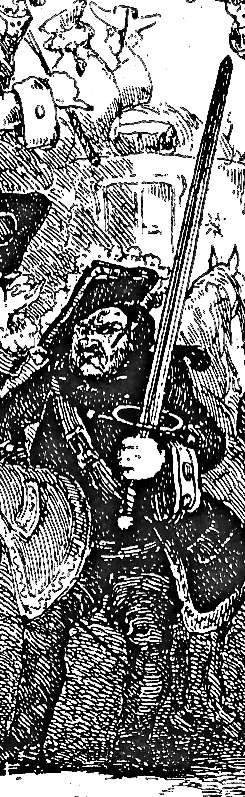
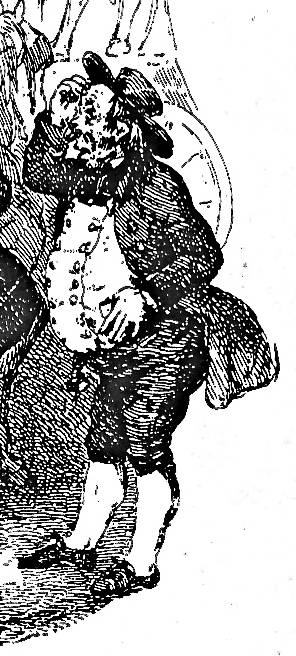
Tricorn hats, rapiers, big cuffs, powdered wigs, and a damsel in distress entering a coach: these are the properties of historical romance, a genre at which Dickens and Phiz are poking fun in the September 1837 instalment of The Pickwick Papers. In the illustration accompanying the short story "The Tale of The Bagman's Uncle," Phiz realizes a scene from another of the novel's whimsical inset tales of the supernatural (the most celebrated being the Christmas ghost story "The Goblins who Stole a Sexton," narrated by Wardle at Dingley Dell) as the protagonist, Jack Martin ("The Bagman's Uncle") is carried back to eighteenth-century Edinburgh. Released from the Fleet Prison and now back at the Bush Inn, Bristol, Mr. Pickwick and Sam enter the travellers' room and encounter the one-eyed bagman, who offers to entertain the host (none other than Moses Pickwick himself) and his guests with a story his uncle had told him. The narrator is Tom Smart, whom Pickwick and the reader met much earlier, when he told "The Bagman's Story" in chapter 14. However, this story's protagonist is his uncle, Jack Martin, who, like the sexton Gabriel Grub, has had too much to drink when the main part of the action occurs. After a well-lubricated party in the old town of Edinburgh, he climbs into a compound containing derelict coaches and falls asleep in one, whereupon he finds himself listed as a passenger on an eighteenth-century mail coach about to depart for London. After the moment realised in the illustration, the gallant Jack heroically rescues the young lady from the machinations of the villainous son of the Marquess of Filletovile — the young aristocrat in the powdered wig who, despite his fashionable exterior and delicate gesture, grips her wrist cruelly in Phiz's illustration.
Through his deliberate exaggeration of the weaponry Phiz implies that the reader should take this second "tall tale" by Tom Smart with a grain of salt. That Dickens has set the majority of the inset tale in Edinburgh, that the romantic situation is an eighteenth-century "costume piece," and that Dickens's first-person narrator pokes fun at Scottish names ("a Baillie Mac something and four syllables after it, who lived in the old town of Edinburgh" [423] in the Canongate) suggests that the story is a lampoon of the romances of Sir Walter Scott, the best-selling fiction writer of the Romantic era whose artistic success (but not his penurious death) young Charles Dickens hoped to emulate. Phiz's Jack Martin (right) scratches his forehead in disbelief; the henchman's gigantic blade (which in the text he is "wearing" — presumably carrying the weapon in a scabbard, but which the illustrator has thought fit to emphasize as an obvious signifier of danger to the protagonist by having the burly henchman carry it out of its scabbard) serves to separate the red-nosed dreamer from his dream-vision.
A curious connection to the book's other dream-vision, that of Gabriel Grub in The Goblin and the Sexton in the January 1837 number, is the lantern standing centre in the foreground, suggesting a night-time setting for each illustration (in the September 1837 instalment, the blunderbuss-wielding guard is carrying such a lantern). That this is a dream Phiz suggests by rendering the six secondary characters — on the top of the coach, on another carriage (right rear), and including the trumpeter — in unshaded outlines, as if they are phantoms or delusions.
This is the A version of the original steel plate, according to Johannsen (p. 64).
Parallel Scenes in Other Editions (1837-74)
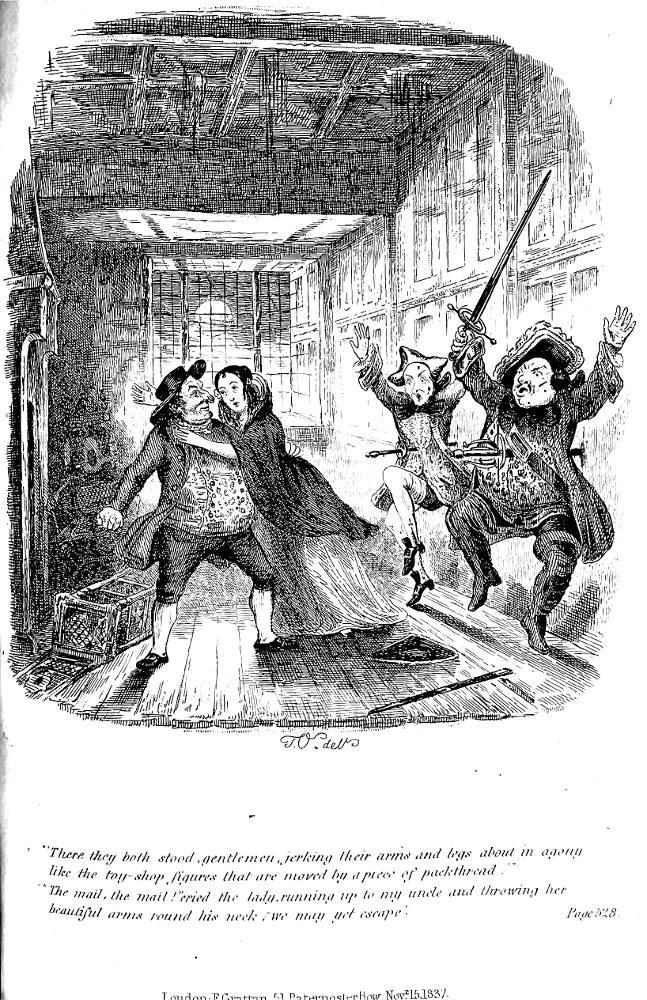

Left: Thomas Onwhyn's "extra" engraving ‘“There they both stood, gentlemen, jerking their arms and legs about in agony, like the toy-shop figures that are moved by a piece of pack-thread. / “The mail, the mail!” cried the lady, running up to my uncle and throwing her beautiful arms round his neck; “we may yet escape.” (Nov. 15, 1837). Right: Phiz's Household Edition woodcut reworks his original 1837 steel engraving as These attentions were directed, not towards him, but to a young lady, who just then appeared at the foot of the steps (1874). [Click on the images to enlarge them.]
Bibliography
Cohen, Jane Rabb. Charles Dickens and His Original Illustrators. Columbus: Ohio State U. P., 1980.
Davis, Paul. Charles Dickens A to Z: The Essential Reference to His Life and Work. New York: Facts On File and Checkmark Books, 1998.
Dickens, Charles. The Posthumous Papers of the Pickwick Club. Illustrated by Robert Seymour, Robert Buss, and Phiz. London: Chapman and Hall, November 1837. With 32 additional illustrations by Thomas Onwhyn (London: E. Grattan, April-November 1837).
_______. The Pickwick Papers. The Household Edition. 22 vols. London: Chapman and Hall, 1874; New York: Harpers and Brothers, 1874. Vol. 6.
Guiliano, Edward, and Philip Collins, eds. The Annotated Dickens. Vol. 1. New York: Clarkson N. Potter, 1986.
Hammerton, J. A. The Dickens Picture-Book. London: Educational Book Co., 1910.
Johannsen, Albert. "The Posthumous Papers of The Pickwick Club. Part XVII. Plate 37. Page 523." Phiz Illustrations from the Novels of Charles Dickens. Chicago: U. Chicago Press, 1956. Pp. 64-65.
Steig, Michael. Dickens and Phiz. Bloomington & London: Indiana U.P., 1978.
Created 7 January 2012
Last modified 20 February 2024