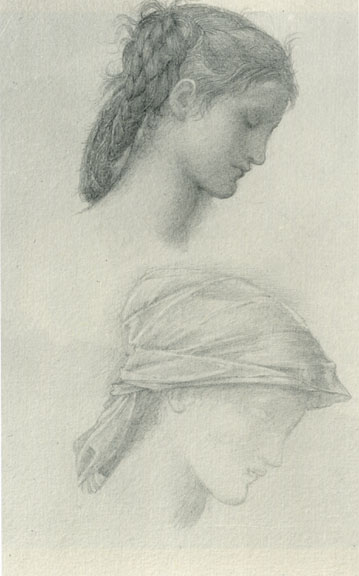
Two Head Studies; for the Figure of Fortune
Sir Edward Coley Burne-Jones, Bt ARA (1833-1898)
1870s
Pencil on white paper
10 1/2 x 6 1/8 inches, 26.5 x 15.5 cm.
Provenance: Sir Philip Burne-jones Bt. Given by him to the Chelsea Art Union at St. Dunstan's Albert Hall Bazaar for the Blinded Soldiers and Sailor, May 1917
Verso: drapery studies
Peter Nahum Ltd, London has most generously given its permission to use in the Victorian Web information, images, and text from its catalogues, and this generosity has led to the creation of hundreds of the site's most valuable documents on painting, drawing, and sculpture. The copyright on text and images from their catalogues remains, of course, with Peter Nahum Ltd.
Readers should consult the website of Peter Nahum at the Leicester Galleries to obtain information about recent exhibitions and to order their catalogues. [GPL]

Commentary by Hilary Morgan
This drawing is a fine study for the head of Fortune for 'The Wheel of Fortune'(1) and dates from the first half of the 1870s. The bowed profile and swathed head are also reminiscent of 'Flamma Vestalis'(Grosvenor Gallery 1886, Private Collection, Switzerland) but this drawing is clearly not a work of the 1880s, neither is it a likeness of Margaret Burne-Jones, who inspired 'Flamma Vestalis'. Because of its format and because it is drawn on both sides, it probably originated in a sketchbook.
'The Wheel of Fortune' is another of the pessimistic subjects derived the 'Troy Tryptich'. It is the first of four 'Triumphs' in the predella; and it is a significant indication of Burne-Jones's fatalism that he produced no less than six paintings of the power of Fortune, but only one or two on the subjects of each of the succeeding triumphs, Fame, Oblivion and Love. In 'Fortune', blind Fortune turns a huge wheel, to which are bound a slave, a king and a poet. Burne-Jones was obsessed with the head of Fortune and he made many studies for it, both drawings and paintings.
The present drawing reveals Burne-Jones's deep interest in Renaissance art in the early 1870s. He began to accumulate photographs of paintings and drawings at this time and some of his albums are in the collection of University College. In 1871 he wrote to his friend Charles Norton asking for photographs, stating 'You know what I like - all helpful pieces of modelling and sweet head drawing' and 'I love Da Vinci and Michael Angelo most of all'. These two artists exerted the strongest influence on this drawing. The intricacies of plaited hair which began to fascinate him in this period relate to a group of Leonardo's drawings in Windsor Castle. The swathed head which he finally used for the painting derived from Michelangelo's Sybils on the Sistine ceiling. Burne-Jones visited Rome for the first time in 1871 and in the Sistine chapel 'folded his railway rug thickly, and, lying down on his back, read the ceiling from beginning to end, peering into every corner and revelling in its execution', using the best opera glasses he could buy. Would that this was still possible today!
References
Burne-Jones, John. Memorials of Sir Edward Burne-Jones. Volume 2. London: Macmillan, 1904.
Christian, John. '"La Roue de la fortune"de Burne-Jones'. La Revue du Louvre et des Musées de France. Number 34, 1984. pp. 204-211.
Morgan, Hilary and Nahum, Peter. Burne-Jones, The Pre-Raphaelites and Their Century. London: Peter Nahum, 1989. Catalogue number 53.
Last modified 2 January 2002