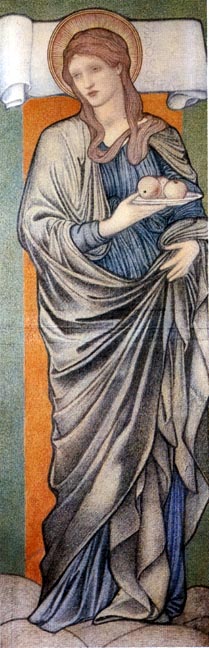
St. Dorothea; from the stained glass window design for St. Martin's church, Brampton, Cumberland
Sir Edward Coley Burne-Jones, Bt ARA (1833-1898)
Inscribed 'S.Dorothea' and inscribed 'Brampton' on the reverse of the stretcher
Coloured chalks on two sheets of cream paper
68 x 22 1/2 inches, 173 x 57 cm
Provenance: Charles de Pauw
Peter Nahum Ltd, London has most generously given its permission to use in the Victorian Web information, images, and text from its catalogues, and this generosity has led to the creation of hundreds of the site's most valuable documents on painting, drawing, and sculpture. The copyright on text and images from their catalogues remains, of course, with Peter Nahum Ltd.
Readers should consult the website of Peter Nahum at the Leicester Galleries to obtain information about recent exhibitions and to order their catalogues. [GPL]

Commentary by Hilary Morgan
This is a stained glass design of 1880, for part of the east chancel window of St. Martin's church, Brampton, Cumberland. St. Dorothea appears in the fourth window light of the bottom tier. The church itself was designed by Philip Webb. Burne-Jones considered Brampton to be one of his most important commissions. Not only was he an intimate friend of both the patron and the architect, but the church provided a contemporary setting for his designs. He refers in his account book to the window as: 'A colossal work of fifteen subjects — a masterpiece of style, a chef-d'oeuvre of invention, capo d'opera of conception — a Herculean labour — hastily estimated in a moment of generous friendship for £200...'(Manuscript, Fitzwilliam Museum, Cambridge)
Although Burne-Jones originally intended to enter the Church, he lost most of his conventional religious belief at Oxford University. He later stated: 'There are only two sides of Christianity for which I am fitted by the spirit that designs in me - the carol part and the mystical part'. (G.B.-J, 1904) This attitude attracted him to the legend of St. Dorothea, which he treated in 'Theophilus and the Angel' (versions 1863-7 and 1868) and for glass in All Saints Cambridge (1866) as well as in the present figure. St. Dorothea was a Christian martyr condemned to death by the Roman governor Fabricus. The scribe, Theophilus, who mocked her faith, asked her to send him flowers and fruits from paradise (which she carries here) to mark her arrival. This she did, although she died in winter, and the miracle brought about his own conversion and martyrdom.
References
Burne-Jones, G. Memorials of Edward Burne-Jones. Volume 2. London: Macmillan, 1904. Plate 160.
Highly Important Victorian Paintings and Drawings. Catalogue for sale of 24 October 1979. London: Sotheby's Belgravia, 1978. Catalogue number 4.
Morgan, Hilary and Nahum, Peter. Burne-Jones, The Pre-Raphaelites and Their Century. London: Peter Nahum, 1989. Catalogue number 65.
Last modified 2 January 2002