
Note that the illustrations here (after the first one, of the front cover) come from our own website rather than the book, which, however, is very generously illustrated). — JB.
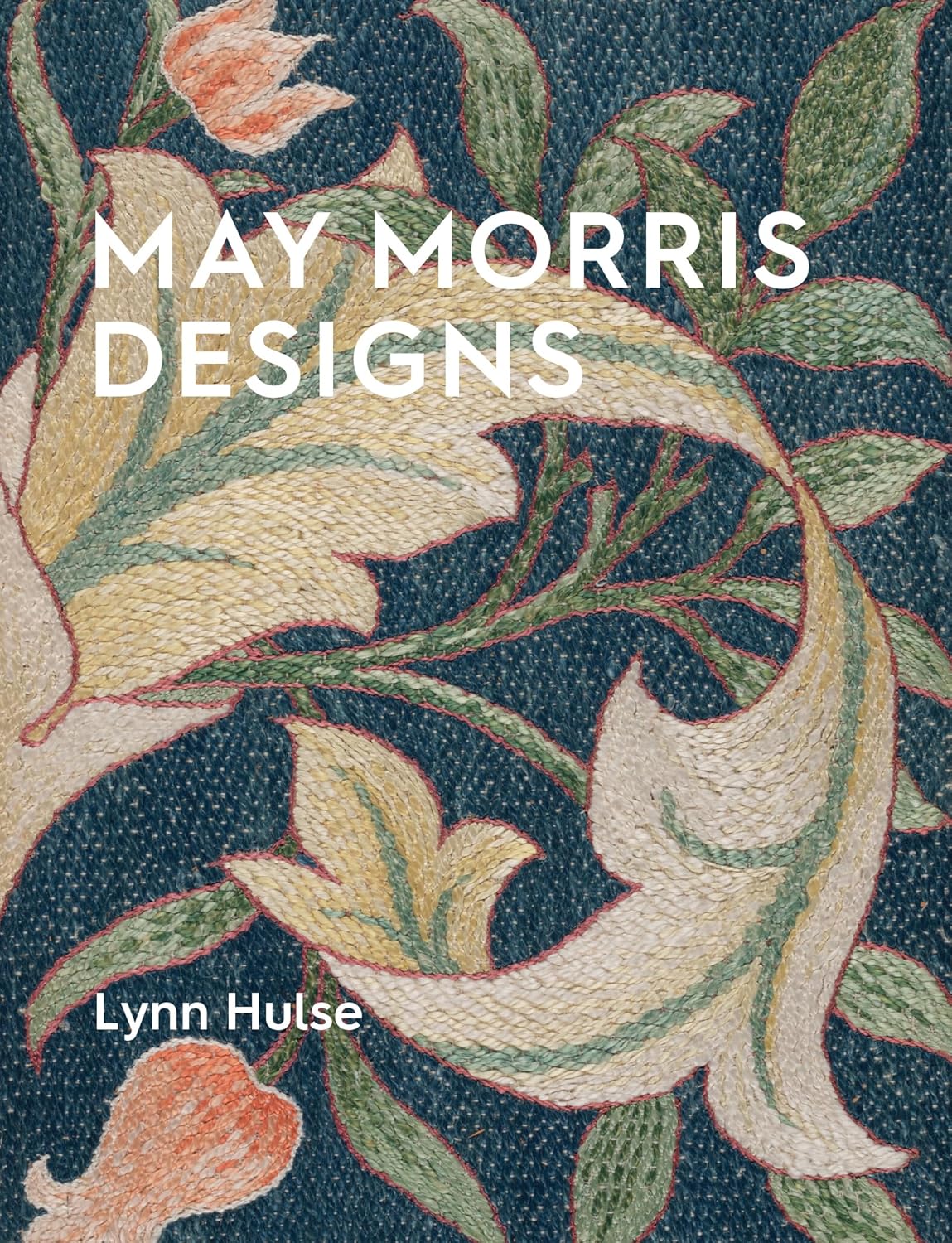
Lately, May Morris (1862-1938) has become something of a cause célèbre amongst custodians of the Arts and Crafts legacy. This is not because she has been "hidden from history," like so many artistic women of her time, but because the recognition she has been granted has been predicated only and narrowly on her identity as William Morris’s younger daughter. Her activities in that role have been woefully underwritten according to this new – and ongoing – championship, and deserve to be not just noted but celebrated. Thus Hulse’s opening line is, aptly, “May Morris is recognized today as one of the leading design-makers of the Arts and Crafts movement" (9) and "today" is the key word in that sentence.
Something of a harbinger of this trend was Jan Marsh’s essay on May Morris in Bridget Elliott and Janice Helland’s significant collection of essays Women Artists and the Decorative Arts 1880-1935 (Ashgate, 2002), while the new edition of Morris’s own Decorative Needlework in 2010 (Dodo Press, London) and the 2012 May Morris 150th Anniversary Exhibition (William Morris Society) gave material form to her achievement for those taking notice. From then on the attention has accumulated: a conference on May Morris held at the William Morris Gallery in 2016, generating a publication tellingly entitled May Morris: New Perspectives (2017); the exhibition May Morris, Art and Life at the William Morris Gallery in 2017-18, and the resulting book May Morris, arts and crafts designer (Anna Mason et al., V and A, 2017); a second showing of this show in Edinburgh (Dovecot Studios) in 2020; the exhibition May Morris, designer and advocate at the Art Institute of Chicago in 2021; the exhibition May Morris, art and advocacy at the Russell-Cotes Gallery (Bournemouth) in 2025 – and it continues: May Morris, crafting a legacy will open at the Lady Lever Gallery (Port Sunlight) in two months’ time.
Any admirer of the Morris enterprise will be familiar with William’s telling watchwords, such as: “[E]verything made by man’s hands has a form, which must be either beautiful or ugly; beautiful if it is in accord with Nature, and helps her; ugly if it is discordant with Nature, and thwarts her” (‘The decorative Arts," 1878) or “Have nothing in your houses that you do not know to be useful, or believe to be useful” ("The Beauty of Life," 1880). They may think straight away of rooms or staged displays seen in museums and National Trust properties in which the wallpaper, the curtains, the decorated furniture, make a vivid visual impression. But this book is not about the marvellous Gesamtwerk which conjures a whole environment, a world of values – it presents only one of the forms that Morris and his colleagues had at their disposal to enact these aims with which to beguile the reader. But Hulse, a leading Morris expert – and I mean Morris as in William and May - manages to make this one medium impressive, many-layered and resonant.
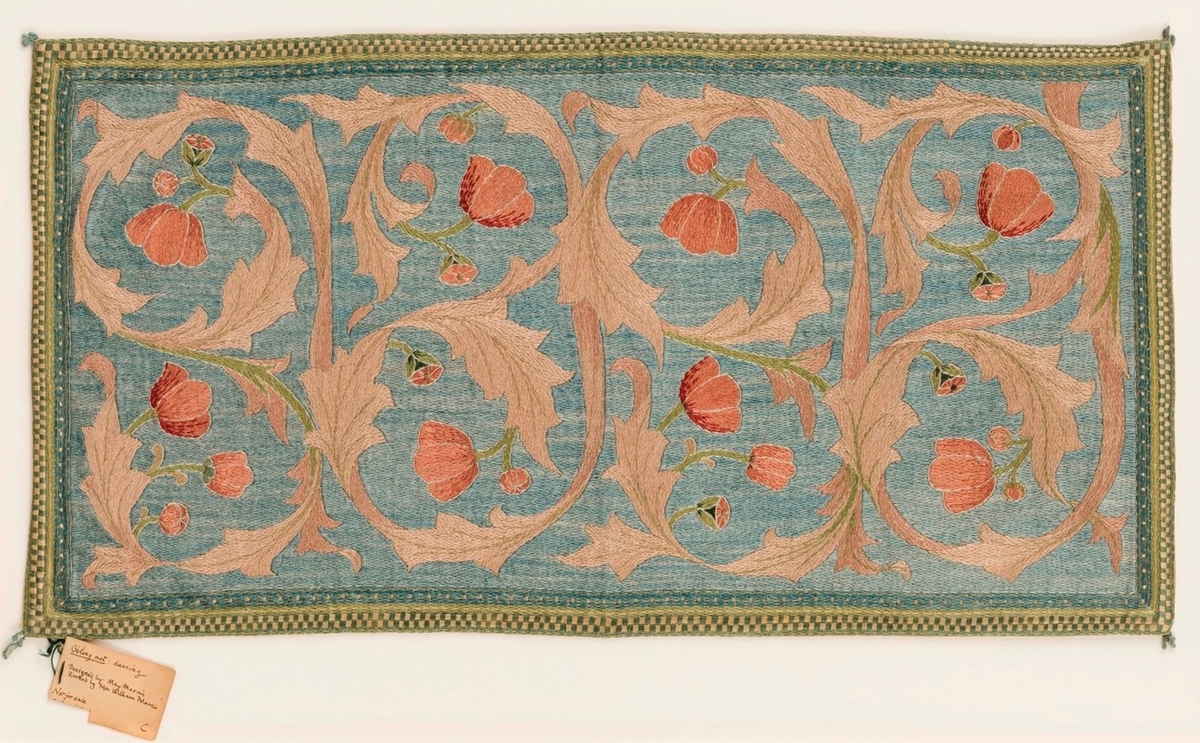
Rectangular cloth entitled Westward Ho! with an embroidery design by May Morris, worked by her mother Jane, 1885-86. [Click on the image for further details and to enlarge it.]
The book is in three sections: "May Morris and the revival of decorative needlework," "The Elements of art embroidery," and "From sketch to finished pattern." This division of matter allows Hulse to sound the trumpet for Morris junior as a significant actor in the history of the Arts and Crafts movement, to educate the reader on the finer points of the particular medium in which she specialized, and to explain the practical processes that enable the legions of amateur needleworkers – such as our mothers and aunts, I cannot resist observing, although that may put me in a definite age bracket – to benefit from the Morris expertise. The unusual delight that this book offers is that readers can complete their experience by working Morris’s designs for themselves. Hulse is herself both a scholar and a needleworker and draws on her experience for this unusual book. She teaches what she calls Ornamental Embroidery, twenty-five examples of which are at the heart of this volume, drawn from the collections of the Ashmolean Museum, Oxford (84-102).
Hulse follows the history of the form from the first half of the nineteenth century (15-16). The existing enthusiasm for certain national treasures such as the Opus Anglicanum and the Bayeux tapestry led, in the period of both the Gothic revival and the ‘woman question’, to various initiatives to mobilise needlework for societal as much as cultural reasons. Of course it was William Morris’s enterprise that gained embroidery a new public alongst other medievalist forms such as stained glass and weaving, but Hulse reminds the reader that a surge of individuals broke into print or practice from the 1870s (when Morris senior began public speaking) in the promotion of hand-work (18). The gradual emergence of women makers alongside male designers such as Walter Crane, Christopher Dresser and Selwyn Image is described, and nods are given to other women sewing in May Morris’s environment such as her own mother Jane Morris, her aunt Bessie Burden, Catherine Holliday and Maude Deacon (this number eventually including students of May’s).
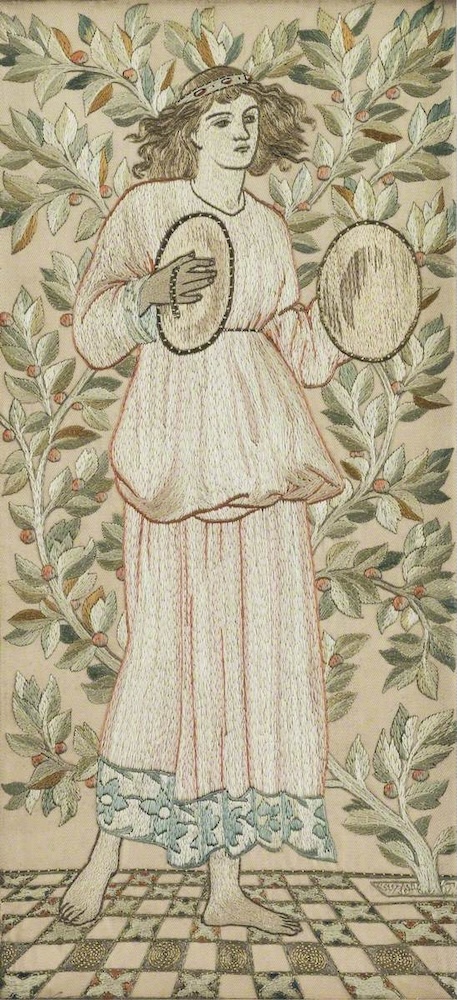
Minstrel with Cymbals, a finished work of 1885. [Click on the image for further details and to enlarge it.]
The elements that identify artistic embroidery are four, according to Hulse: design, colour, materials and stitch. To illustrate this, initial designs, trial pieces, paper patterns and finished work are illustrated throughout the text – and the high-quality illustrations, many of exquisite details, are a highlight of this volume. This will come as no surprise to readers who are also practitioners, in however modest a way, but Hulse’s address of these elements – and especially the last, stitch - will be not only interesting but illuminating for readers who have never picked up a needle and thread of any sort in their lives. Particular designs, such as Maids of Honour and Angel Minstrel/Angel with Cymbals, that were used over and over in diverse objects, illustrate the impact of the selection of colour, materials and stitch on a piece of work. Just on a prosaic level, who would have thought of all the specific items to which embroidery was applied under May Morris’s enterprising management? These are the ones assembled in this volume: book cover, cushion cover, fire screen, decorative panel, sofa back, table cover, runner, frieze, work-bag, sachet, photograph frame, clothing, banner. Put in charge of the embroidery section of her father’s firm in 1885 at the age of twenty-three, she certainly pulled her weight. Between 1888 and 1919, she also wrote extensively about her specialism, her various publications making an impressive list (13). She was also, of course, responsible for the prolongation of the Morris firm after her father’s death, and it could be surmised that she also played a crucial role in the eventual publication of her father’s writings, although they were published under J.W. Mackail’s name.
In its emphasis on the practice of needleworking, this book is atypical and refreshing, returning both Morrises’ passionate exercise of skill, creativity and invention to the real-world application that was of course Morris and Company’s raison d’être. This volume, then, is not only a "how it was done’ history but a ‘how to do it yourself" manual.
Bibliography
[Book under review] Hulse, Lynn. May Morris Designs: The Essence and Soul of Beautiful Design. Oxford: Ashmolean Museum, 2025. £25.00 ISBN 978-1-910807-69-9
Elliott, Bridget and Helland, Janice eds. Women Artists and the Decorative Arts 1880-1935. Aldershot: Ashgate, 2002.
Hulse, Lynn, ed. May Morris: Art and Life. London: Friends of the William Morris Gallery, 2017.
Mason, Anna et al. May Morris: Arts and Crafts Designer. London: Thames & Hudson/V&A, 2017.
Morris, May. Decorative Needlework. London: Joseph Hughes, 1893 (new edition 2010).
Created 20 Frebruary 2026