
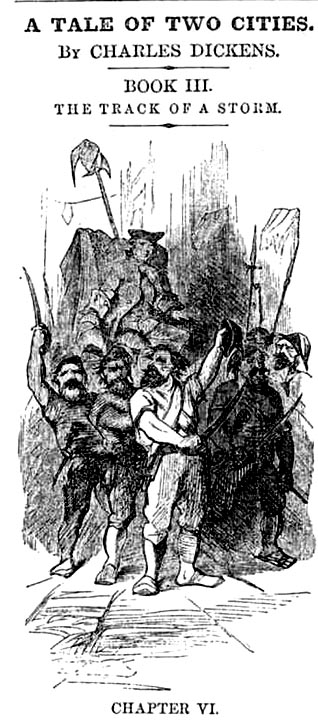
Headnote Vignette of Dr. Manette chaired through the Paris streets after the trial of Charles Darnay: Book III, Chapter 6 ("Triumph").
John McLenan
8 by 4 cm (3 inches high by 1 ⅜ inches wide)
Dickens's A Tale of Two Cities
The twenty-fourth installment of the novel appeared in Harper's Weekly (15 October 1859): 699; it had originally appeared in the UK on Saturday, 8 October in All the Year Round.

Passage Illustrated: The Ragged Mob carries Dr. Manette Home in Triumph
Then, began one of those extraordinary scenes with which the populace sometimes gratified their fickleness, or their better impulses towards generosity and mercy, or which they regarded as some set-off against their swollen account of cruel rage. No man can decide now to which of these motives such extraordinary scenes were referable; it is probable, to a blending of all the three, with the second predominating. No sooner was the acquittal pronounced, than tears were shed as freely as blood at another time, and such fraternal embraces were bestowed upon the prisoner by as many of both sexes as could rush at him, that after his long and unwholesome confinement he was in danger of fainting from exhaustion; none the less because he knew very well, that the very same people, carried by another current, would have rushed at him with the very same intensity, to rend him to pieces and strew him over the streets . . . . [W]hen he and Doctor Manette emerged from the gate, there was a great crowd about it, in which there seemed to be every face he had seen in Court — except two, for which he looked in vain. On his coming out, the concourse made at him anew, weeping, embracing, and shouting, all by turns and all together, until the very tide of the river on the bank of which the mad scene was acted, seemed to run mad, like the people on the shore.
They put him into a great chair they had among them, and which they had taken either out of the Court itself, or one of its rooms or passages. Over the chair they had thrown a red flag, and to the back of it they had bound a pike with a red cap on its top. In this car of triumph, not even the Doctor's entreaties could prevent his being carried to his home on men's shoulders, with a confused sea of red caps heaving about him, and casting up to sight from the stormy deep such wrecks of faces, that he more than once misdoubted his mind being in confusion, and that he was in the tumbril on his way to the Guillotine.
In wild dreamlike procession, embracing whom they met and pointing him out, they carried him on. Reddening the snowy streets with the prevailing Republican colour, in winding and tramping through them, as they had reddened them below the snow with a deeper dye, they carried him thus into the courtyard of the building where he lived. Her father had gone on before, to prepare her, and when her husband stood upon his feet, she dropped insensible in his arms. [Book the Third — "The Track of a Storm," Chapter VI, "Triumph," 699]
Commentary: A Chapter of Reversals as Dr. Manette's "Triumph" Proves Illusionary
The headnote vignette sets up an expectation of triumph for both Dr. Manette, whose having been a Bastille prisoner makes him something of an icon to the mob, and his son-in-law. Darnay has testified that he gave up his French citizenship and renounced his title and family connections years before, and that he recently returned to support the family's steward, Gabelle. After Manette's attesting to Charles's moral character and mentioning his trial at the Old Bailey as a spy for the French, Darnay is released. However, after this jubilant street scene, four Jacobins arrive at the Doctor's rooms to re-arrest Darnay, acting upon the denunciation just made by the Defarges. Thus, Dickens reverses Darnay's "Triumph," and McLenan depicts him once again as a prisoner of the revolutionary regime in "The Citizen Evrémond, called Darnay", just as he had recently been in in La Force.
Other Illustrated Editions (1859-1910)
- Hablot K. Brown or 'Phiz' (16 illustrations, 1859)
- Sol Eytinge, Junior (8 illustrations, 1867)
- Fred Barnard (25 illustrations, 1874)
- A. A. Dixon (12 illustrations, 1905)
- Harry Furniss (32 illustrations, 1912)
Related Material
- John McLenan's Thirty-One Headnote Vignettes for A Tale of Two Cities in Harper's Weekly (7 May — 3 December 1859)
- Phiz's July 1859 Plates for Dickens's A Tale of Two Cities
- French Revolution
- Victorian Images of the French Revolution
- "A Tale of Two Cities (1859): A Model of the Integration of History and Literature"
Scanned image by Philip V. Allingham; text by PVA and George P. Landow. [You may use this image without prior permission for any scholarly or educational purpose as long as you (1) credit the person who scanned the image and (2) link your document to this URL in a web document or cite the Victorian Web in a print one.]
Bibliography
Allingham, Philip V. "Charles Dickens's A Tale of Two Cities (1859) Illustrated: A Critical Reassessment of Hablot Knight Browne's Accompanying Plates." Dickens Studies. 33 (2003): 109-158.
Dickens, Charles. A Tale of Two Cities. Illustrated by John McLenan. Harper's Weekly: A Journal of Civilization, 7 May through 3 December 1859.
Dickens, Charles. A Tale of Two Cities: A story of the French Revolution. Project Gutenberg e-text by Judith Boss, Omaha, Nebraska. Release Date: September 25, 2004 [EBook #98].
Guiliano, Edward, and Philip Collins. The Annotated Dickens. 2 vols. New York: Clarkson N. Potter, 1986.
Victorian
Web
Illustra-
tion
John
McLenan
A Tale of
Two Cities
Next
Created 27 November 2007
Last modified 27 November 2025