
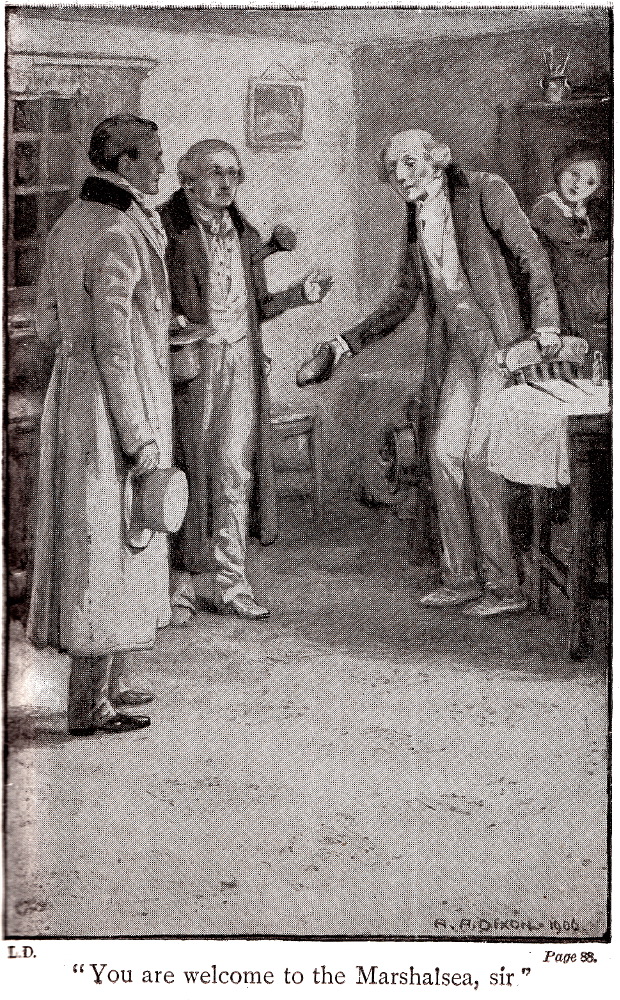
“You are welcome to the Marshalsea, sir.”
1906
Lithographic reproduction of a watercolour
12.3 cm high by 8 cm wide (4 ⅞ by 3 ¼ inches)
Second illustration for Little Dorrit, Collins' Pocket Edition (1906), facing p. 88, and referencing p. 88.
[Click on image to enlarge it and mouse over text for links.]
Scanned image and text by Philip V. Allingham.

Passage Illustrated from Chapter VIII, “The Lock.”
‘Mr. Clennam,’ returned the other, rising, taking his cap off in the flat of his hand, and so holding it, ready to put on again, ‘you do me honour. You are welcome, sir;’ with a low bow. ‘Frederick, a chair. Pray sit down, Mr. Clennam.’
He put his black cap on again as he had taken it off, and resumed his own seat. There was a wonderful air of benignity and patronage in his manner. These were the ceremonies with which he received the collegians.
‘You are welcome to the Marshalsea, sir. I have welcomed many gentlemen to these walls. Perhaps you are aware — my daughter Amy may have mentioned that I am the Father of this place.’
‘I — so I have understood,’ said Arthur, dashing at the assertion.
‘You know, I dare say, that my daughter Amy was born here. A good girl, sir, a dear girl, and long a comfort and support to me. Amy, my dear, put this dish on; Mr. Clennam will excuse the primitive customs to which we are reduced here. Is it a compliment to ask you if you would do me the honour, sir, to —’
‘Thank you,’ returned Arthur. ‘Not a morsel.’ [Chapter VIII, “The Lock,” p. 88]
Commentary: Juxtaposition of Plate and Moment Realised
The 1906 Collins Pocket Edition of Little Dorrit has positioned its illustrations immediately adjacent to the textual passage illustrated, except in the case of the Frontispiece, which directs the reader to p. 831. Earlier volumes in the Collins Pocket Edition series seem to randomly position the individual lithographs. Whereas, for example, in the Dixon-illustrated volume A Tale of Two Cities (1905), the full-page lithographic plates are often quite a number of pages removed from the passages realised — both well before and well after: “Pray control your agitation,” for instance, faces p. 65, but realises p. 33; whereas “Killed!” shrieked the man faces p. 129, but references p. 134. In this printing of the novel, the reader has usually just encountered the passage illustrated before turning the page to see its pictorial representation. Here, for example, we have just followed Arthur down a narrow entry passage, past an open “strong door,” to meet brothers William and Frederick Dorrit on page 87. Turning to page 88, we find the textual scene playing out as we now study the two elderly, respectably dressed brothers (decidedly lookalikes), with Arthur Clennam, top-hat in hand, to the left, and Amy, upper right, in what would pass for a thoroughly respectable middle-class parlour.
The second illustration for the novel introduces two further significant figures in the story after the frontispiece has introduced us to Amy Dorrit and Arthur Clennam. He is welcomed to the Marshalsea by its “Father,” William, who resides in the notorious London debtor's prison with his wife and two of his children, Tip (the feckless Edward) and Little Dorrit (dutiful Amy), who was actually born there, but works daily outside its walls for Mrs. Clennam. William is called the “Father of the Marshalsea” by virtue of his having been a prisoner there longer than any other inmate. As is the custom, Arthur leaves a monetary “tribute.” After this scene, Arthur learns that he has lingered too long, and must now spend the night locked it.
Pertinent illustrations in two other British editions: 1857 and 1910
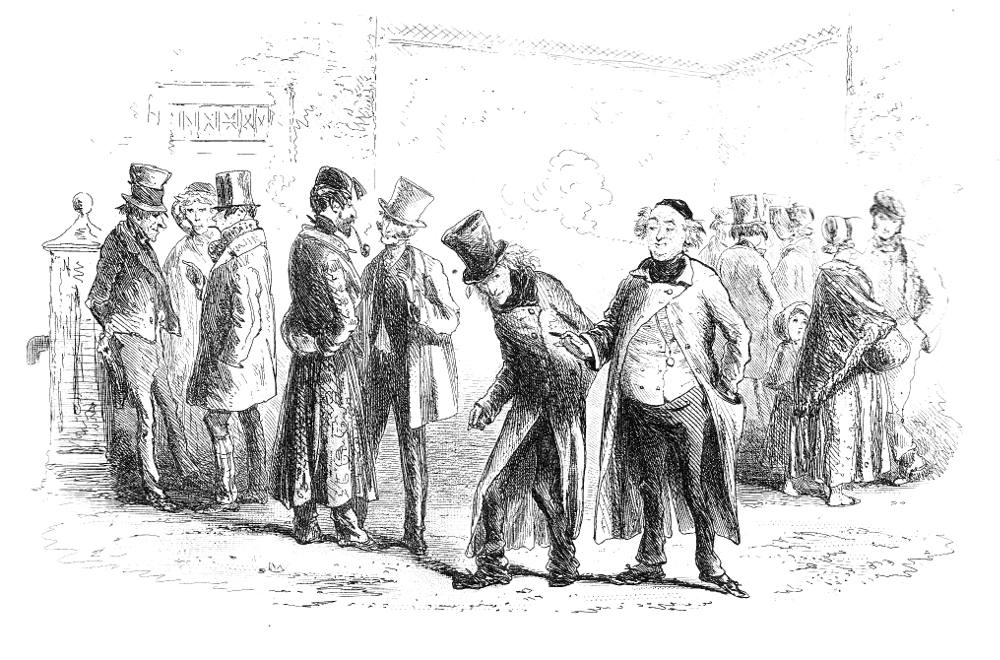
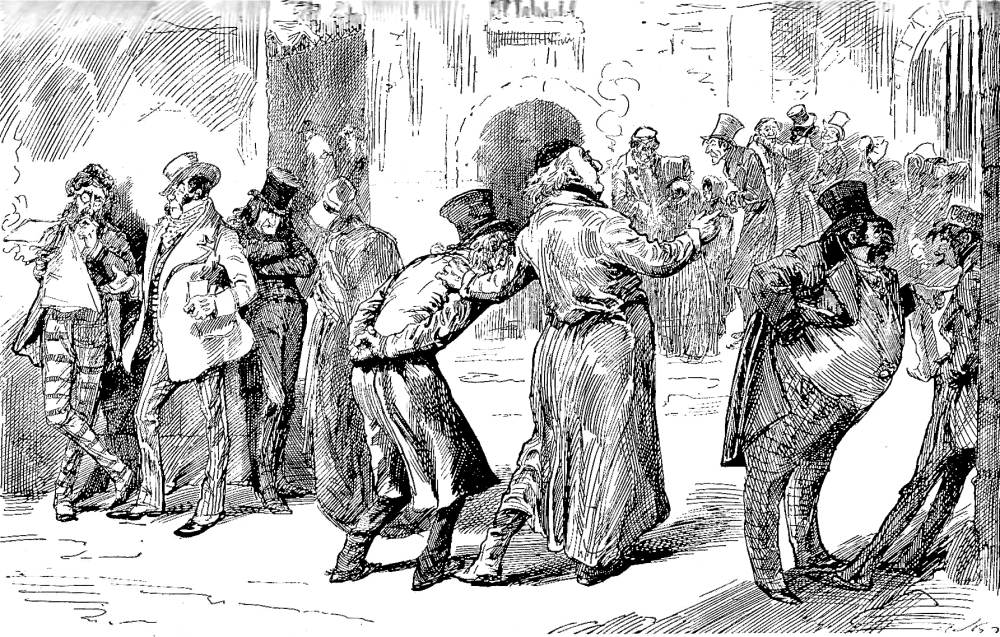
Left: Phiz's original serial illustration which introduces the Dorrit brothers, The Brothers (May 1856). Right: Harry Furniss's treatment of the Dorrit brothers: The Dorrit Brothers in the Marshalsea, for Chapter 19 in the 1910 edition.
Related Material: The Other Illustrated Editions (1863 — 1910)
- Illustrations by "Phiz" (Hablot Knight Browne) for Little Dorrit (December 1855 — June 1857)
- James Mahoney's 58 illustrations for Dickens's Little Dorrit (1873)
- Harry Furniss's 29 illustrations for Dickens's Little Dorrit (1910)
- Charles Dickens's Little Dorrit (1857): Site Map
- Felix Octavius Carr Darley — three engraved frontispieces, volumes 1, 2, and 4: 1863)
- Illustrations by Sol Eytinge, Jr. — 16 plates from the Ticknor and Fields' Diamond Edition (1867)
Bibliography
Dickens, Charles. Little Dorrit. Illustrated by Hablot Knight Browne ("Phiz"). The Authentic Edition. London: Chapman and Hall, 1901 [rpt. 30 May 1857 volume].
Dickens, Charles. Little Dorrit. Frontispieces by Felix Octavius Carr Darley and Sir John Gilbert. The Household Edition. 55 vols. New York: Sheldon & Co., 1863. 4 vols.
Dickens, Charles. Little Dorrit. Illustrated by Sol Eytinge, Jr. The Diamond Edition. 14 vols. Boston: Ticknor & Fields, 1867.
Dickens, Charles. Little Dorrit. Illustrated by James Mahoney. The Household Edition. 22 vols. London: Chapman and Hall, 1873. Vol. V.
Dickens, Charles. Little Dorrit. Illustrated by A. A. Dixon. With an engraved title by Harry Furniss. London and Glasgow: Collins Clear-Type Press, 1906.
Dickens, Charles. Little Dorrit. Illustrated by Harry Furniss. The Charles Dickens Library Edition. 18 vols. London: Educational Book, 1910. Vol. XII.
Created 5 September 2026