
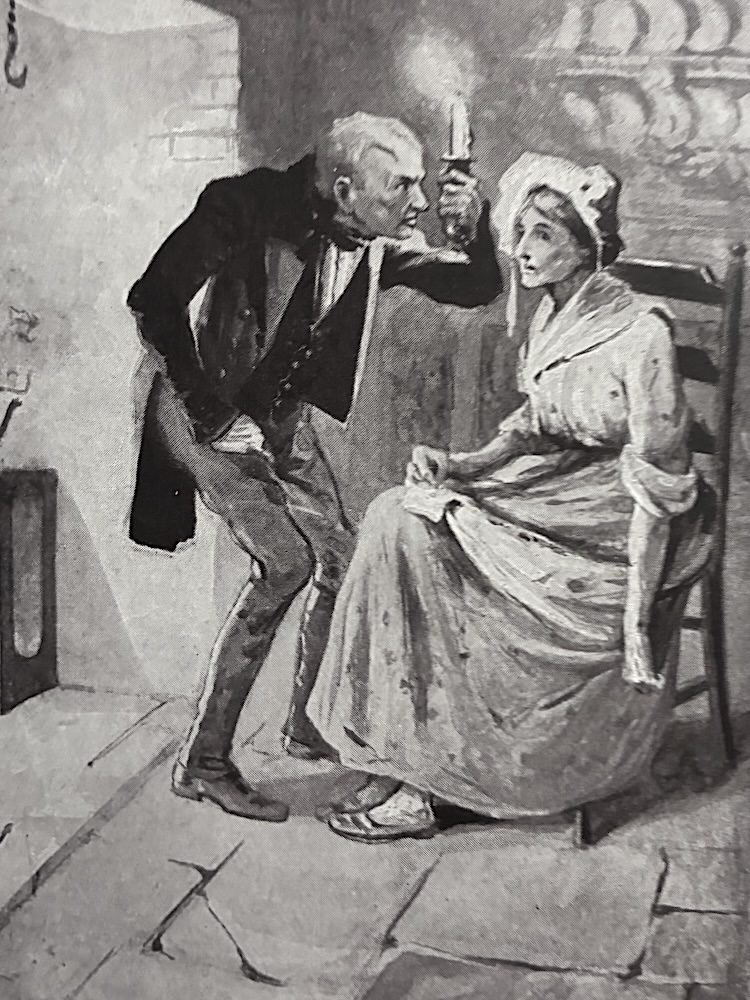
“Mr. Flintwinch held the candle to her head!”
Arthur A. Dixon
1906
Lithographic reproduction of a watercolour
12.2 cm high by 8.1 cm wide (4 ⅞ by 3 ¼ inches), framed.
Third illustration for Little Dorrit, Collins' Pocket Edition (1906), facing p. 191, referencing p. 190.
[Click on image to enlarge it and mouse over text for links.]
Scanned image and text by Philip V. Allingham.

Passage Illustrated from Jeremiah Flintwinch's Interrogation of His Wife
‘Then say no more. Say no more. Let Little Dorrit keep her secret from me, and do you keep it from me also. Let her come and go, unobserved and unquestioned. Let me suffer, and let me have what alleviation belongs to my condition. Is it so much, that you torment me like an evil spirit?’
‘I asked you a question. That’s all.’
‘I have answered it. So, say no more. Say no more.’ Here the sound of the wheeled chair was heard upon the floor, and Affery’s bell rang with a hasty jerk.
More afraid of her husband at the moment than of the mysterious sound in the kitchen, Affery crept away as lightly and as quickly as she could, descended the kitchen stairs almost as rapidly as she had ascended them resumed her seat before the fire, tucked up her skirt again, and finally threw her apron over her head. Then the bell rang once more, and then once more, and then kept on ringing; in despite of which importunate summons, Affery still sat behind her apron, recovering her breath.
At last Mr Flintwinch came shuffling down the staircase into the hall, muttering and calling ‘Affery woman!’ all the way. Affery still remaining behind her apron, he came stumbling down the kitchen stairs, candle in hand, sidled up to her, twitched her apron off, and roused her.
‘Oh Jeremiah!’ cried Affery, waking. ‘What a start you gave me!’
‘What have you been doing, woman?’ inquired Jeremiah. ‘You’ve been rung for fifty times.’
‘Oh Jeremiah,’ said Mistress Affery, ‘I have been a-dreaming!’
Reminded of her former achievement in that way, Mr Flintwinch held the candle to her head, as if he had some idea of lighting her up for the illumination of the kitchen.
‘Don’t you know it’s her tea-time?’ he demanded with a vicious grin, and giving one of the legs of Mistress Affery’s chair a kick.
‘Jeremiah? Tea-time? I don’t know what’s come to me. But I got such a dreadful turn, Jeremiah, before I went — off a-dreaming, that I think it must be that.’ [Chapter XV, “Mrs. Flintwinch has another Dream,” p. 190]
Commentary: Introducing the Contrasting Flintwinches, Jeremiah and Affery, as Comic Foils
Since Dickens has introduced Jeremiah Flintwinch, Mrs. Clennam's clerk and confidential business partner with a detailed description in Chapter 3, Dixon had little difficulty in producing a likeness consistent with the text: omitting the watch, the illustrator gives him the black coat and waistcoat of the earlier description, emphasizing his crab-like angularity, his extreme thinness, and his drab gaiters. As in the text, the interrogation here occurs in Mrs. Clennam's kitchen, below stairs, as we may judge from the Welsh dresser and the stone flooring. Dixon's visual triumph here is Mistress Affery's eerie composure and trance-like facial expression, if not quite amounting to feeble-minded terror, but certainly the expression of a perpetual dreamer. The movements above of the noisy wheeled-chair, mentioned in text and belonging to the invalided Mrs. Clennam, probably condition this dialogue, but of course cannot be shown.
Jeremiah Flintwinch, Affery's irascible husband, harbours a secret from his wife, but in her sleep she has apprehended his confidential conversations with their employer, the dour and devious Mrs. Clennam, although the contents of these dialogues so confuse her that she is sure that she must have dreamed them, as well as the strange noises emanating from the walls of the house, quite unlike the "rats, cats, water, [and] drains" that her husband proposes as the cause. Affery is utterly bewildered how, in her fugue state, Jeremiah can be so assertive with Mrs. Clennam, and what secret the pair are keeping from her that concerns Little Dorrit. The answer, of course, is the codicil.
Pertinent illustrations in five other editions: 1857, 1863, 1867, 1873. and 1910
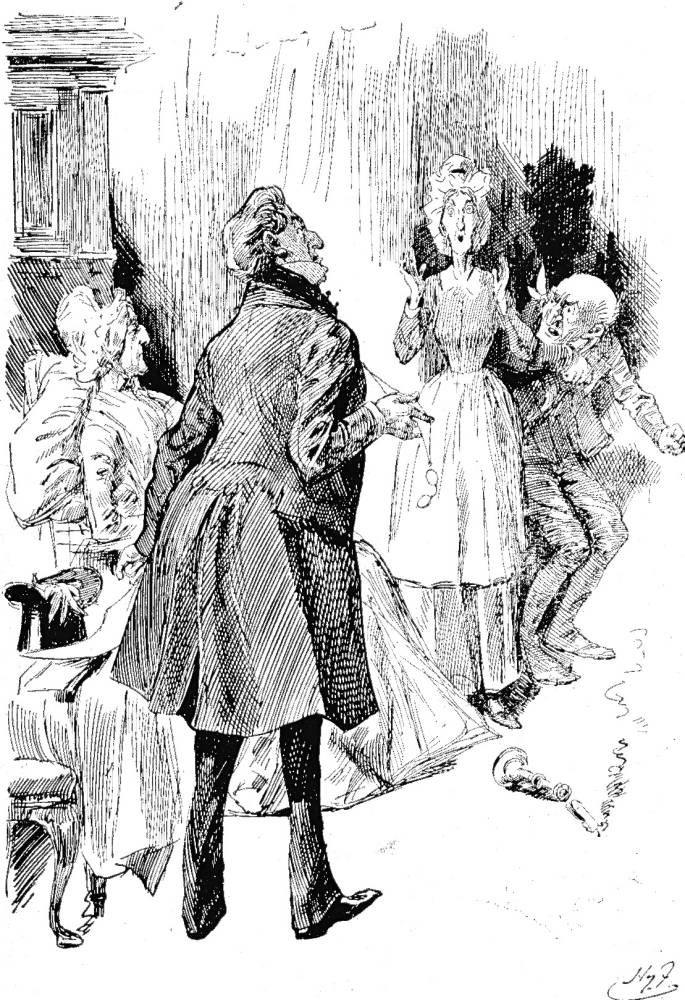
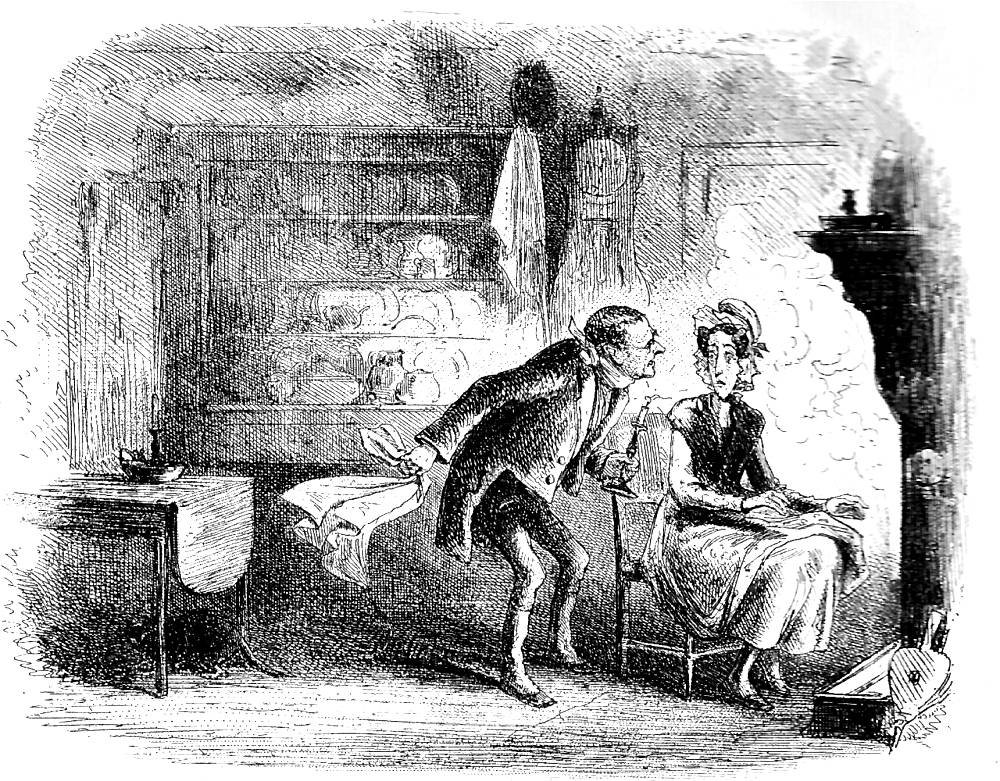
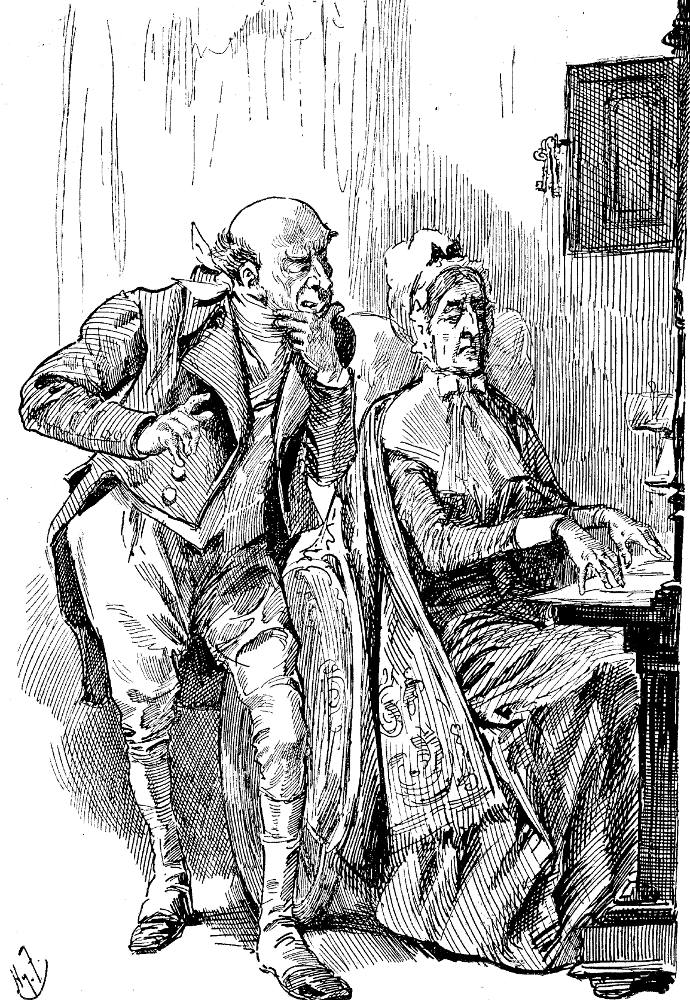
Left: Harry Furniss's treatment of the odd couple: Mistress Affery's Alarm, for Chapter 17 in the 1910 edition. Centre: Phiz's original serial illustration which introduces the ill-sorted couple, Mr. and Mrs. Flintwich (April 1856). Right: Furniss's detailed dual portraitof two of the novel's most negative characters: Jeremiah Flintwich and Mrs. Clennam, for Book I, Chapter 5, "Family Affairs," in the 1910 Charles Dickens Library edition.
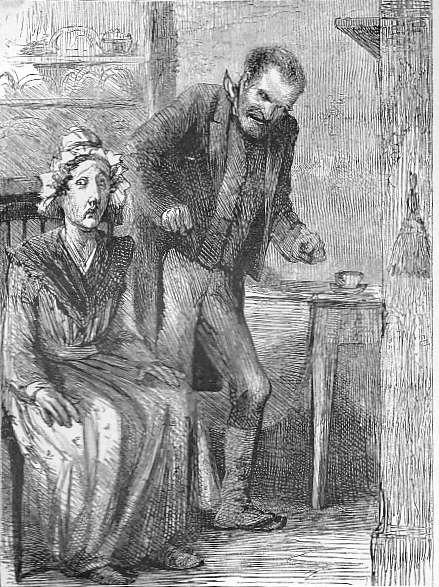
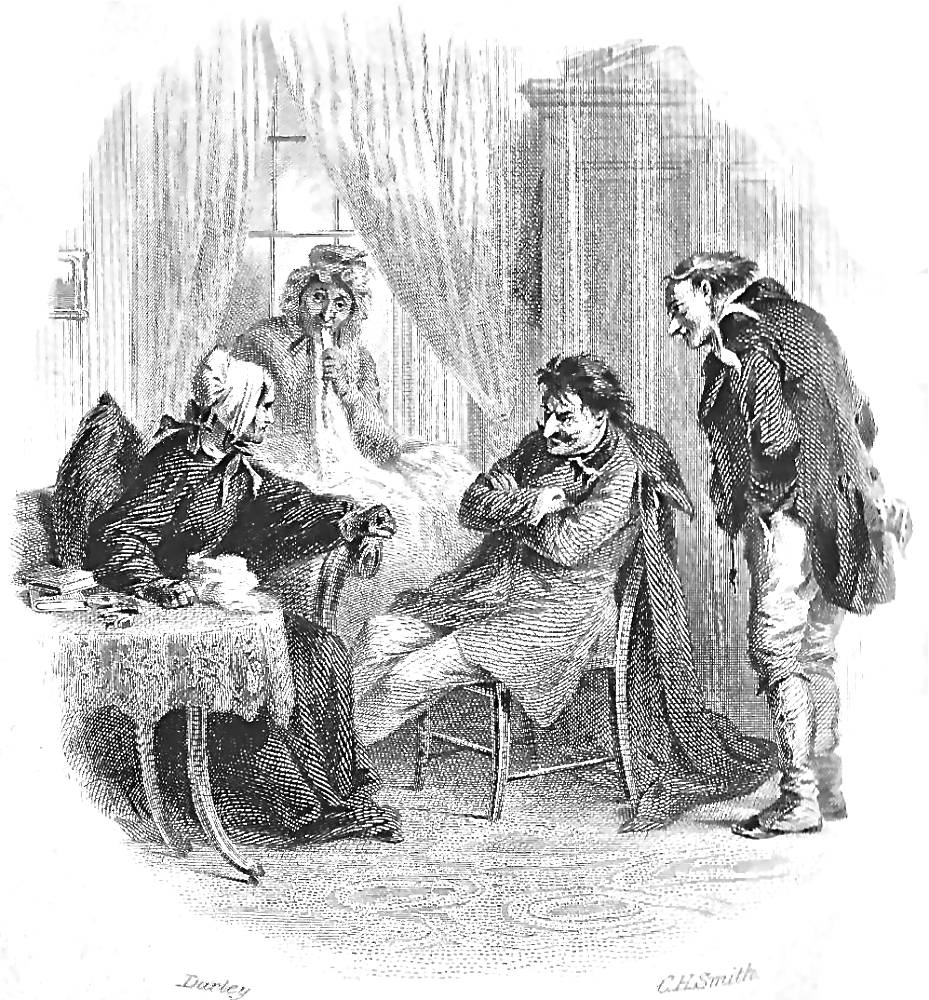
Left: Sol Eytinge, Junior's dual study of the perpetually anxious Affery and her rough-and-ready husband, Mrs. Clennam's confidential servant, Mr. and Mrs. Flintwinch (1867), as described in Book 1, Chapter 3. Right: The American Household Edition frontispiece depicting Mrs. Clennam, Affery, Flintwinch, and Blandois, Closing In — Book II, Ch. XXX (1863). [Click on the images to enlarge them.]
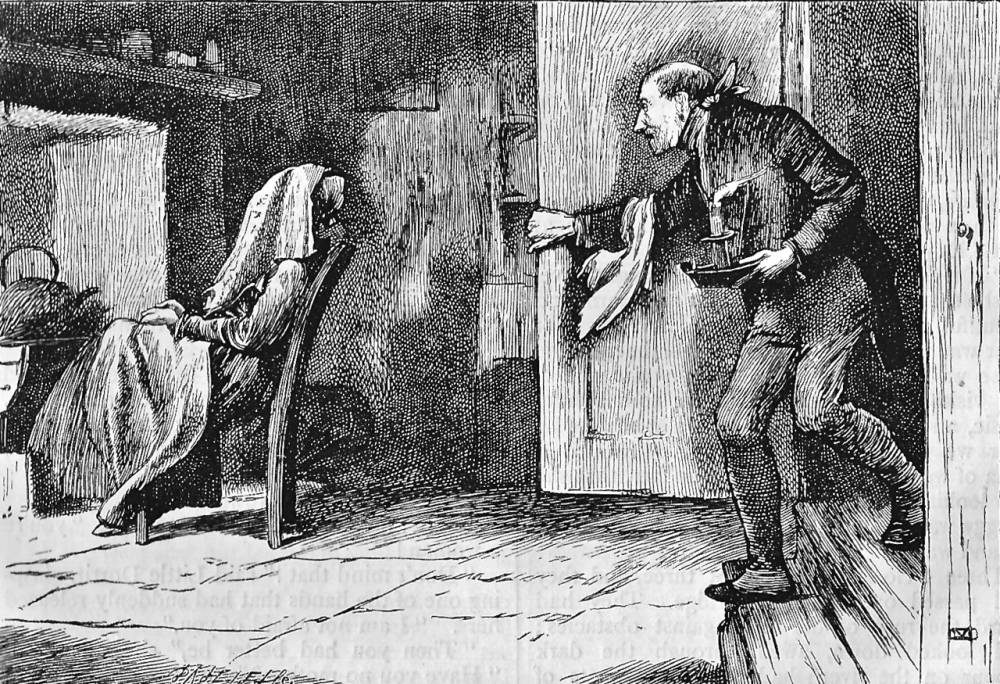
Above: Mahoney's British Household Edition version of the same "downstairs" scene in the kitchen, He came stumbling down the kitchen stairs, candle in hand (1873). [Click on the image to enlarge it.]
Related Material: The Other Illustrated Editions (1863 — 1910)
- Illustrations by "Phiz" (Hablot Knight Browne) for Little Dorrit (December 1855 — June 1857)
- James Mahoney's 58 illustrations for Dickens's Little Dorrit (1873)
- Harry Furniss's 29 illustrations for Dickens's Little Dorrit (1910)
- Charles Dickens's Little Dorrit (1857): Site Map
- Felix Octavius Carr Darley — three engraved frontispieces, volumes 1, 2, and 4: 1863)
- Illustrations by Sol Eytinge, Jr. — 16 plates from the Ticknor and Fields' Diamond Edition (1867)
Bibliography
Dickens, Charles. Little Dorrit. Illustrated by Hablot Knight Browne ("Phiz"). The Authentic Edition. London: Chapman and Hall, 1901 [rpt. 30 May 1857 volume].
Dickens, Charles. Little Dorrit. Frontispieces by Felix Octavius Carr Darley and Sir John Gilbert. The Household Edition. 55 vols. New York: Sheldon & Co., 1863. 4 vols.
Dickens, Charles. Little Dorrit. Illustrated by Sol Eytinge, Jr. The Diamond Edition. 14 vols. Boston: Ticknor & Fields, 1867.
Dickens, Charles. Little Dorrit. Illustrated by James Mahoney. The Household Edition. 22 vols. London: Chapman and Hall, 1873. Vol. V.
Dickens, Charles. Little Dorrit. Illustrated by A. A. Dixon. With an engraved title by Harry Furniss. London and Glasgow: Collins Clear-Type Press, 1906.
Dickens, Charles. Little Dorrit. Illustrated by Harry Furniss. The Charles Dickens Library Edition. 18 vols. London: Educational Book, 1910. Vol. XII.
Created 6 September 2026