
In this second set of readings in George Meredith's work (the first is online here), Sylvia Hornsby expands on another important aspect of her doctoral thesis for Canterbury Christchurch University, Moving through Uncertainty with George Meredith (2023). The thesis itself, with its wider range of approaches, is available online at https://pure.canterbury.ac.uk/ — Jacqueline Banerjee
eorge Meredith's work is notable for its bold depictions of gender fluidity. This study looks at his unconventional images of women, which challenged the social expectation of stereotypical gender roles in the mid-nineteenth century. Part One outlines how women were expected to conform to perceived ideals of femininity in behaviour and appearance. Masculine traits were ridiculed, and any deviation was seen as a threat to the stability of society. These conventions were challenged by the philosopher John Stuart Mill as well as by Meredith: both believed that the model of femininity was socially constructed and unnatural. In the close readings that follow, five of Meredith’s novels are shown to demonstrate the ways in which he uses his writing to express his belief in a woman’s right to behave naturally. His understanding of society’s restrictions on women, and his critique of its feminine ideal, are evident in his female characters, who participate in physical activity and express natural sensuality, displaying a blend of male and female characteristics. Meredith’s boldness in depicting the attraction of masculine traits in women is evident from his first novel in 1859, to the portrayal of a "new idea of women" in his last completed novel published in 1895. Whilst challenging social expectations and attitudes, Meredith acknowledges the difficulties of redefining stereotypical roles, and the perceived threat to their masculinity experienced by men. The essay notes his influence on twentieth-century writers who expressed gender fluidity in literature, and the relevance of his writing in the twenty-first century.
Part One
Society’s expectation of the ideal woman
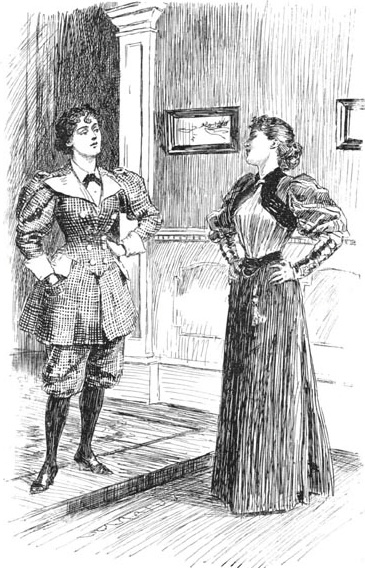
"The Bicycle Suit," Punch (1895). [Click on all the images on this page
to enlarge them, and for more information about them.]
The image of "The Angel in the House" in Coventry Patmore’s sequence of poems (1854-1862) conveys the nineteenth-century social expectation of a wife, confined to the domestic sphere, and accepting her husband’s authority. Conforming to the convention of feminine behaviour was perceived as important in maintaining social stability, and concerns were expressed in publications of the second half of the century about any display of masculine traits in women. Dr Kate Mitchell, in her book The Gentlewoman’s Book of Hygiene (1892), asserted that cricket was an acceptable sport for women because it was not "in any way conducive towards the formation of unfeminine habits" (58). She hoped that "women will never want to imitate men, either in their dress or in their smoking ... if we must take to one of them ... let us choose the tobacco and discard the costume" (142). The desirability of feminine clothing is emphasised by doctor Gordon Stables, writing as "Medicus" in The Girls’ Own Paper in the mid-nineties. Although he approves of cycling for girls "for health and pleasure," he refers to the "awful absurdity" of "Rational Dress" and is critical of the "new woman or new girl who, instead of dressing like a lady, fits herself out like a mountebank" (1895, 1896).
"an eminently artificial thing"
The social perception of the feminine ideal was challenged by philosopher John Stuart Mill, who stated in his 1869 book The Subjection of Women that the subordination of women was wrong. His opinion was established "from the very earliest period when I had formed any opinions at all" on social matters, and was strengthened by reflection and experience (133). Mill believed that assumptions concerning a woman’s role are socially constructed, and that the expectation of conforming to behaviour and appearance is unnatural: "What is now called the nature of women is an eminently artificial thing" (155). Arguing that a woman should have the right to use her "natural inclinations" within her capabilities, for the benefit of society (161), Mill stated that "many women have proved themselves capable of everything, perhaps without a single exception, which is done by men, and of doing it successfully and creditably" (187). He reasoned that limiting a woman to a passive role may prevent her physical and mental development, asserting that, contrary to popular belief, there was rarely a risk of nervous "susceptibility’ for women who share "in the healthful physical education and bodily freedom of their brothers" (198). Mill concluded that women are "schooled" into the suppression of their feelings, being restricted from developing "in their most natural and most healthy direction" (240).
"the constraint put upon their natural aptitudes"
Mill’s book The Subjection of Women was read with enthusiasm by Meredith, who had established his own philosophy at an early age. He stated in a letter written towards the end of his life: "since I began to reflect I have been oppressed by the injustice done to women, the constraint put upon their natural aptitudes and their faculties" (Letters, 1513). He is reported to have told artist Mary Watts that "circumstances have so moulded [women] they are seldom themselves," and Lucy Ella Rose concludes from Watts’ diary that Meredith believed gender to be "socially constructed, that ... woman is conforming to male ideals of femininity" (74-91).
The benefit of well-being for girls who enjoyed physical activities perceived as "masculine" is described by Meredith while on holiday with his daughter in Cornwall, referring to "walks diversified by scalings of crags and vaultings over 3 dozen stone fences per diem" (Letters, 886). The walks were guided by Leslie Stephen "who allowed no more privileges to the petticoat than to the breech." Meredith’s daughter and her friend at first were "astounded ... then they were smitten with the fun.... Both were made manlier - an excellent thing in the education of girls" (Letters, 891).
Part Two
The "uncustomary" view
Meredith used his fiction to express his belief that natural behaviour was beneficial for a girl’s physical and mental wellbeing. He was critical of the constraints on women, who were expected to conform to society’s model which Mill referred to as the "present artificial ideal of feminine character" (178), and which Meredith perceived as denying individuality. His female characters make use of their faculties, and demonstrate that physicality, sensuality and masculine traits, considered to be unfeminine, are normal behaviour. Challenging the social expectation and failing to reinforce the image of the feminine ideal was unconventional, and male authors who wrote from a woman’s point of view were criticised for displaying feminine traits. Coventry Patmore suggested: "I should think it cowardly to know women as well as [Meredith] does" (qtd. in L. Stevenson, 325). John Stuart Mill notes the likelihood of public adversity towards "the expression, even by a male author, of uncustomary opinions, or what are deemed eccentric feelings" (159).
"nailed to our sex"

Front cover of The Egoist, by Lynton S. Lamb, dust-jacket design of 1959 showing Clara on a lively horse, looking the other way as she rides a little ahead of Willoughby.
In his novels The Egoist (1879) and Lord Ormont and his Aminta (1894), Meredith suggests that a sense of restriction is unhealthy, and that natural behaviour has a positive effect on a girl’s health, wellbeing and sense of identity. Contemporary concerns about physically active women displaying masculine traits are addressed in his female characterisation. In The Egoist, Meredith satirises Sir Willoughby Patterne’s attempts at complete control of his future wife’s thoughts and movements. Sir Willoughby’s fiancée Clara is described enjoying the freedom of activity, while retaining femininity in the beauty of her natural abilities. She is "fleet" when running, smoothly and swiftly (79), and having been "a playfellow with boys," she is skilled in rowing, which is deemed a "manly exercise" (81). Clara expresses frustration at not competing in a race with Crossjay and Vernon, as they swim across the lake and back, and she thinks "enviously": "We women are nailed to our sex!" (248). In Lord Ormont and His Aminta Meredith compares the restraint of social convention to a constricting corset. Aminta as a schoolgirl is one of the "young ladies," limited to spectating not participating in outdoor activity. Watching the boys behave naturally, playing in the snow "happy as larks in air," the girls have a sense of unnatural restriction as if unable to breathe. The narrator notes that "The thought of the difference between themselves and the boys must have been something like the tight band - call it corset - over the chest, trying to lift and stretch for draughts of air" (17). Towards the end of the novel, Aminta is able to experience pride and worth in her skill as a swimmer, a "comrade in salt water" for her friend Matthew, and she feels "privileged to cast away sex" (374, 376).
The "perfect pearl"
The character of Constance Asper in Diana of The Crossways (1885) is Meredith’s depiction of the "feminine ideal of man" and his critique of society’s ideal woman. Constance is considered by the Hon. Percy Dacier to be a suitable wife, as she is passive and detached from the outside world. The "lofty isolation of her head above politics gave her a moral attractiveness in addition to physical beauty" (330), and the "angelical beauty of a virgin mind and person captivated him" (331). Conforming to the male ideal of femininity, Constance is approved by society: "The world worships her as its perfect pearl" (331). Dacier shuns women who "contrive to ensnare us through wonderment at a cleverness caught from their traffic with the masculine world: often ... a parrot repetition of the last male visitor’s remarks" (331). The narrator identifies with Dacier as a man in the use of "us," but is critical of contemporary views when thinking of "the desire of men to worship women," stating that "there is a pathos in a man’s discovery of the fair young creature undefiled by any interest in public affairs’ (330, 331). Constance is portrayed as being cold and unnatural.
The "effigy bride"
Metaphors of ice, stone and china are used frequently in Meredith’s novels to represent immobility and coldness as well as beauty, and his imagery in descriptions of Constance convey an unnatural lack of animation. She is close to the "ideal of the perfectly beautiful woman’ as perceived by Dacier, who has the "English taste for red and white, and cold outlines . . . secretly admired a statuesque demeanour with a statue’s eyes . . . the security of frigidity" (186). He himself is described "as cold as a fish" (201) and has a "background of ice in [his] composition" (329). Constance’s "white features refreshed him as the Alps the Londoner" (330), and "the white radiation of Innocence distinguished" her (331). Dacier’s thoughts following the "excitement" of his marriage proposal reveal that her lips were "rather cold: at any rate, they invigorated him ... and her fortune would be enormous" (334). Meredith suggests that her behaviour is unnatural: Constance "did not like to be seen eating in public. Her lips opened to the morsels, as with a bird’s bill, though with none of the pecking eagerness" (331). By contrast, the character of Lucy in The Ordeal of Richard Feverel is described as "a daughter of earth" and the image of an innocent young girl eating dewberries on the river-bank conveys the sensuality of natural behaviour (96). Constance and Dacier are viewed following their marriage by Emma Dunstane, a perceptive voice of reason throughout Diana of The Crossways. "Perfectly an English gentleman of the higher order, [Dacier] seemed the effigy of a tombstone one, fixed upright and civilly proud of his effigy bride.... She was white from head to foot; a symbol of purity" (372). Emma’s opinion is that "He had taken the woman best suited to him" (373).
"anything but the feminine ideal of man"
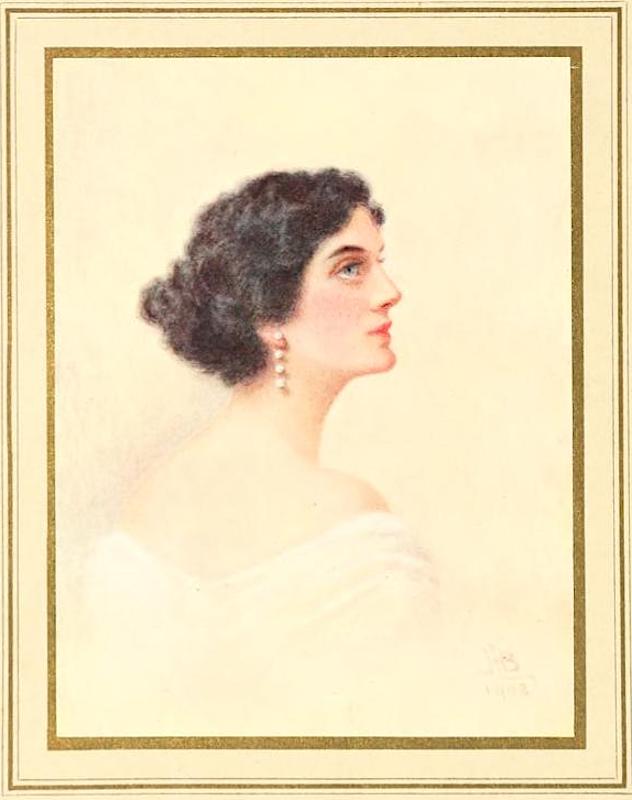
Diana Warwick, as depicted by artist Herbert Bedford.
The coldness of Constance contrasts with the vitality of the title character Diana, who reflects on the passive role expected of women in a letter to Emma, and notes the difficulty of challenging expectations: "if we take to activity ... we conjugate a frightful disturbance ... I have the misfortune to know I was born an active" (64). Diana is said to be "famous for her beauty and her wit" (1) and Meredith acknowledges the prejudice against women who display traits considered by society as inappropriate for a woman. The narrator notes that "a woman having political and social views of her own" is viewed with mistrust (5) and that a "quick-witted woman exerting her wit is both a foreigner and potentially a criminal" (103). Aware that social opinion limits her interest in political affairs, Diana reflects on "the misfortune of her not having been born a man" (156). Traits perceived as masculine in a woman are ridiculed by Emma’s husband, Sir Lukin Dunstane, who expresses scorn of the language as well as the appearance of a "Radical woman with horse teeth, hatchet jaws.... As for a girl ... her interjections, echoing a man, were ridiculous ... unfeminine topics" (41). Diana acknowledges the effect of using masculine language, relating that her husband accuses her of having "rendered him ridiculous - I had caught a trick of 'using men’s phrases'"(132). Despite his scorn, Sir Lukin admits admiration for Diana, saying: "she’s man and woman in brains" (251). Dacier, unofficially engaged to Constance, is attracted by Diana’s beauty and intelligence, thinking of her as "womanly, yet quite unlike the womanish woman" having humour and wit (242). However, Dacier concurs with society’s view, concluding that the model of a woman like Diana is "anything but the feminine ideal of man" (336).
Meredith’s "boldness"
Rebecca Mitchell refers to Meredith’s challenge to "the simple binary formation of male / female gender" (xxxviii), and Alice Crossley notes "the ambiguity with which Meredith envisions sexual orientation" in his novel Rhoda Fleming published in 1865 (139). Meredith risked criticism and loss of readership with his first novel The Ordeal of Richard Feverel (1859) in which he describes an adulterous affair and the eroticism of androgyny. "The seduction scene and Meredith’s boldness in treating delicate subjects earned him some hostile criticism and lost him the circulating-library sale which would have brought financial success" (Williams, introduction, 3). Meredith referred to this novel in a letter of April 1894, having read a "little brochure" by the philosopher Edward Carpenter. This was Sex-Love, noted by Letters, as being "one of a series of privately printed pamphlets" which discussed sexual freedom and gender fluidity. In his letter, Meredith expressed "great satisfaction to find these wholesome truths plainly put. I have for forty years harped on them, but the literary rounding of the theme in the mirror of fiction cannot be so useful as the directer method.... I respect the writer" (Letters, 1157). A contemporary critic of The Ordeal of Richard Feverel in the Saturday Review relates how "the young husband is carried away by the trickeries and arts of a much naughtier woman than the young wife" (Williams 72).
"a much naughtier woman"
Richard Feverel is attracted to Mrs Bella Mount, the woman who is "much naughtier" than his young wife Lucy: "She talks capitally: she’s wonderfully clever. She’s very like a man, only much nicer. I like her" (337). He makes "late evening calls" (353), and Bella’s seduction of Richard is related in Chapter XXXVIII "An Enchantress." The account of adultery was likely to offend critics and the reading public, but Meredith risked further criticism by portraying Bella’s habit of cross-dressing, challenging the stereotypical "ideal" image of a woman in her choice of language and clothing. Bella addresses him as "Dick," and leaves him to return "arrayed like a cavalier ... her hat jauntily cocked, and a pretty oath on her lips to give reality to the costume" (354). Meredith shocks readers by conveying the erotic effect of her appearance as Bella becomes "Sir Julius," and of her language as "a graceful cavalier." Richard finds her "man-like conversation ... was a refreshing change on fair lips" (353). The contrast of her attire with her feminine eyes and lips "aired her sex bewitchingly." Her proposal that they walk the streets at midnight arm-in-arm in character is daring, and Bella’s unconventional behaviour is explained as being an expression of her natural sense of masculine identity: "Wasn’t it a shame to make a woman of me when I was born to be a man?" (354). Meredith shows how Bella intentionally uses her sexuality, and that the uncertainty of the role adds to Richard’s excitement. "The woman now and then would peep through Sir Julius. Or she would sit, and talk, and altogether forget she was impersonating that worthy fop" (355). When the masculine persona fails to attract, "the wily woman resumed her shell. The memory of Sir Julius breathing about her still, doubled the feminine attraction" (357).
"a supersensual naughtiness"
Meredith demonstrates in the character of Bella that the combination of masculine and feminine traits in a woman is natural, and erotic for men. In Lord Ormont and his Aminta (1894) he shows the sensuality of androgynous behaviour as being attractive to men and to women. The character of Mrs Lawrence Finchley has a natural blend of male and female characteristics. Her "boy’s head held boy’s brains" (130) and men and women are attracted to her masculine good looks and intelligence. The reader is told that Lord Ormont, who has "a keen appreciation of female beauty" (28) "had one of his wilful likings for Isabella Lawrence Finchley," perceived by his secretary Matthew Weyburn as "a lady with the head of a comely boy, the manner, softened in delicate feminine, of a capital comrade ... a supersensual naughtiness" (121). Weyburn’s view of Mrs Lawrence Finchley as having "the look of a handsome boy" is reported to Ormont’s wife Aminta, who has "a sisterly taste for the boyish fair one flying her sail independently" (156). Mrs Lawrence explains to Aminta the need to express her natural identity, saying that she was "born with this taste for the ways and games and style of men," and conveys the frustration of restriction stating that: "if I’m not allowed to indulge my natural taste, I kick the stable-boards and bite the manger" (157). Meredith’s suggestion of same-sex attraction is controversial, as Mrs Lawrence is "pressing to be more than merely friendly" (156). Aminta "threw her arms around her, and they laughed their mutual peal. Caressing her still, Aminta said 'I don’t know whether I embrace a boy'" (157).
"another of Mr Meredith’s triumphant androgynes"
The attraction of a woman’s natural physical ability, and "animation" of features instead of conventional feminine beauty is conveyed in Meredith’s last completed novel, The Amazing Marriage, published in 1895. Carinthia is described by a reviewer in the Saturday Review as "another of Mr Meredith’s triumphant androgynes, a wonderful girl with a man’s heart" (qtd. in Williams 438). The character represents the realisation of Meredith’s long-held views: he was a quarter of the way through writing the book in 1879 (Letters, 569). Carinthia’s striking appearance is conveyed by the character of the philosopher Gower Woodseer as a "beautiful Gorgon, haggard Venus." She is unconventional, "a new idea of women" (79, 80). Her physical strength in movement, perceived as a masculine attribute, is portrayed as a skill in the "mountain girl" (120), who has a natural ability to climb, and takes pride and pleasure in physical activity. Taught by her father how to jump, a "drop of a dozen feet or so from the French window to a flower-bed was not very difficult" (35). Her brother affirms: "You’re a capital walker, you’re a gallant comrade" (39,40). Carinthia’s clothing is appropriate to activity, wearing "good Styrian boots" (39), and she is aware of the perception that Chillon "should have been the girl and she the boy" (48). Her appearance is conveyed in her brother’s thought: "No one could fancy her handsome" although her features are "expressive enough; at times ... marvellous in their clear cut of the animating mind" (38). Woodseer refers to people’s perception of "perfect beauty" as being "suitable for paintings and statues. Living faces, if they’re to show the soul ... must lend themselves to commotion.... Repose has never such splendid reach as animation ... in the living face" (313, 314).
"a reluctant husband’s admiration"

Carinthia Jane, as depicted by Herbert Bedford.
The challenges faced by men in accepting unconventional women is recognised by Meredith, and represented by the character of Lord Fleetwood in The Amazing Marriage. Fleetwood’s first sight of Carinthia - the strong, active woman who is excited by "a spice of danger" in climbing - produces conflicting emotions. Although he is attracted by her agility and courage as she is "tempted to adventure ... a shameful spasm of terror seized him at sight of a girl doing what he would have dreaded to attempt" (120, 121). He marries Carinthia, but is perturbed by her independence and unconventional behaviour on their honeymoon journey. The physicality which Fleetwood admired in her natural setting, is perceived as inappropriate in her new role as his wife. She "needed no help to mount the coach" and rejected his arm. Fleetwood "did not visibly wince" and "swallowed" the sight of her "stride from the axle of the wheel’ which "would have been a graceful spectacle on Alpine crags" (147). Reaching their destination, Fleetwood reveals embarrassment at the perception of Carinthia’s behaviour by others. Before a ladder is brought to help her descend from the coach, she has "stepped, leaped and entered the inn" causing Fleetwood to remark to Chummy Potts "We are very independent" (159). By the end of the novel, Carinthia has "won a reluctant husband’s admiration" (393), which is indicated in the repetition of his "respect" for her. Acknowledging his wife as an "equal," Fleetwood "bowing to the visible equality, chafed at a sense of inferiority" (492). Meredith’s characterisation indicates Fleetwood’s resistance to the reversal of male and female roles, and the perception of an independent woman as a threat to the self-image of masculinity.
Meredith’s boldness in using fiction to express unconventional ideas of the feminine image were influential on twentieth-century writers who risked criticism and censorship in writing of female sensuality and gender fluidity. Connections between Meredith and D.H. Lawrence have been noted by D.D. Stone, who asserts that Meredith "anticipated D.H. Lawrence in terms of subject matter" (336). In his Study of Thomas Hardy (1914), Lawrence wrote: "For every man comprises male and female in his being . . . A woman consists of male and female" (qtd. in Dix 54). The characters in Lawrence’s novels combine gender characteristics, and Carol Dix recognises that his depiction of fluid gender roles, representing the liberation of the individual, challenged sexual stereotypes and anticipated the androgynous behaviour of the later twentieth century (14). Meredith’s philosophy and expression of androgyny in nineteenth-century fiction remain relevant more than one hundred and fifty years later, as questions of gender identity and challenges to the traditional binary roles in society continue to be discussed in the twenty-first century.
Related Material
Bibliography
Meredith, George. The Letters, of George Meredith. 3 Vols (continuous pagination). Edited by C.L. Letters. Oxford: Clarendon. 1970.
Crossley, Alice, "George Meredith’s Rhoda Fleming: Sexuality, Submission and Subversion" in Yearbook of English Studies, vol 49. Cambridge: MHRA, 2019.
Dix, Carol, D.H. Lawrence and Women. London: Palgrave Macmillan Limited, 1980.
Meredith, George. The Ordeal of Richard Feverel. [1859]. London: Constable & Company Ltd., 1913.
Meredith, George. The Egoist. [1879]. London: Constable & Company Ltd., 1915.
Meredith, George. Diana of The Crossways: A Novel. [1885]. London: Constable & Company Ltd., 1911.
Meredith, George. Lord Ormont and his Aminta, A Novel. [1894]. London: Chapman & Hall, 1895.
Meredith, George. The Amazing Marriage. [1895]. London: Constable & Company Ltd., 1922.
Mill, John Stuart. On Liberty and The Subjection of Women. [1859,1869] London: Penguin. 2006.
Mitchell, Dr Kate. The Gentlewoman’s Book of Hygiene. London: Henry and Co. 1892.
Mitchell, Rebecca N, and Benford, Criscillia, eds. George Meredith: Modern Love and Poems of the English Roadside, with Poems and Ballads. New Haven and London: Yale University Press, 2012.
Rose, Lucy Ella, "A Feminist Network in an Artists’ Home: Mary and George Watts, George Meredith, and Josephine Butler" in Journal of Victorian Culture Vol.21, 2016 - Issue 1, pp.74-91 (Leeds Trinity University, Taylor & Francis).
Stables, Gordon, writing as "Medicus." "Useful pastimes for health and pleasure," 1895; "Cycling as a pastime and for health’, 1896 in The Girls’ Own Paper. Cambridge: The Religious Tract Society, now Lutterworth Press, founded 1880, available online at https:/www.victorianvoices.net
Stevenson, Lionel. The Ordeal of George Meredith. New York: Charles Scribner’s Sons, 1953.
Stevenson, Richard C. The Experimental Impulse in George Meredith’s Fiction. Lewisburg: Bucknell University Press, 2004.
Stone, D D. Novelists in a Changing World: Meredith, James and the Transformation of English Fiction in the 1880s. Cambridge, Massachusetts: Harvard University Press, 1972.
Williams, Ioan, ed. Meredith: The Critical Heritage. London: Routledge & Kegan Paul Ltd, 1971.
Created 15 March 2026; last modified 26 March 2026