

he scariest movie of my childhood was Clash of the Titans. In the original version (1981), Ray Harryhausen's analog stop-motion animation complemented Sir Laurence Olivier's petty, terrified Zeus, the ultimate tyrannical ruler and hypocritical deadbeat dad. Everyone knows the famous, now ridiculous line: "Release the Kraken!" But in the immediate aftermath of Jaws (1975), what could be more frightening than the bubbles of respiration escaping through the bars of a creaky, barnacle-encrusted subterranean gate, rising to give a first glimpse of the green scaly pelt of a still-unimaginable creature never represented in any picture-book Noah's ark?
A century and a half earlier, another artist knew how to invoke that fear and fascination even better than Harryhausen. Here is the poet Alfred Tennyson, as a student at Trinity College, Cambridge:
Far, far, beneath the abysmal sea,
The ancient, dreamless, uninvaded sleep,
The Kraken sleepeth: faintest sunlights flee
About his shadow sides ...
Once by man and angels to be seen,
In roaring he shall rise and on the surface die (qtd. in Holmes 3)
Tennyson's Kraken of 1830 was, as Harryhausen's would be, the thing we are afraid of and also the fear itself: all that is ancient, unenlightened, and unregulated coming back into the world from wherever we've lodged it in ourselves. It is also, as Herman Melville and the execrable H.P. Lovecraft thought, the unconscious, all that we bury and then obliquely pursue. No wonder it's so bad to lose one's temper. It has been released from its primeval prison.
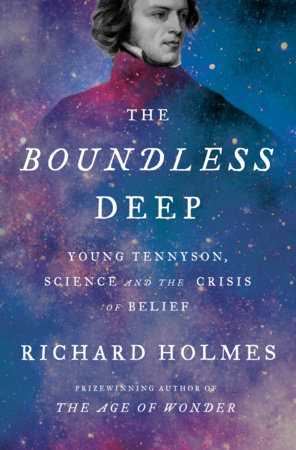
For Richard Holmes, award-winning biographer of Romantic scientists, suicidal early balloonists, and their poetic counterpart Percy Bysshe Shelley, Tennyson's Kraken poem provides the provocation for his new book, The Boundless Deep: Young Tennyson, Science, and the Crisis of Belief. But this book is also something else: the encapsulation of Holmes's studies of Romanticism and his early-career fascination with science, especially geology and palaeontology. Throughout his career, Holmes has drawn attention to the ways in which Victorians encountered these sciences of time and secular doubt, finding them simultaneously scary and full of liberatory potential.
Several exciting studies of Victorian ideas of (deep) time and social progress have been published lately, including Ruth M. McAdams's Temporality and Progress in Victorian Literature and Koenraad Claes and Elizabeth Ludlow's The Nineteenth-Century Present: Literature, Print Culture, and Historicity (both 2025). Holmes does not cite either McAdams or Claes and Ludlow, possibly because they were published too late in his book's development. Nevertheless his book mines similar territory from a new angle. Specifically, Holmes argues that Tennyson's exploration of controversies in Romantic proto-evolutionary science fueled the doubts that empower his masterpiece In Memoriam (1850) and make Young Tennyson the best Tennyson, the last Romantic, and also a kind of Kraken, released to destroy his staid Anglican Young-Earth-Creationist world, only to be safely contained again by the older Tennyson, the newly-minted Poet Laureate, or, as Holmes puts it, the man with that Zeus-like beard.
Holmes tells this story mostly in chronological, linear order. After an introductory explication of the Kraken poem, contextualized by the Kraken myth, he follows Tennyson from childhood to Cambridge and into his lifelong friendships, notably his tragic bromance with the doomed Arthur Hallam (1811-1833) and subsequent dark night of the soul. On the way, Holmes unpacks developments in the so-called new geology, such as the discoveries of Charles Lyell, James Hutton, Robert Chambers, and Mary Sommerville, showing how the poet "gradually [...] became fully aware of the revolutionary implications" of the new science. (89). Glossing Tennyson, Holmes sees this science of the very old as putting humanity in a new predicament, "violently dethroned from [its] position at the centre of the Universe and relegated to an obscure position" (90).
Though Holmes succinctly and clearly summarizes the scientific knowledge that brought Tennyson to this point of crisis, I would have liked to see some acknowledgement of similar developments that Tennyson, for reasons of class and culture, did not encounter personally. Primarily these developments pertain to radical working-class London's community of amateur scientists and the political applications illuminated so well by evolutionary biologist Adrian Desmond in his captivating Reign of the Beast: The Atheist World of W.D. Saull and his Museum of Evolution (2024), generously published as an open-access book. Some of that material might have been more relevant to Holmes's story of Tennyson than the minutiae of his courtship and marriage. Likewise, I wanted to know how queer theory and contextualizations of Victorian ideas about sexuality might help to make sense of Tennyson's expression of scientifically grounded doubt in the specific context of the death of a beloved male friend.
I particularly appreciated Holmes's careful close-reading of In Memoriam no. 56 in light of the scientific contexts that he had just reconstructed, as well as his conscientious, three-dimensional documentation of the internal struggles that led to Tennyson caging himself (or, at any rate, the version of himself celebrated by Holmes) in order to fit the role of Poet Laureate. That, too, Holmes suggests, was a kind of adaptation for evolutionary advantage. A discussion of Tennyson's friend Edward FitzGerald's Orientalization of humanist doubt in his Rubáiyát of Omar Khayyam (1859) would have been pertinent here. Does not Robert Browning do the same thing in "Karshish, the Arab Physician?"
Despite its weaknesses, The Boundless Deep is a wonderful, essential book that anyone who teaches "Nature, red in tooth and claw" or even that ode to Darwin-Award-winning military leadership, "The Charge of the Light Brigade," ought to read. Anyone who teaches or reads Victorian poetry will find The Boundless Deep and urgent, relevant, and provocative reassessment of Tennyson's meaning and value. As I read, I kept thinking of Romanticist Stephen Behrendt's poem, "Snakeskin" (2014), in which the "ghostly coils" of an exoskeleton open up deep time for a backyard gardener of the American West. Rescued for his daughters' contemplation, the remains are poetic in Wordsworth's sense, the Kraken-like shell of a "sinuous body we've never glimpsed." I am not sure I share Holmes's conviction that Tennyson's journey to doubt and subsequent self-closeting make him "a new kind of national poet" (355), nor that his attempt, in Idylls of the King (1859), to create a proto-democratic, quasi-constitutional English pseudo-past ruined by unruly female sexuality is less interesting than his other work. However, I am glad to have met the Tennyson that Holmes has summoned from the depths.
Links to Related Material
Bibliography
[book under review] Holmes, Richard. The Boundless Deep: Young Tennyson, Science, and the Crisis of Belief. New York: Pantheon, 2026.
Behrendt, Stephen. "Snakeskin." The Poetry Foundation, 2014.
Claes, Koenraad and Elizabeth Ludlow, eds. The Nineteenth-Century Present: Literature, Print Culture, and Historicity. Manchester: Manchester UP, 2025.
Desmond, Adrian. Reign of the Beast: The Atheist World of W.D. Saull and his Museum of Evolution. Open Book Press, 2024.
Holmes, Richard. The Age of Wonder: How the Romantic Generation Discovered the Beauty and Terror of Science. New York: HarperCollins, 2008.
—. Shelley: The Pursuit. [1974.] New York: New York Review Books, 2003.
McAdams, Ruth M. Temporality and Progress in Victorian Literature. Edinburgh: Edinburgh UP, 2025.
Created 17 September 2026
Last modified 18 September 2026