
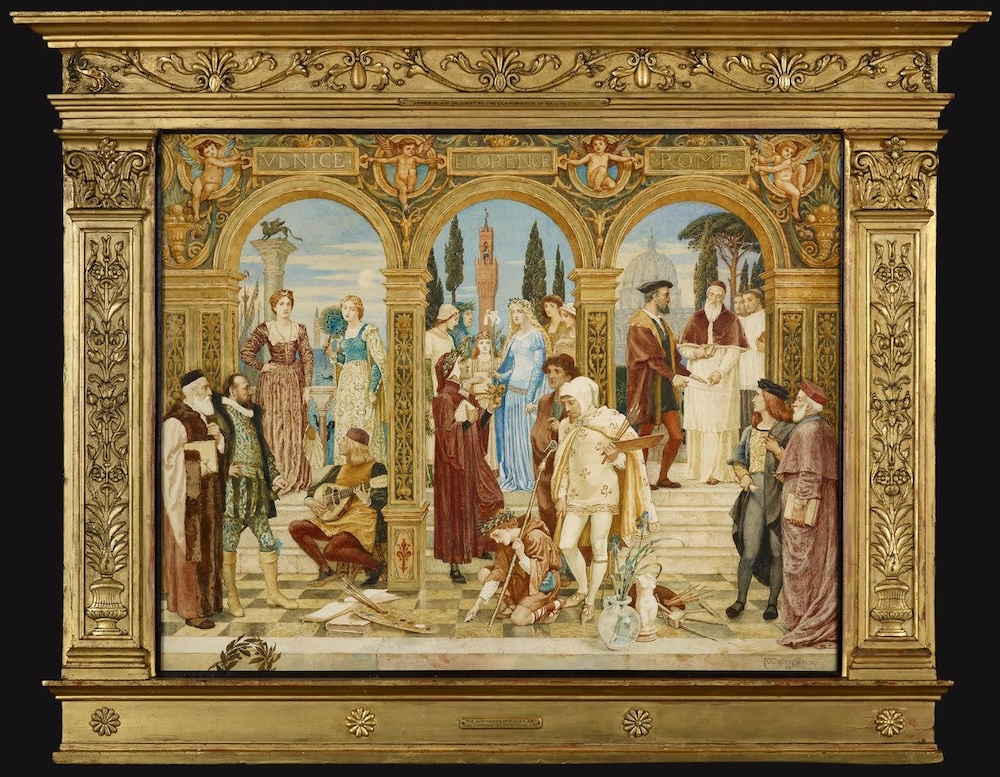
The Apotheosis of Italian Art, by Walter Crane, RWS(1845-1915). 1885-86. Watercolour and gouache on paper; 24 x 30 inches (61.2 x 76.3 cm). Collection of Manchester Art Gallery, accession no. 1917.4. Image courtesy of Manchester Art Gallery via Art UK under the terms of the Creative Commons Attribution-NonCommercial-NoDerivitives licence (CC BY-NC-ND). [Click on images to enlarge them.]
Crane exhibited this watercolour at the Grosvenor Gallery in 1886, no. 16. Greg Smith and Sarah Hyde have explained how this watercolour, commissioned by Henry Irving, came about:
This watercolour is a record of a tableau vivant, which Crane organized as part of the celebrations to mark the reorganization of the Institute of Painters in Watercolour in 1885. The idea was to represent the different epochs in art in a historical pageant. Crane designed three groups: Rome, Florence and Venice representing the Arts of Italy. The Crane family featured prominently: Mary took the part of Laura, Beatrice an angel, Lionel the young Giotto, while Crane himself was Cimabue" (113). Crane was very familiar with the Italian cities depicted, as well as with the Italian Renaissance art he greatly admired, having not only spent much of 1871-73 in Italy on his honeymoon but later returning in December 1881 when he visited Turin, Genoa, Pisa, Florence, Rome, Sienna, and Venice before going back to London in January 1882. For Crane the Renaissance period was obviously the highest point in the development of Italian art.
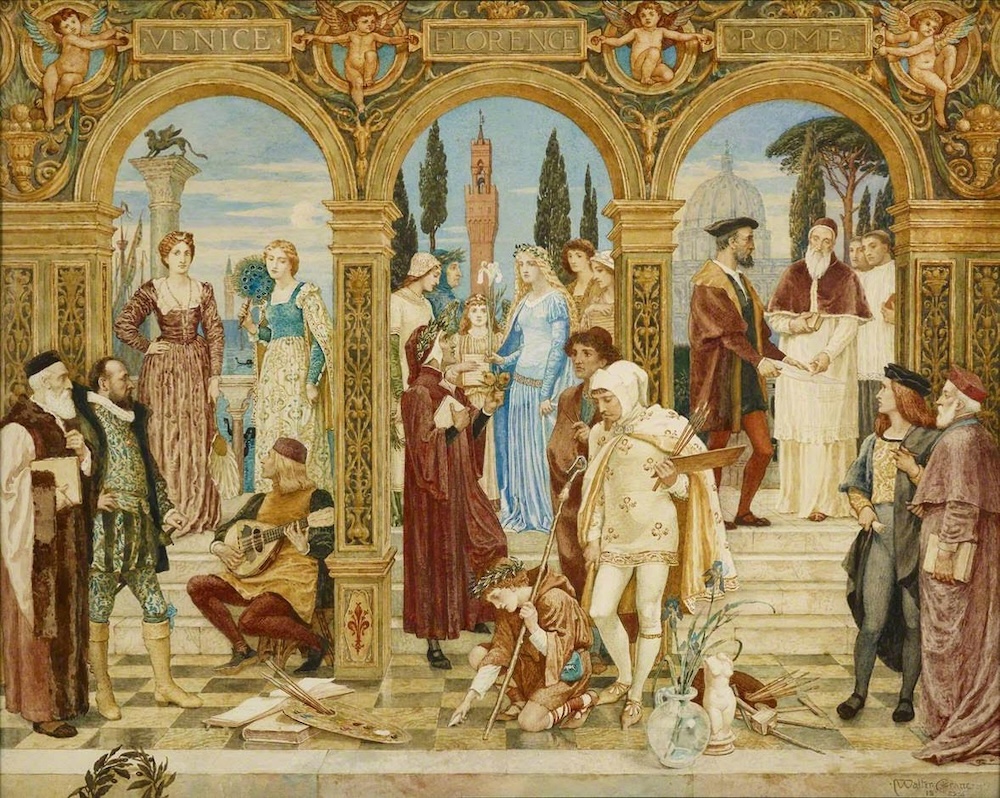
A closer view of the painting.
The Manchester Art Gallery website outlines what the picture represents:
Scene depicting various half-familiar figures, including Dante, Cimabue, Michelangelo, Pope Julius II and Raphael, in historical dress, standing beneath three arches. The arches are inscribed from left to right, "Venice," "Florence," and "Rome." Beyond the arches are recognisable landmarks which further identify each place; the lagoon, the Palazzo Vecchio and St. Peter's. The arches are decorated with cupids and torches. The figures below stand in various groups. In the centre a young boy wearing a laurel wreath on his head, with a shepherd's crook in his hand, kneels on the tiled floor, drawing on the surface. A man in medieval dress watches him, brushes and a palette in his left hand. More artist's equipment lies on the floor in the foreground. The other figures stand around this central group, some standing at the top of the steps behind the arches.
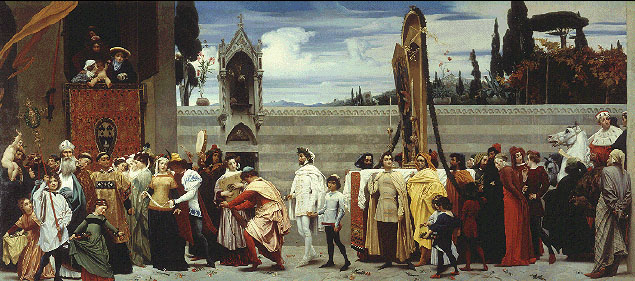
The costume that Crane wears as Cimabue is reminiscent of that worn by the artist in Frederic Leighton's early masterpiece Cimabue's Celebrated Madonna Carried in Procession through the Streets of Florence. Crane’s costume is even closer to that worn by Cimabue in Leighton’s design of c.1868 for a mosaic for the South Kensington Museum, part of the so-called “Kensington Valhalla.” In Leighton's early painting it is Cimabue with a wreath of laurel leaves around his head while in Crane's watercolour it is apparently his pupil Giotto who has the honour. In the Venice section it is the painter Titian who is featured with his long white beard and wearing a black skull cap.
Contemporary Reviews of the Painting
Henry Blackburn, in his ever-useful Grosvenor Notes, gives the most detailed explanation of what is portrayed in this painting:
This water-colour drawing, full of colour and graceful costume, suggestive of the arts of Italy, originated in a design for one of the tableaux at the Royal Institute of Painters in Water Colours last year. Several well-known painters will be recognized, typical of the arts of Venice, Florence, and Rome. Under the centre arch are Cimabue, Giotto as a shepherd boy, N. Pisano, Dante and Beatrice, &c. On the right, Michel Angelo shews a plan to Pope Julius II; below is his rival, Raphael, a cardinal standing beside him. On the left are the figures of Paul Veronese, Titian, &c. Bellini on the steps, playing a mandolin. [7]
A critic for The Academy explained who was responsible for the various art periods represented in the Masque of Painters:
The costume ball of the Royal Institute of Painters in Water-colours is to be proceeded by a "Masque of Painters," representing celebrated artists and contemporary eminent characters, embracing the period from Pericles to Sir Joshua Reynolds, divided into six groups, viz., Greece, arranged by Mr. Sacheverel Coke; Italy, by Mr. Walter Crane; Germany, by Messrs. J.D. Linton and W. Dendy Sadler; France and Spain by Mr. R. Caton Woodville; Holland, by Messrs. E.A. Abbey and T. Walter Wilson; England, by Mr. Seymour Lucas and Chas. Green. The whole will be described in verses written by Mr. Edmund W. Gosse and spoken by Mr. J. Forbes Robertson as chorus. [283]
Bibliography
Academy and Art School News." The Artist VI (1 May 1885): 139.
The Apotheosis of Italian Art. Art UK. Web. 25 November 2025.
The Apotheosis of Italian Art. Manchester Art Gallery. Web. 25 November 2025.
Blackburn, Henry. Grosvenor Notes (May, 1886); No. 16, 7.
"Notes on Art and Archaeology." The Academy XXVII (April 18, 1885): 283.
Smith, Greg and Sarah Hyde. Walter Crane 1845-1915. Artist, Designer and Socialist. London: Lund Humphries, 1989., cat. E1, 112-13.
Created 25 November 2025