
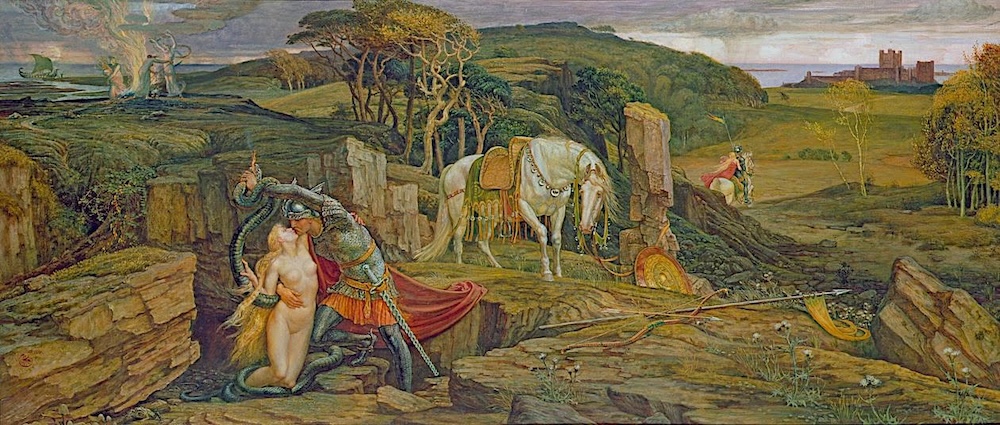
The Laidley Worm of Spindleston Heugh. c.1881. Oil on canvas. 29 3/8 x 66 3/4 inches. Private collection. Image courtesy of Sotheby's.
Crane exhibited this oil painting at the Grosvenor Gallery in 1881, no. 120. The picture is based on an old Northumberland ballad. The legend was published in The Northumberland Garland, a collection of famous songs edited by Joseph Ritson and published by R. Triphook in London in 1810. The ballad was said to have been composed by the old mountain-bard, Duncan Frasier, around 1270 A.D. It was more likely to have been written, however, by the Rev. Robert Lambe, Vicar of Norham, in the eighteenth century. Many Victorians would have been familiar with the story through English Fairy Tales edited by Joseph Jacobs, but this was not Crane's source for the story because it was not published until 1890. In his reminiscences Crane gives an account of the genesis of this picture when he heard of the tale while on a holiday. In the summer of 1877, at the recommendation of George Howard, Crane and his family had gone to the Northumberland village of Bamborough on holidays: "I found plenty of subjects, and among others Spindleston Heugh gave me its curious legend of 'Laidly [Laidey] Worm,' associated with the spot, materials for a romantic picture which I afterwards carried out and exhibited at the Grosvenor" (176).
In Jacobs' retelling of the story there once lived a king in Bamborough Castle who had a fair wife and two children, a son named Childe Wynd and a daughter named Margaret. Childe Wynd went forth across the sea to seek his fortune but soon after he left, his mother died. One day while the king was out hunting he came across a lady of great beauty, and fell so much in love with her that he determined to marry her, not knowing she was a witch. When she met her beautiful stepdaughter Margaret, she was consumed with jealousy and cast Margaret under a spell, turning her into a dreadful dragon, the Laidly [Laidley] Worm. This was her spell:
I weird ye to be a Laidly Worm,
And borrowed shall ye never be,
Until Childe Wynd, the King's own son
Come to the Heugh and thrice kiss thee;
Until the world comes to an end,
Borrowed shall ye never be.
The country folk eventually learnt the true identity of the Laidley Worm and sent over the sea for her brother to restore his sister. When Childe Wynd heard the news, he swore a mighty oath to rescue his sister and seek revenge on their cruel stepmother. The witch queen attempted to use her power over the Laidley Worm to prevent her brother's ship from landing, but after meeting resistance from the dragon, he landed around the next point of land at Bundle Sands. The moment Childe Wynd had landed, the queen's power over the Laidley Worm went. When Childe Wynd came rushing up to the Laidley Worm it made no attempt to stop him or hurt him, but just as he was going to raise his sword to slay it, the voice of his own sister Margaret came from its jaws saying:
"O, quit your sword, unbend your bow,
And give me kisses three;
For though I am a poisonous worm.
No harm I'll do to thee."
After he had kissed the loathsome dragon for the third time with a hiss and a roar the Laidley Worm reared back and before Childe Wynd stood his sister Margaret. Childe Wynd then rode away to the castle and went to the witch queen's bower. When he saw her, he touched her with a twig of a rowan tree. No sooner had he done so than she shrivelled up, until she became a huge ugly toad (see Jacobs 183-87).
In Crane's painting Childe Wynd can be seen clutching his sister Margaret as she transforms from being the Laidley Worm to a fair princess. His white horse is in the centre midground tethered to the famous Spindle Stone, a detached pillar of Whin Sill east of the high crags of Spindleston Heughs. Bamburgh Castle is shown in the background to the right of the composition. Childe Wynd's sailing ship is shown to the left where it landed in Bundle Bay. The figures on the hill to the left of the composition likely represent the witch queen casting a spell around a blazing fire accompanied by her attendants. Isobel Spencer thought this a typical Pre-Raphaelite subject: "His choice of this source reflects the taste of the Pre-Raphaelites and their followers (Swinburne wrote a version of the same ballad) but it was also the kind of narrative which became generally popular with Victorian painters on the look-out for dramatic narratives" (123).
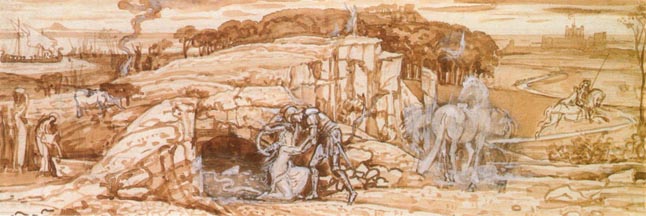
Sketch for "The Laidley Worm of Spindleston Heugh", c.1881. Pencil and brown wash, heightened with Chinese white; 5 3/8 x 16 3/8 inches (14.2 x 42.2 cm). Image courtesy of the Fine Art Society (103). [Click on this image to enlarge it and for more information about it.]
This is one of Crane's works most influenced by Edward Burne-Jones. Perhaps the most obvious influence is his The Doom Fulfilled, the gouache version of which dates from 1877, showing Perseus rescuing Andromeda by slaying a serpent and set in a very rocky background. The rocky background is also reminiscent of those seen other Burne-Jones's paintings, such as his Pan and Psyche of 1872-74, now at the Fogg Museum at Harvard, or his Hill-Fairies, oil studies made in conjunction with The Last Sleep of Arthur in Avalon but ultimately not used for the final composition. Burne-Jones had previously shown a knight fighting a dragon in his St. George and the Dragon of 1866. Crane could also have been influenced by Italian Old Master precedents for his incorporation of a rocky landscape, such as Mantegna's The Agony in the Garden or Da Vinci's The Virgin of the Rocks.
Contemporary Reviews of the Painting
The Architect merely praised this picture in passing: "Mr. Walter Crane sends two pieces of fantastic invention, that set us wandering pleasantly in the lands of legend and mythology" (320). F.G. Stephens in The Athenaeum admired both Crane's Europa and this picture: "By him also is The Laidley Worm of Spindleton [sic] Heugh (119), a legend of terrible significance, powerfully conceived and energetically depicted, with wealth of colour and tragic quaintness" (599). Harry Quilter in The Spectator once again complained about Crane's inablility to paint the nude convincingly: "Two fanciful pictures by Mr. Walter Crane (120), (133), deserve considerable attention for their inventiveness, and a certain air of poetry which clings to them. The figures in each are the worst part, especially when the artist attempts - as he will attempt, despite all warning - to draw the nude. That is the one thing which cannot be painted out of the inner consciousness" (768).
Henry Blackburn in his Grosvenor Notes gave the story of the legend first and then described episodes shown in the painting:
The episode (of the riding away) is shown in the picture, as also another, the witch wives trying by spells to destroy the good knight's ship, which being made of the charmed rowan (mountain ash) wood, of course resisted their efforts. Bamboro' Castle is seen away on the right of the picture, and in front are the crags Spindleton, while to the left is the Budle River, with the knight's ship. This picture is in a dark key of colour, and its gloomy lurid light, contrasting with the fairer flesh tones, are intended to reflect the wild, romantic character of the subject, not unmixed with a certain quaintness. [40]
Note: The sketch for the oil painting is now at the Whitworth Gallery, Manchester, which gives slightly different measurements for it (5 7/8 x 17 3/8 inches (14.9 x 44.2 cm)).
Bibliography
Blackburn, Henry. Grosvenor Notes (May 1881), no. 120: 40.
Crane, Walter. An Artist's Reminiscences. London: Methuen, 1907. 176.
The Fine Art Society Story. Part I. London: The Fine Art Society, 2001. Catalogue Number 23.
"The Grosvenor Gallery." The Architect XXV (7 May 1881): 319-20.
Jacobs, Joseph. English Fairy Tales. London: David Nutt, 1890, tale XXXIII: 183-87.
Quilter, Harry. "Art. The Grosvenor Gallery." The Spectator LIV (11 June 1881): 767-68.
Spencer, Isobel. Walter Crane. New York: Macmillan Publishing Co. Inc., 1975. 123.
Stephens, Frederic George. "Fine Arts. The Grosvenor Gallery." The Athenaeum No. 2792 (30 April 1881): 599.
Vickers, Jane. The Pre-Raphaelites. Painters and Patrons in the North East. Newcastle upon Tyne: Tyne and Wear Museums Service, 1989, cat. 32, 74.
Victorian Pictures. London: Sotheby's (8 June 1993).
Created 28 November 2025