
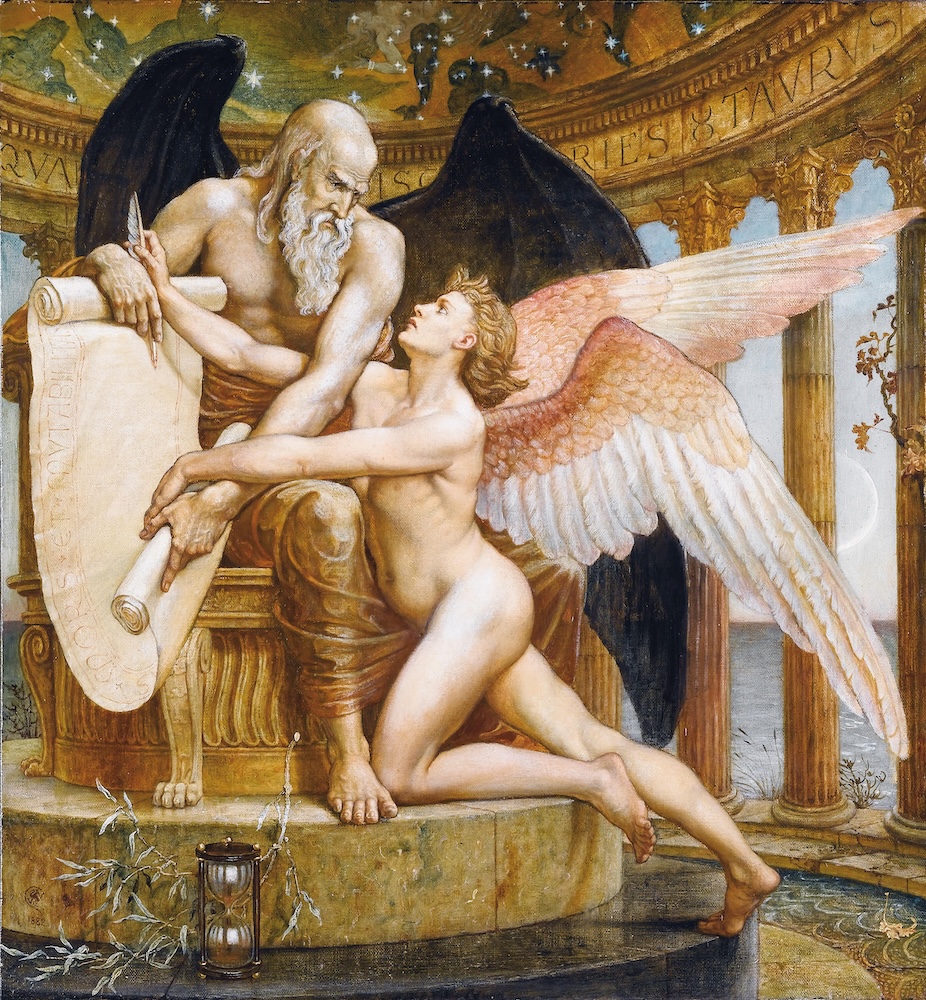
The Roll of Fate by Walter Crane (1845-1915). 1882. Oil on canvas. 28 x 26 inches (71.1 x 66 cm). Private collection, image ©2009 Christie's Images Limited, by kind permission (right click disabled; not to be reproduced).
Crane exhibited The Roll of Fate at the Grosvenor Gallery in 1882, no. 36. It is one of his first allegorical works. It portrays the naked young figure of Love, or possibly an angel, looking up with a pleading expression on his face and attempting to change the path of events by preventing Time, shown as a bald elderly man with a white beard who sits on his golden throne with a frown on his face, from unrolling the scroll on which mankind's destiny is recorded. The angel holds on to the scroll with his left hand while his right hand grasps the quill pen with which Time records mankind's fate. A large hour glass, representing the passage of time, is seen in front of the marble dais upon which the figures rest. The scene is set within a circular classical building with Corinthian columns and whose ceiling shows stars in the heavens. The sea can be seen in the background.
The painting was accompanied in the catalogue by these lines from Edward FitzGerald's translation of the Rubáiyát of Omar Khayyám:
Would that some winged angel ere too late
Arrest the yet unfolded Roll of Fate,
And make the stern Recorder otherwise
Enregister, or quite obliterate!'
Ah love! Could you and I with him conspire
To grasp this sorry scheme of things entire,
Would we not shatter it to bits - and then
Remould it nearer to the heart's desire!
John Christian has discussed the genesis of this picture, seeing it as reflecting recent family tragedies:
Like so many members of the Pre-Raphaelite circle, Crane was a great admirer of this poem, which he had first encountered when visiting Burne-Jones in the 1870s; he had seen a manuscript version, now in the British Library, which had been written by William Morris for Georgiana Burne-Jones and illuminated with figures designed by Burne-Jones and executed by Fairfax Murray…. The picture's subject was inspired by two bereavements that Crane suffered early in 1881, the death of his fourth child, a baby son, in January, followed by that of his sister Lucy in May. In his autobiography, Crane describes how he and his wife were so distressed by the death of their child that they left London, settling during the spring of 1882 at Wickhurst, an old manor house "on the side of a hill overlooking Sevenoaks Weald." It was there that he painted The Roll of Fate.
Isobel Spencer has pointed out how the lines from FitzGerald's translation were "expressive of the artist's sad and baffled feelings" at that time, which, in turn, were reflected in the picture: "Deep emotions have tempted Crane to venture from the cool glades and limpid pools of classical myth to scale loftier peaks of Victorian high art. The angel is the most impressive nude yet to come from his brush. But in spite of wings and astral portents this work remains a literal interpretation of an evocative text, rather too substantial and earthbound" (126). The work is reminiscent of the symbolist works of his friend G.F. Watts, such as Love and Death.
Contemporary Reviews of the Painting
When the painting was shown at the Grosvenor Gallery it was not extensively reviewed. F.G. Stephens in the Athenaeum provided the most extensive, albeit somewhat mixed, review:
Mr. Walter Crane has sent nine pictures and drawings. One of these is a quaint, but somewhat clumsy Renaissance allegory of Time enthroned within his temple, which "Lends broad verge of distant lands," and looks upon the sea, over which rides the spectral "new moone Wi' the auld moone in his arme." An angel kneeling and struggling with the inevitable strives to make Time alter the record on the scroll which has opened itself before them both. The angel is a noble and manly figure, whose limbs are well drawn and modelled from the stalwart shoulders to the heels. The cool and golden carnations are clear and solid. Time, on the other hand, is but a poor conception, and the design in general is an anachronism, not worth spending much art upon. [576]
Bibliography
Blackburn, Henry. Grosvenor Notes. London: Chatto and Windus (May 1882): cat. 36, 16.
Christian, John. Victorian and British Impressionist Pictures Including Drawings and Watercolours. London: Christie's (4 June 4 2009): lot 24. https://www.christies.com/lot/lot-5210398/?from=salesummary&intObjectID=5210398&sid=7a968eaf-2ba8-4124-86ad-966032f806ac
Crane, Walter. An Artist's Reminiscences. London: Methuen, 1907. 230-31.
Konody, Paul G. The Art of Walter Crane. London: George Bell & Sons, 1902. 96.
The Sacred and Profane in Symbolist Art. Toronto: Art Gallery of Ontario, 1969, cat. 124.
Spencer, Isobel. Walter Crane. New York: Macmillan Publishing Co. Inc., 1975. 125-26.
Stephens, Frederic George. "Fine Arts. The Grosvenor Gallery Exhibition." The Athenaeum No. 2845 (6 May 1882): 575-76.
The Work of Walter Crane, with notes by the artist." Easter Art Annual (extra number of the Art Journal). London: J. S. Virtue & Co. Limited, 1898. 25.
Created 28 November 2025