
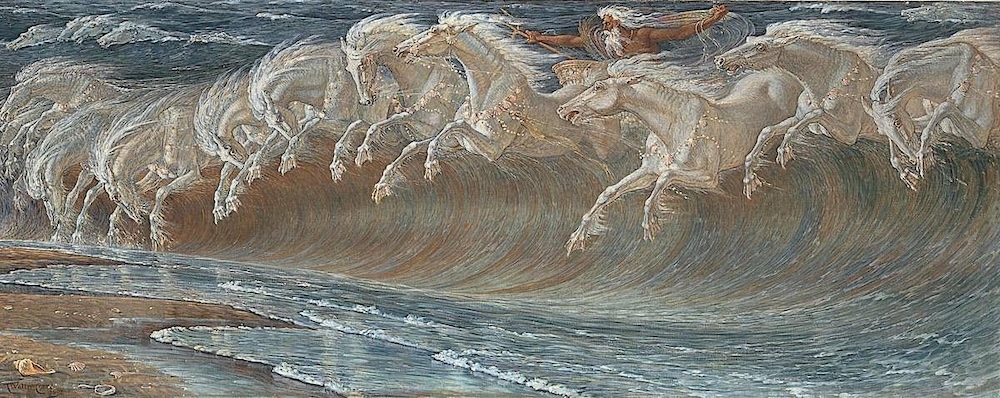
Neptune’s Horses by Walter Crane (1845-1915). 1892. Oil on canvas. 33 3/4 x 84 5/8 inches (85.6 x 215 cm). Collection of Neue Pinakothek, Munich, inventory no. 13419. Image courtesy of the Neue Pinakothek.
The large oil version is one of Crane's most famous late paintings and one of his best-known Symbolist works. Isobel Spencer has referred to it as his "most successful imaginative picture of the decade" and found it reminiscent of Algernon Swinburne's descriptions of the sea (130). It was exhibited at the New Gallery in 1893. The small sketch for the picture was exhibited at the Royal Watercolour Society in 1892. The painting shows Neptune, the god of the sea, trident in his outstretched right hand, riding in his chariot pulled by white stallions as the waves crash on the shore. Crane himself explained how these two pictures, showing the foam on the waves metamorphosing into horses, came about, saying that it was inspired by the sight of the waves of the Atlantic ocean breaking on a beach at Wauwinet in Nantucket, where the family was on holiday in the United States in 1892:
Watching the sea breaking all day along the long line of shore - the wind often catching the crests of the waves just as they curled over to break, and blowing the spray out like the mane of prancing steeds - the motive suggested itself which I afterwards carried out in my picture Neptune Horses, the first sketch for which was made at Wauwinet. As a child in the early days at Torquay I had been accustomed to hear the waves spoken of as "white horses," and the idea seemed to be a perfectly natural and familiar one - though it was only now that I attempted to give it form. I sent the sketch to the winter exhibition of the Old Water Colour Society in November of that year, and the large picture of the same subject was shown at the New Gallery summer exhibition of the following year. Curiously enough, Mr. Watts [G.F. Watts] exhibited the same year, also at the New Gallery, his picture of 'Sea Horses,' quite different in conception and arrangement, and treated as a narrow vertical panel, while mine was a frieze-shaped one. But it was an odd coincidence that we should both, unbeknownst to either, produce pictures on the same theme at the same time. [408]
In the Art Journal in 1898 Crane further explained: "but though the main idea, of the foam-crests forming white horses with tossing manes, was the same, Mr. Watts' picture showed a wave breaking at sea, while mine depicted waves breaking upon a shore - though my first sketch expresses the former idea" (28).
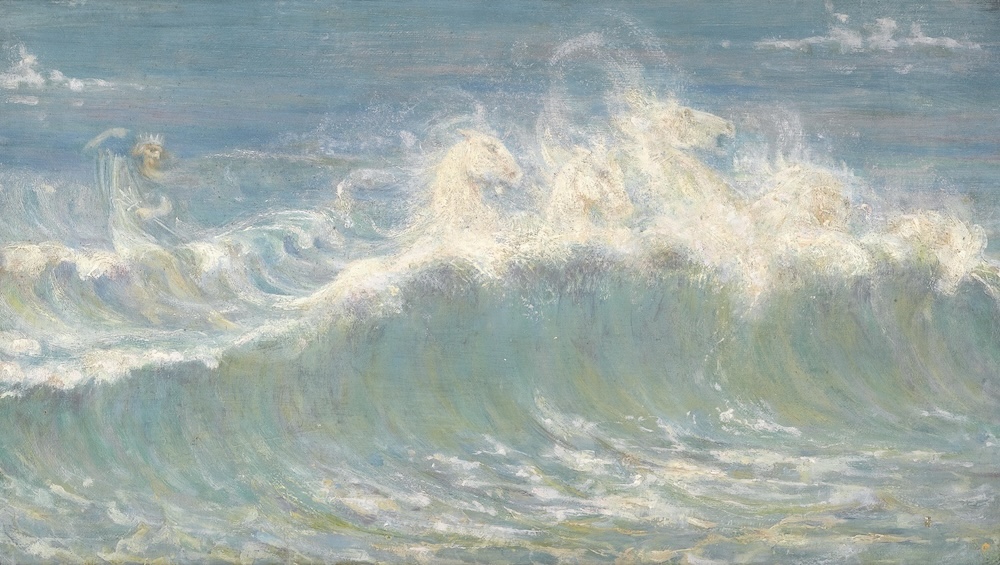
Neptune's Horses. c.1892-93. Oil on canvas. 10 x 17 ½ inches (25 by 45 cm). Private collection. Image courtesy of Sotheby’s, London.
The small sketch Crane referred to sold at Sotheby's, London on 10 May 2012, lot 14. G. F. Watts's Neptune's Horses of 1886-87 is in the collection of the National Trust, Fenton House, London.
Paul Konody feels that this work exemplified Crane's ability to realize visually the forms of nature: "Whilst a picture like Neptune's Horses, in which the horses' limbs and manes are forced into the lines of foam-curved waves, may be cited to prove how thoroughly and completely his mind has absorbed the forms of nature. To use such forms freely and with ease in a composition, the main lines of which are rigidly fixed beforehand, presupposes a quite uncommon power of visual realization, far greater than that required for the adaptation of the same forms to conventional pattern-designing" (93). Crane explained how in works like Neptune's Horses, while he was inspired by nature, the work was transformed into something symbolical and decorative:
On the one hand there is the art which brings directly out of nature - the record of impressions, or a rendering of the forms, facts, and accidents of the external world - more or less imitative in aim. On the other there is the art which is indirectly influenced by nature - the record or re-creation of ideas, which selects or invents only such forms as may express a preconceived idea, as a poet uses words - more or less typical, symbolical and decorative in aim … but, broadly speaking, the first is the record mainly of the outer vision; the second is mainly the record of the inner vision. [29]
Contemporary Reviews of the Painting
The Artist noted the strange coincidence of Watts and Crane both exhibiting the same subject: "Two pictures, each entitled Neptune's Horses (78 and 216) witness to a curious coincidence of motive in Mr. Watts and Mr. Crane respectively. The latter picture is very powerful, and, in its way, effective work" (184). F. G. Stephens in The Athenaeum greatly preferred G.F. Watts's version of this subject, which he described as a masterpiece, while Crane's (which, speaking personally, is hard to understand), was considered a failure:
It is noteworthy that Mr. Crane has attempted in No. 216 to realize the same notion, and, whatever other merits his large picture may possess, he has completely failed in that nobler sort of success which distinguishes No. 78 [by Watts]. Having already described this the leading work for the year of the younger artist, it will now be only necessary to say that he has chosen brilliant sunny daylight, a glowing blue sky, and a pure green sea; but he has introduced, instead of Mr. Watts's steeds, veritable white and somewhat lean horses, which, however energetically designed they may be, are as real as ever drew a hansom down Regent Street. Beautiful as it is in many respects, Mr. Crane's Neptune's Horses is his greatest mistake, while the Neptune's Horses is one of Mr. Watts's greatest triumphs. [577]
D. S. MacColl, the critic of the Spectator, also much preferred Watts's treatment of the subject: "His [Watts's] sea-horses in the present exhibition are a pleasing example of his art, where it has slipped, for the time, the burden of allegory, and has treated a fancy with an appropriate lightness. Mr. Crane takes the same conceit too heavily, and treats it with a peculiarity of rather comic detail that makes it grotesque" (606).
Bibliography
British and Irish Art. London: Sotheby's (10 May 2012): lot 14. https://www.sothebys.com/en/auctions/ecatalogue/2012/british-irish-art/lot.14.html?locale=en
Crane, Walter. An Artist's Reminiscences. London: Methuen, 1907. 408.
Konody, Paul G. The Art of Walter Crane. London: George Bell & Sons, 1902. 93.
MacColl, Dugald Sutherland. "Art. The New Gallery." The SpectatorLXX (6 May 1893): 606-07.
"The New Gallery." The Artist XIV (1 June 1893): 183-84.
O'Neill Morna. Walter Crane. The Arts and Crafts, Painting, and Politics, 1875-1890. New Haven and London: Yale University Press, 2010. 165-67.
Stephens, Frederic George. "Fine Arts. The New Gallery." The Athenaeum No. 3419 (6 May 1893): 576-78.
Watts, G.F. Neptune's Horses. National Trust, Fenton House, London. Art UK. Web. 29 November 2025.
Created 29 November 2025