
he strange facts in the case of Richard Dadd are well known. He started his career as a talented student at the Royal Academy, quickly established a reputation as a fairy painter and illustrator, went on a trip to the Middle East, killed his father on his return while suffering from a psychotic episode, fled to France, was deported and then locked up in Bethlehem Hospital and Broadmoor for the rest of his life. It is a grim biography, with some unexpected twists. He was lucky to escape the gallows – bearing in mind that he was rational enough to try to escape his crime – and equally fortunate in that he was treated compassionately in his asylums, given painting materials, and allowed to paint. Concealed from the world, he was largely forgotten until Patricia Allderidge rescued his art in her study of 1974, which accompanied an exhibition at the Tate.
Assessing Dadd’s significance has always been problematic, but he is most often viewed as the archetypal ‘mad artist’. His fascination with fairies was taken as a sign of insanity in his own time (a connection also made in the case of another institutionalized fairy-artist, Charles Doyle), and for many modern critics Dadd’s troubling imagery and distortions are clear evidence of his mental condition.
Richard Dadd – Beyond Bedlam (The Royal Academy, London, 25 July – 25 October, 2026) is an attempt to give a broader, more considered view of his achievements by showing how he was an accomplished artist whose talents transcend the tragic circumstances of his life. In this approach Dadd is not the raving lunatic who happened to paint, but the painter who happened to develop mental illness. The exhibition designedly does not include his medical records (which survive in the Bethlehem Archive), and the viewer is invited to contemplate the work untangled from the baggage of speculation, or at least some of the speculation, as to the nature of his psychiatric illness.
That re-balance is partly achieved by displaying a good portion of the work produced before Dadd’s imprisonment. In the opening room we find an impressive display of watercolours of the early 1840s, most notably of tiny portrait heads of his own family – and including one of the unfortunate parent. These are delicate, nuanced images, the work of a sensitive artist with a sharp eye for character. His wood-engravings of ‘Robin Goodfellow’ in S.C. Hall’s Book of British Ballads (1842), made up of delicate arabesques of dancing imps and radiating flowers, are similarly impressive. But Dadd quickly moved on to mainstream success in the wider world of art, focusing on fairy paintings to illustrate Shakespeare’s A Midsummer Night’s Dream. Titania Sleeping and Puck (1841–43) are the prime examples here, embodying the artist’s characteristic combination of classical figures, lush foliage, grotesque imps or fairies, shrill lighting and incongruously Gothic touches such as the batwings in the painted frame in Titania.
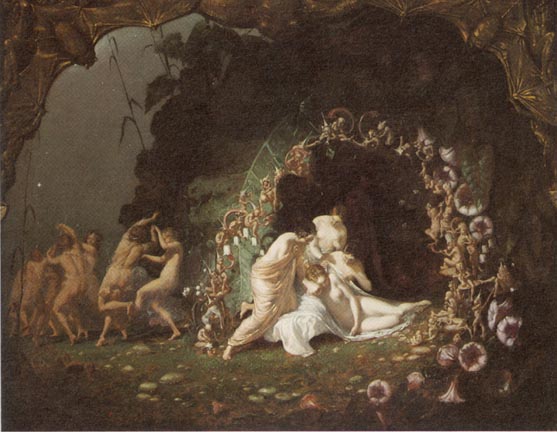
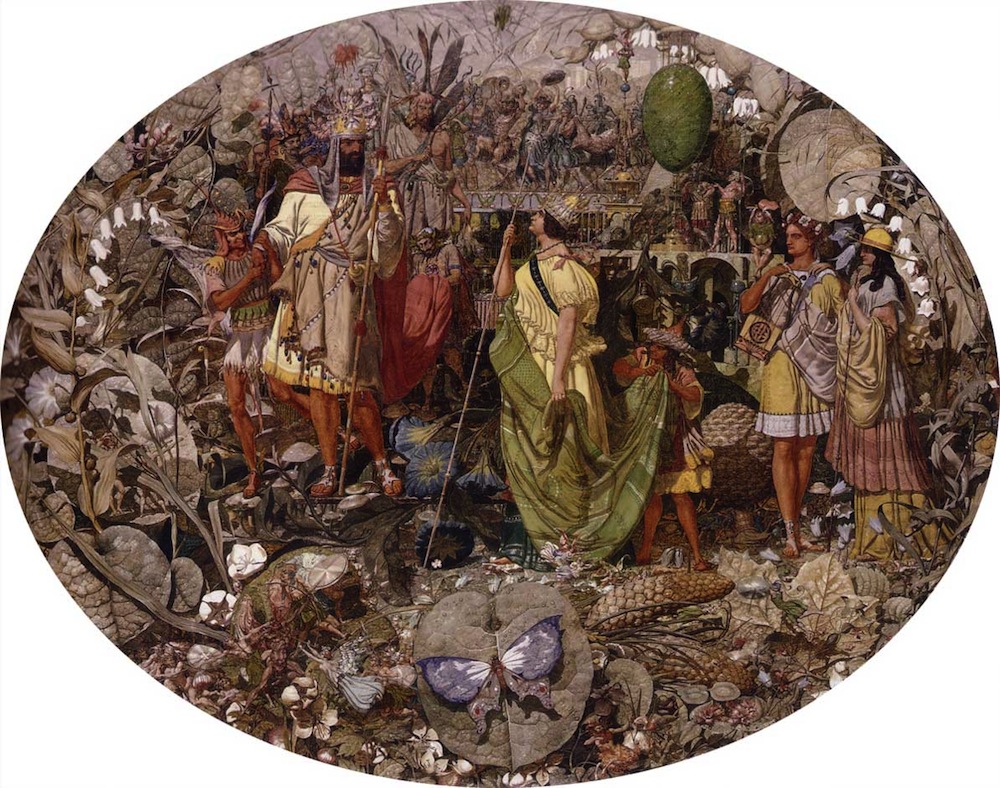
Dadd and Shakespeare. Left: Titania Sleeping. Right: Contradiction: Oberon and Titania. [Click on all the images for larger pictures and more details.]
Both paintings are slightly sinister, and that’s the point of including them: they anticipate the strange figures in The Fairy Feller’s Master Stroke (1855–64) and Contradiction: Oberon and Titania (1854–58). The grotesques appearing in the two later paintings are routinely taken as evidence of Dadd’s madness, but, as the exhibition shows, they already appear in earlier work when, it seems, he was in his right mind. Indeed, the notion of Dadd’s fairy imaginings as a sign of psychosis is completely false: all Dadd was doing was drawing on a long tradition in which the ‘little people’ were associated with menace and malignity. Daniel Maclise has the same iconography in his fairy painting, so does John Anster Fitzgerald, so does Richard Doyle, so does Joseph Noel Paton. None of these painters was suspected of madness, yet Dadd has been framed as the maniac who was ‘away with the fairies.’ It is a pity that some of the works of these other practitioners were not included in the show; that would have strengthened the idea that he was working in a distinctive genre and not painting fairies because he was delusional.
The inclusion of earlier work more generally reinforces the notion of Dadd as an outstanding talent who absorbed the visual languages of his time. In the second room is a luscious selection of Oriental watercolours and sketches that reflect on his journey to the Middle East with the bibliographer and collector, Sir Thomas Phillips (1842). Of special interest are his sketchbooks. These contain febrile, passing shots of the world as he made drawings on the move, pencil in hand, sometimes swaying on the back of a camel, and always managing to scribe his impressions of buildings and costumes, the old and the young, Turks engrossed in reading and studies of heads. There are some accomplished watercolours too. Again, established conventions are employed, notably in a washy portrait of Phillips dressed up in Oriental gear; but best of all is An Artist’s Halt in the Desert. Lit by the light of a fire against a shimmering night sky, this is the very embodiment of a certain sort of defamiliarization. We can imagine the artist as the Englishman abroad, savouring the romantic novelty of the scene, unsure of his cultural referents.
That journey was supposed to be the crucible of Dadd’s insanity, with ‘foreign influences’ and heatstroke being advanced as the cause of his mania. What we certainly have in these works is a careful observer making sense of the cultural Other. But the work is not isolated: all that he does in these pictures is carried forward, especially in the brilliant use of colour that reasserts itself in The Fairy Feller’s Master Stroke and other later creations. Again, the exhibition takes us far beyond bedlam by suggesting the continuum between Dadd Not Mad and Mad Dadd.
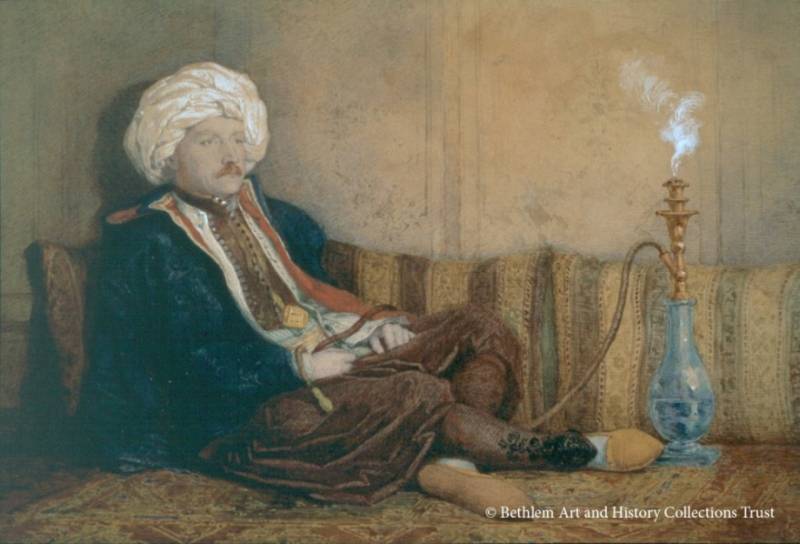
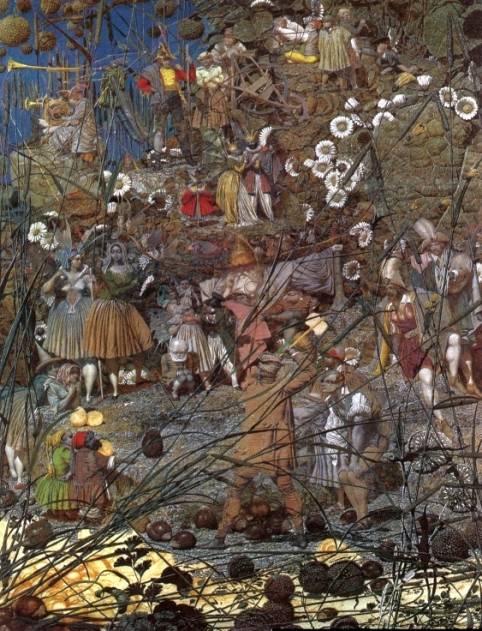
Dadd abroad and in fairyland. Left: Sir Thomas Phillips. Right: The Fairy Feller’s Master Stroke.
We are left, nevertheless, with the oddness of the work produced in hospital. The congested, all-seeing Pre-Raphaelite detail and flattened space of Oberon and Titania are a special challenge, seeming to suggest an aberrant worldview, and the same can be said of The Fairy Feller’s Master-Stroke and The Flight Out of Egypt (1849–50). What can we say of these paintings? Contradictions spring to mind. On the face of it, they seem randomly organized, by turns livid and sensitively coloured, grotesque and lyrical, disconnected but audaciously establishing contact in the gaze between their figures and the viewer. They don’t make perfect sense, they challenge and unsettle, and it is hard to place them. In the psychedelic 60s they were taken as Victorian equivalents of a bad trip, hyper-charged with the half-disclosed meanings of a drug-induced fantasy, bewildering, and ultimately terrifying. The Beatles, in their surrealist stage, in Pepper Land or with Lucy in the Sky, would surely have approved. But the paintings do not have the incoherence of the art of the insane (as seen, for example, in the Collection de l’art Brut, in Lausanne), and are informed with draughtsmanship of a high order.
In the final estimation it seems that the link between Dadd’s insanity and his art is not as clear-cut as it might appear to be. That understanding is important, because it does allow us to view him as more than a maniac, an outsider whose art is only interesting as an imprint of whatever mental illness – schizophrenia? – that he was supposed to have. Richard Dadd – Beyond Bedlam is a thought-provoking opportunity to reassess, shifting emphasis from the man to the work, and from the madness to what is actually on the surface of images as they were produced within a wider corpus. The portrait that emerges is one not so much of ‘Mad Dadd’ as ‘Poor Dadd,’ as S. C. Hall called him, an artist whose work followed a logical trajectory and was shattered by a ghastly series of events.
Related Material
Bibliography
Allderidge, Patricia. The Late Richard Dadd . London: Tate Gallery, 1974.
The Book of British Ballads. Ed. S. C. Hall. London: How, 1842–44.
Created 9 August 2026