
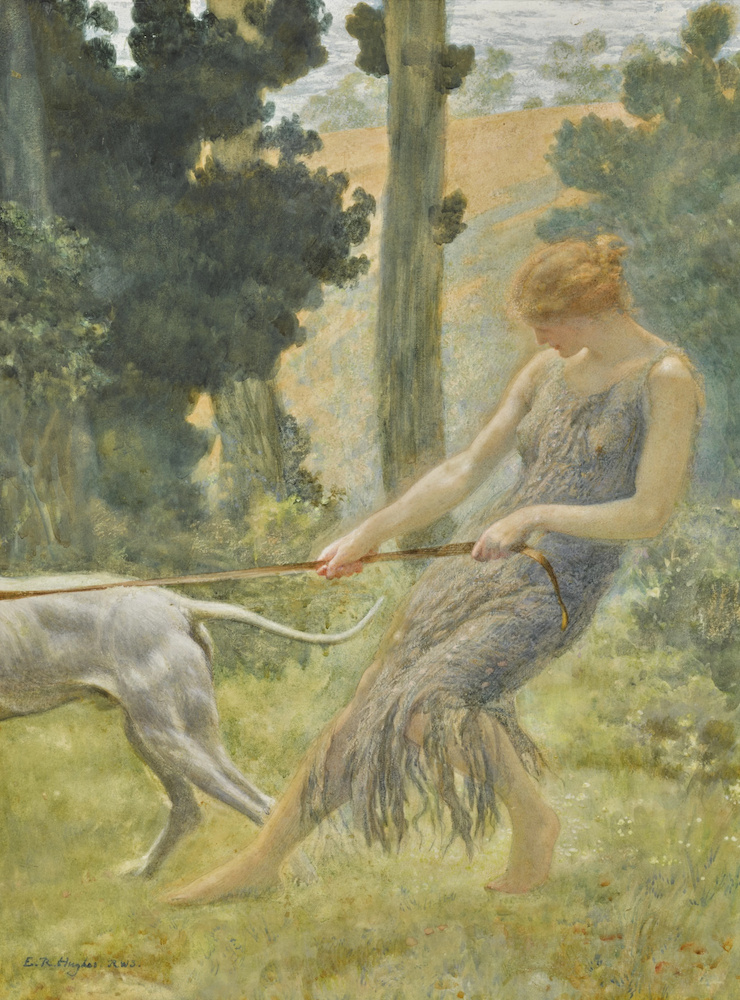
The Transformation of Callisto. c.1900. Watercolour with tempera on board. 20 ½ x15 ¼ inches (52 x 38 cm). Private collection, image courtesy of Sotheby's, London. [Click on the image to enlarge it.]
The Transformation of Callisto was previously identified as Lady Walking her Dog when it was with the Leicester Galleries in London. Victoria Osborne thought the subject was more likely to be the goddess Diana and her hound based on the work's similarity to Walter Cranes's Diana and Endymion that he exhibited at the Grosvenor Gallery in 1883 (92). However, when Hughes's painting was sold at Sotheby's in 2018, their specialists felt it was likely to have a more poetic interpretation:
The tattered classical gown which appears to be metamorphosing into hair, suggests that this maiden is Callisto, the daughter of King Lycaon of Arcadia…. Callisto was one of Diana's huntresses, transformed by Juno into a bear when she discovered that the nymph had been seduced by Jupiter who later transformed her into the constellation Ursa Major. Hughes had painted Callisto in another watercolour entitled The Nymph Callisto, dressed in the same dress and here she seems to be at the moment of transformation as her once-faithful hound pulls away from her."
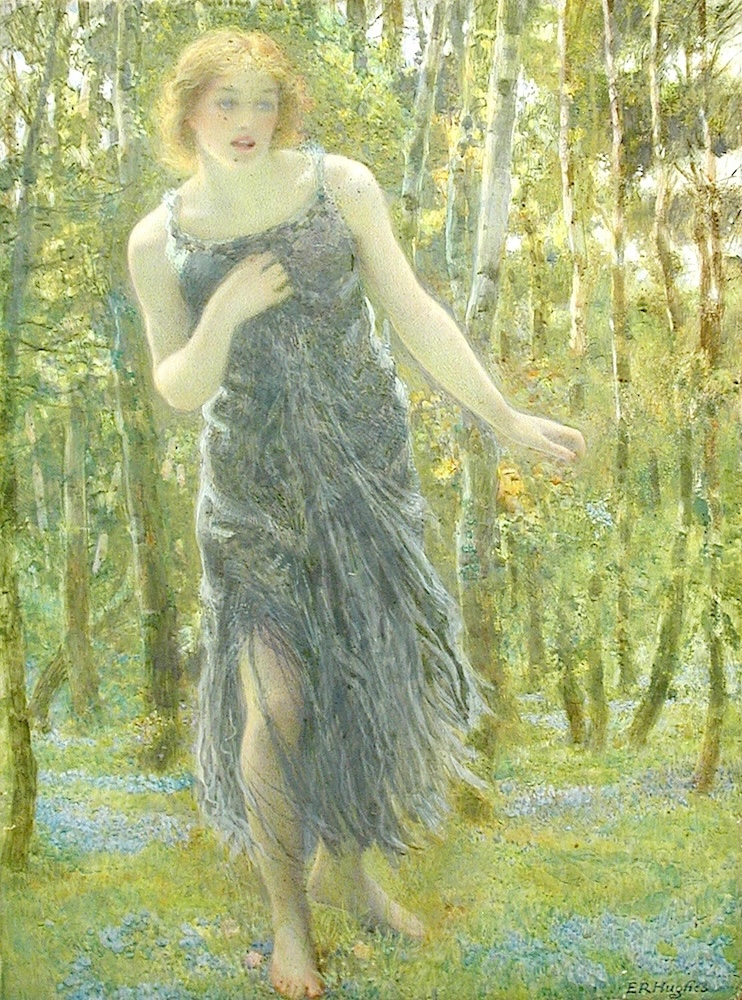
The Nymph Callisto. Watercolour with tempera on board. 14 5/8 x 11 inches (37 x 28 cm). Private collection, image courtesy of Cheffins (Fine Art), Cambridge (sold June 14, 2017). [Click on the image to enlarge it.]
In The Nymph Callisto, Callisto's dress appears even more bedraggled as her transformation progresses.
The Transformation of Callisto is considered one of Hughes's earliest contributions to the tempera revival but this has been complicated by difficulties dating the work precisely. Victoria Osborne feels it may date to the early 1880s finding "the free handling of the medium is atypical of the tempera painters of the period… and so to predate the beginnings of the tempera revival proper by at least ten years" (92). Other scholars, however, feel it dates from c.1900. The Society of Painters in Tempera was founded in 1901 and Hughes is known to have been a member at least by 1909.
Bibliography
Nahum, Peter. Egg Tempera. London: Leicester Galleries, 2013. https://www.leicestergalleries.com/browse-artwork-detail/MTczMjQ=
Osborne, Victoria Jean. "A British Symbolist in Pre-Raphaelite Circles: Edward Robert Hughes RWS (1851-1914)." M. Phil. thesis, University of Birmingham, 2009. 92.
Victorian, Pre-Raphaelite & British Impressionist Art. London: Sotheby's (12 July 2018): lot 43.
Created 7 May 2026