
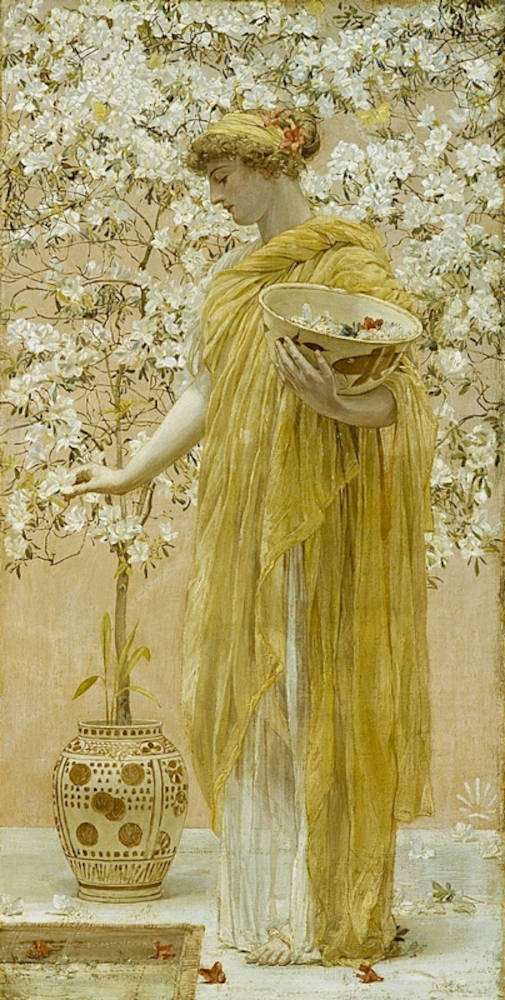
Azaleas, by Albert Joseph Moore, ARWS (1841-1893). 1868. Oil on canvas. 78 x 39 1/2 inches (198.1 x 100.3 cm). Courtesy of Collection of the Dublin City Gallery The Hugh Lane, registration no. 5. [Click on the image to enlarge it.]
Moore exhibited Azaleas at the Royal Academy in 1868, no. 621. This is Moore's first large-scale "subjectless" painting and also his first of a single standing woman wearing classical draperies that would soon dominate his art. As Gregory Hedberg has pointed out "the variety of these paintings lies in the different colour combinations and not major compositional changes" (143). Robyn Asleson has suggested that in these works Moore sought to rediscover the formal qualities responsible for the beauty that the Greeks had elicited from nature and the human body and chose to clothe his models in classical drapery because it provided the greatest scope for abstract expression (97-98). Azaleas again shows both classical and Oriental features. It depicts a full-length standing female figure in profile to the left wearing yellow and white classical drapery and picking azalea blossoms with her right hand from a large shrub planted in a large pot decorated with Japanese roundels. She is holding a large porcelain Oriental "carp bowl" in her left hand, into which she is placing the flowers. She wears a yellow cap that matches her dress and has a few red blossoms in her hair. Similar flowers are seen scattered on the floor, as is one in her bowl, but their source is not depicted. An Oriental mat lies in the white marble floor to her left. Christopher Newall has discussed the "subjectless" nature of this painting: "Here the viewer is given no clue to the inner preoccupation or mood of the figure; nor indeed is it clear whether the painter intends to allow speculation about the figure he has represented, or whether the picture is to be regarded purely as a decorative ensemble the abstract mood of which is determined by its tenor of colour and rich pattern" (111).
The model for the female figure was Milly Jones, the same model who had earlier posed for James Whistler's Symphony in White No. III. She was a popular model for artists in the wider Pre-Raphaelite circle. A preliminary drawing for the standing female figure is in the collection of the Victoria and Albert Museum, London (accession no. D.252-1905).
Contemporary Reviews of the Painting
The most famous review of this painting is by Algernon Swinburne in his Notes on the Royal Academy of 1868, which is frequently quoted to explain Moore's intentions in his work:
The other picture of which I would speak, unlike enough to this in sentiment or in tone, has in common with it the loftiest quality of beauty pure and simple. Indeed, of all the few great or the many good painters now at work among us, no one has so keen and clear a sense of this absolute beauty as Mr. Albert Moore. His painting is to artists what the verse of Theophile Gautier is to poets; the faultless and secure expression of an exclusive worship of things formally beautiful. That contents them; they leave to others the labours and the joys of thought or passion. The outlines of their work are pure, decisive, distinct; its colour is of the full sunlight. This picture of Azaleas is as good a type as need be of their manner of work. A woman delicately draped, but showing well the gentle mould of her fine limbs through the thin soft raiment; pale small leaves and bright white blossoms about her and above, a few rose-red petals fallen on the pale marble and faint-coloured woven mat before her feet; a strange and splendid vessel, inlaid with designs of Eastern colour; another — clasped by one long slender hand and filled from it with flowers — of soft white, touched here and there into blossom of blue: this is enough. The melody of colour, the symphony of form is complete: one more beautiful thing is achieved, one more delight is born into the world; and its meaning is beauty; and its reason for being is to be. [32]
In this same publication W.M. Rossetti also gave us his thoughts on this picture, pointing out its anachronisms, which were of no importance to the artist: "Azaleas. — This will be remembered as one of the illustrations (as the French phrase it) of the Exhibition of 1868. It presents, in life size, a Grecian lady (or at any rate Grecian-robed), at a pot of azaleas, some of which she plucks and drops into a basin. Whether or not azaleas were known to Grecian ladies, whether or not they came from America, are questions not difficult of solution, but of sublime indifference to Mr. Moore" (23).
The Daily Telegraph considered Azaleas: "a strange wild performance, which, at the great altitude at which it is hung, looks more like a piece of framed tapestry than a picture in oils. Examined, however, through a strong opera glass, it proves to be a very curious work indeed, brimful of undeniable talent – of genius almost – but daringly eccentric in design and execution" (qtd. in Baldry 35).
The critic of The Art Journal admired the painting despite its eccentricities:
We are glad to greet once again Mr. A. Moore within the Academy, especially as he may have received but little encouragement to renew his efforts. Azaleas (621), as a matter of course, is not free from eccentricity. Yet must it be admitted that this female form of diaphanous drapery possesses a classic beauty and a dreamy romance not altogether unpleasing. Subtleties in form and colour seem to indicate that the artist cherishes an "ideal," a luxury of the imagination which in these days unfortunately is scarcely deemed permissible. Delicate, faint, and quiescent are the colours; no force of black nor intrusion of positive pigments is permitted to break the spell of dreamy reverie. [106]
Interestingly, The Art Journal also had a French critic review the Royal Academy exhibition for a different perspective: "Mr. A. Moore, with whose opening works we had been struck, has fallen into the ruck of neo-greco. His Azalea woman is pallid as a moonbeam, as incongruous as the spirits evoked by Mr. Home" (223; Daniel Dunglas Home was a prominent Scottish spiritual medium of the nineteenth century).
F.G. Stephens in The Athenaeum somewhat surprisingly compared this picture to Millais's Diploma Work hanging nearby:
Mr. A. Moore's Azaleas (621), which has an elevated position in the North Room, represents a young lady of any period in time, but with a distinctly Greek motive in design, shows admirable art in dealing with many tints of white and their allies. It has draperies that are finally cast, although, like the flesh, which is brilliant enough, they are roughly if not carelessly handled. In some respects, it is worthwhile to compare this work with its neighbour by Mr. Millais, A Souvenir of Velasquez (632), as an equally bold and learned picture in a very different manner. Both are works of fine art, of which Mr. Moore's is the more refined, if less masterful. It is a pity that both are not more complete. [666]
A reviewer for The Illustrated London News regarded Azaleas as purely a work of decorative painting which is obviously exactly what Moore intended: "Mr. A. Moore has a lifesize study of a lady tending a white azalea plant in full flower (621), which seems at once reminiscent of Greek bas-reliefs and of some of the studies of colour in the lightest possible scale by Mr. Whistler, who, by-the-way, is not represented in this exhibition. It is, however, though large and elegant in style, so flat and slight in execution that it can only take decorative rank" (543).
The Building News perceptively reported: "The only decorative painting is a large life-size figure, by Mr. Albert Moore, which ought to have been hung with the architectural drawings" (288). The same publication also commented on the harmony between the picture and its frame, which was also designed by the artist: "Mr. Albert Moore's delicate and original Azaleas (No.624) is one of the few pictures in the Academy that has a frame that fits the picture. The forms employed are simple and well-known, but are so judiciously employed that they have all the charm of novelty, the ornament has a proper proportion to the plain face, and the result is a frame in perfect harmony, both in form as well as in feeling, with the painting it holds. It is purely Greek in conception, and is a most graceful and pleasant design" (384).
Figure paintings with names of flowers

Bibliography
Asleson, Robyn. Albert Moore. London: Phaidon, 2000. 97-100.
Baldry, Alfred Lys. Albert Moore: His Life and Works. London: George Bell and Sons, 1894. 35.
"Exhibition of the Royal Academy." The Illustrated London News LII (30 May 1868): 543.
"A French Critic on the Royal Academy Exhibition of 1868." The Art Journal New Series VII (1 October 1868): 222-24.
Hedberg, Gregory. "Albert Moore." The Victorian High Renaissance. London: Lund Humphries, 1978, cat. 71, 142-43.
Newall, Christopher. The Age of Rossetti, Burne-Jones and Watts. Symbolism in Britain 1860-1910. London: Tate Gallery Publishing Ltd., 1997, cat. 11, 111.
"Picture Frames at the Royal Academy." The Building News XV (5 June 1868): 383-84.
Prettejohn, Elizabeth. Art for Art's Sake. Aestheticism in Victorian Painting. New Haven and London: Yale University Press, 2007. 55, 57-58.
Rossetti, William Michael. Notes on the Royal Academy of 1868. Part I. London: John Camden Hotten, 1868. 23.
"Royal Academy." The Art Journal New Series VII (1 June 1868): 101-10.
"The Royal Academy." The Building News XV (1 May 1868): 287-88.
Staley, Allen. "The Condition of Music." Academy XXXIII (1967): 80-87.
_____. The New Painting of the 1860s, Between the Pre-Raphaelites and the Aesthetic Movement. New Haven, CT: Yale University Press, 2011. 135-38.
Stephens, Frederic George. "Fine Arts. Royal Academy." The Athenaeum No. 2115 (9 May 1868): 666-67.
Swinburne. Algernon. Notes on the Royal Academy of 1868. Part II. London: John Camden Hotten, 1868. 32.
Created 18 May 2022
Last modified 25 August 2026